How the civilization read itself
Egypt read itself through ma'at — order, truth, the right-ordering of the cosmos and the polity together. The pharaoh's principal duty, articulated in inscriptions running from the Old Kingdom through the Ptolemies, was to uphold ma'at: to maintain the proper relation between the gods and the human order, between the king and the people, between the Nile flood and the harvest. The political and the cosmic were the same thing in different registers. Foreign peoples and foreign disorder were isfet — chaos — and the king's authority was the form by which ma'at was kept and isfet held outside the borders.
The continuity across three thousand years is the civilization's most distinctive feature. The form of the state the Old Kingdom established under the Third and Fourth Dynasties — sacred kingship; theocratic bureaucracy; literate scribal class; a Nilotic agricultural economy taxed in kind through the temple-and-treasury system — persisted, with episodes of disruption and reformulation, through the Middle Kingdom, the New Kingdom, the Late Period, the Persian and Macedonian occupations, and the Ptolemaic and Roman conquests. There is nothing comparable in scale of continuity anywhere else in the ancient world.
Political structure
The pharaonic state was a sacred monarchy administered through a literate scribal bureaucracy organised under the vizier (tjaty). The vizier's office combined judicial, fiscal and administrative authority; provincial governors (nomarchs) managed the forty-two nomes (sepatu) into which the country was divided; the temple economy operated as a parallel system of landholding, labour and grain-storage. The whole machinery recorded itself in hieratic and demotic on papyrus, ostraca, and stone — Egypt is the ancient civilization that left the most extensive administrative-documentary record by volume, because the Nile valley's preserving climate kept what the wet climates of Greece and Italy mostly destroyed.
The constitutional form is not republican in any sense the Mediterranean tradition would recognise. There is no citizen body in the Greek sense, no assembly, no rotation of office. What there is is a working theocratic administrative state with a sophisticated legal and fiscal apparatus and a clear chain of authority from the king through the vizier to the local official. The Edwin Smith Papyrus, the Wisdom of Ptahhotep, the Instructions of Amenemope — the surviving administrative and ethical literature gives us a working picture of the political-moral substrate the bureaucracy operated within.
Military structure
The pharaonic state maintained a regular army from the Middle Kingdom onward, and a sophisticated naval and chariot capacity under the New Kingdom. The Egyptian army's principal role under the Old and Middle Kingdoms was the defence of the Nile valley and the projection of force into Nubia and the Levant; under the New Kingdom — Eighteenth and Nineteenth Dynasties — it became a working imperial instrument that carried Egyptian authority into Syria-Palestine, fought Mitanni and the Hittites (most famously at Qadesh under Ramesses II, c. 1274 BCE), and projected force along the Mediterranean and Red Sea coasts.
By the Late Period and the Saite restoration, Egyptian armies were increasingly composed of foreign mercenaries (Greek, Carian, Phoenician, Libyan) under native command. By the Ptolemaic period the army was Macedonian-Hellenistic in its upper officer corps, Egyptian in its rank-and-file, and financed by the same temple-and-treasury apparatus the Pharaonic state had used for two thousand years.
Architectural identity
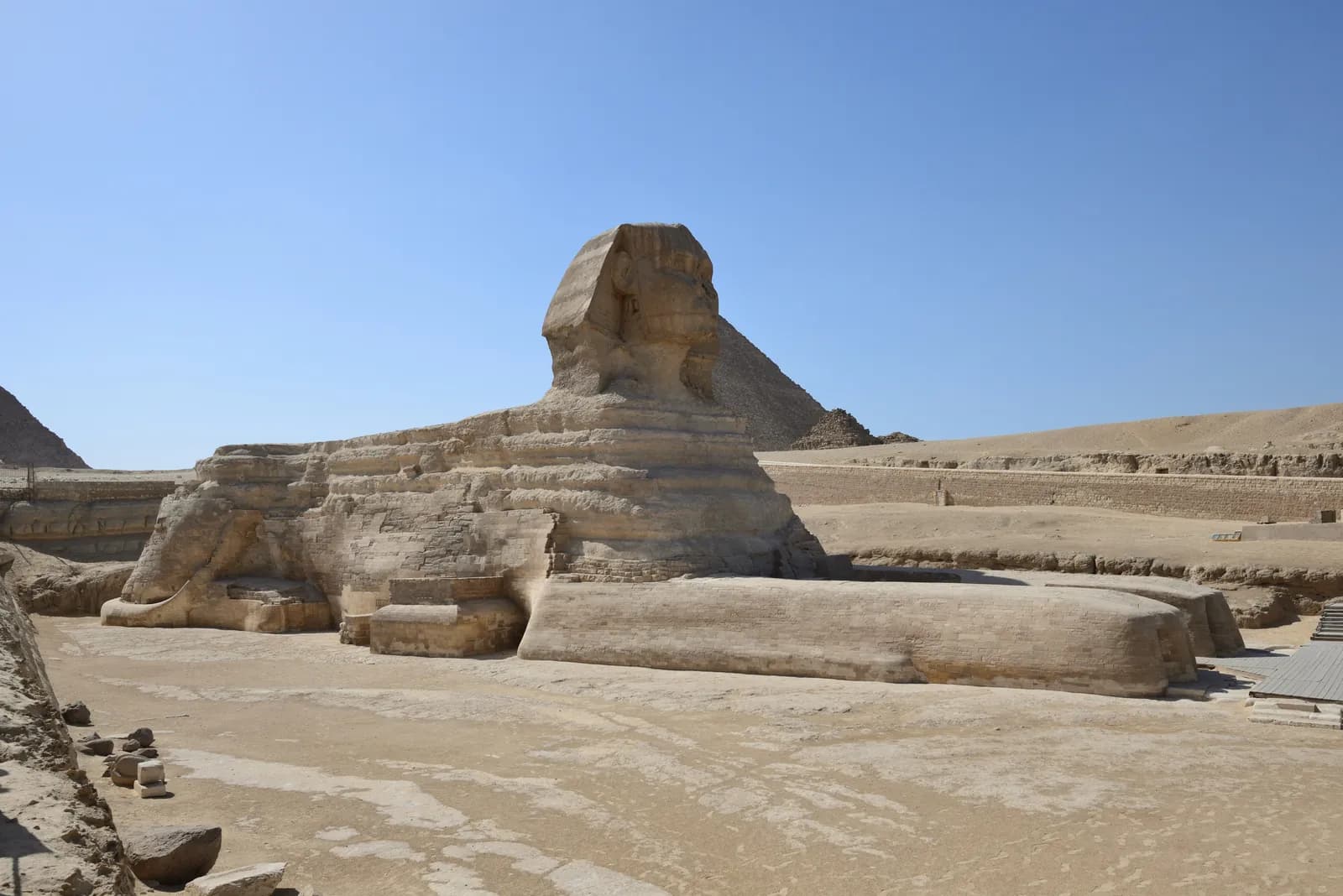
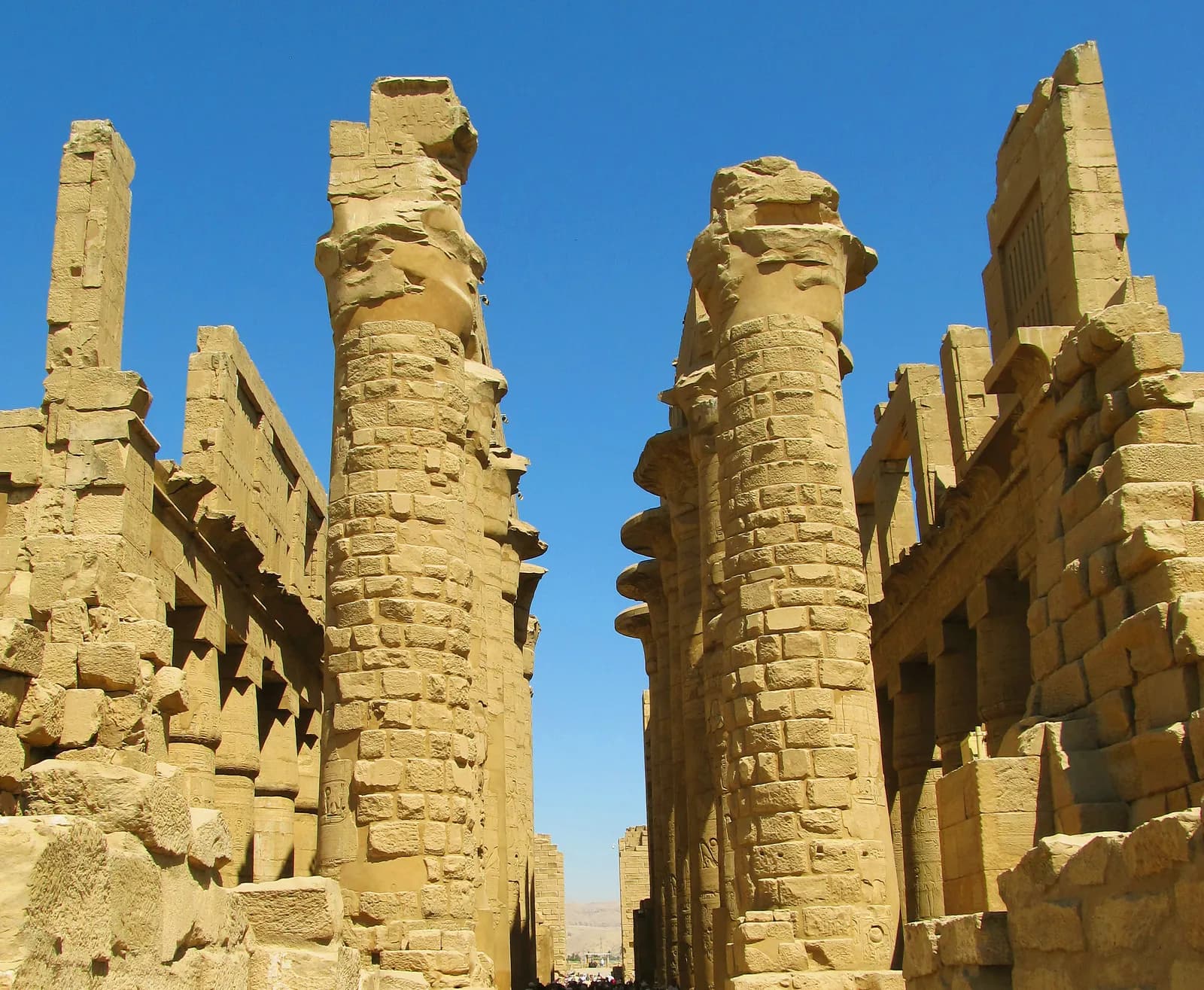
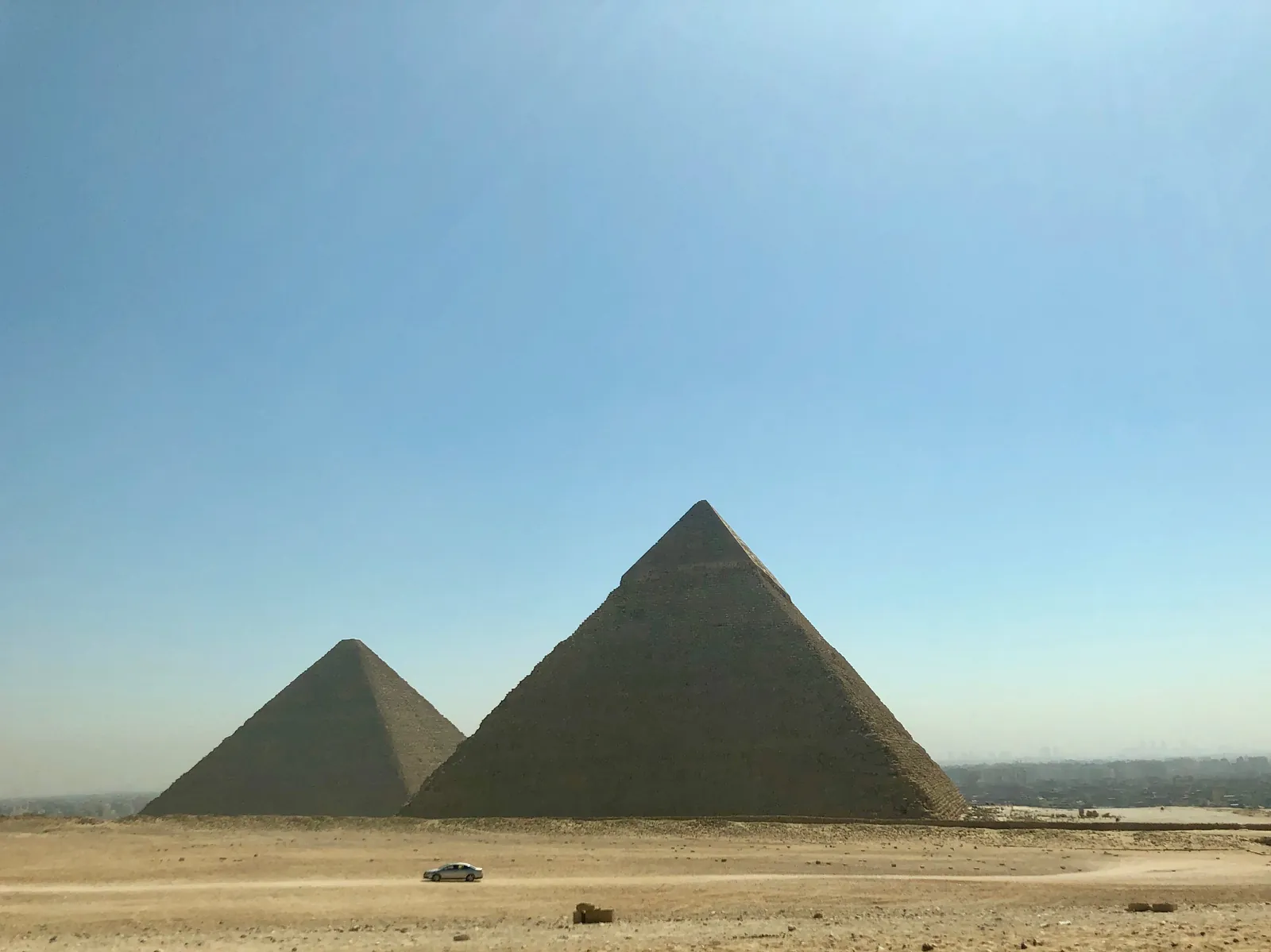
Egyptian architecture is the most visible surviving statement of any ancient civilization's self-understanding. The Old Kingdom pyramid complex at Giza — the three pyramids of Khufu, Khafre and Menkaure, built between c. 2600 and 2500 BCE — remains the most monumental statement of sacred kingship ever made; the form encoded the king's transition into the eternal order at a scale visible across the entire Memphite landscape. The Middle and New Kingdoms shifted the focus to the temple complex — Karnak, Luxor, the Ramesseum, Abu Simbel, Deir el-Bahri, Medinet Habu — built around the cult of Amun-Ra and the king's relationship to him. The Great Hypostyle Hall at Karnak, completed under Seti I and Ramesses II, is the largest column hall to survive from antiquity.
The architectural form carried the political form. To stand inside the Hypostyle Hall, or beneath the cliff-cut colossi of Abu Simbel, is to be inside the working statement of an order that made its authority visible at the scale of the landscape. This is one of the things the platform attempts to acknowledge without sentimentalising: the form is not only impressive; it is the working political instrument of the civilization that made it.
Decline and continuity
The Pharaonic order ended in stages — the Late Period (664–525 BCE), the Persian occupations (525–404 BCE and 343–332 BCE), the Macedonian conquest under Alexander (332 BCE), the Ptolemaic dynasty (305–30 BCE), and the Roman annexation under Augustus in 30 BCE. The civilization persisted longer than the political order. Egyptian religion, hieroglyphic and demotic writing, the temple system and the priestly class continued through the Ptolemaic and Roman periods; the Coptic Christian church inherited and transformed elements of the older religion in late antiquity. The hieroglyphic tradition itself ended in the fifth century CE with the last datable inscription at Philae (394 CE) — the closing of three thousand years of continuous literacy.
Why the platform reads Egypt
The platform reads Egypt as the long ancient case of a durable sacred political order — the counterpoint to the Greek civic experiment and to the Roman republican-imperial transition. The question of how a polity can hold itself together across three thousand years, on principles that are not the principles of Mediterranean civic political life, is one the platform is at the beginning of being able to read seriously. The figures, texts and architectural anchors on this hub are early — Egypt deserves much deeper treatment, and the roadmap names it as one of the next areas the corpus needs to grow into.