The argument we have to take seriously
Two readings of Caesar have been in circulation for two thousand years. The senatorial-republican reading — Cicero's contemporary position, taken up by Lucan, by the Renaissance republicans, by the American founders — is that Caesar killed the Republic. He commanded an army for a decade after his consulship; he refused to disband it when ordered; he crossed the Rubicon and won the civil war that followed; he accepted the dictatorship for life. Those are facts. The senatorial reading takes them to mean that he, as an individual, broke an institutional order that would otherwise have held.
The other reading — visible already in parts of Plutarch, more explicit in parts of Suetonius, dominant in much modern scholarship — is that the order had already broken. Marius had marched on Rome with his army before Caesar was born. Sulla had marched twice. The extraordinary commands voted to Pompey in the 60s BCE were constitutionally astonishing and met no senatorial resistance. The First Triumvirate was a private arrangement among three men because the public institutions were no longer effective. Caesar, on this reading, did not destroy the Republic; he stepped through a door that had been left open for him.
The platform does not need to settle this. The argument itself — what it presses on, how it reads the same facts — is the inheritance.
What was already broken
The structural breakdown was visible to anyone who was reading. The army, since Marius, did not belong to the state in the sense it had two generations before. It belonged to its general, because the veterans' land grants depended on the general, not on the senate. Once a Roman army had marched on Rome and won — Sulla, 88 BCE — the question of whether another would was no longer a question of principle but a question of opportunity.
The senate that should have been the corrective body was internally factionalised in ways it had not previously been. Cicero's letters record the experience of a man trying to construct working majorities across factions whose members no longer believed the institutions of the Republic would survive. The optimates and populares were not parties in the modern sense; they were factional alignments around specific personalities and proposals. Once the personalities became generals with armies, the factional alignments became civil wars.
The financial scale of what wealth from the conquests had done to Roman political life was, by the 50s, irreversible without measures no one was willing to take. Pompey's Eastern settlement returned revenues no senator could compete with. The triumvirs could fund campaigns at scales the senate could not.
What Caesar did
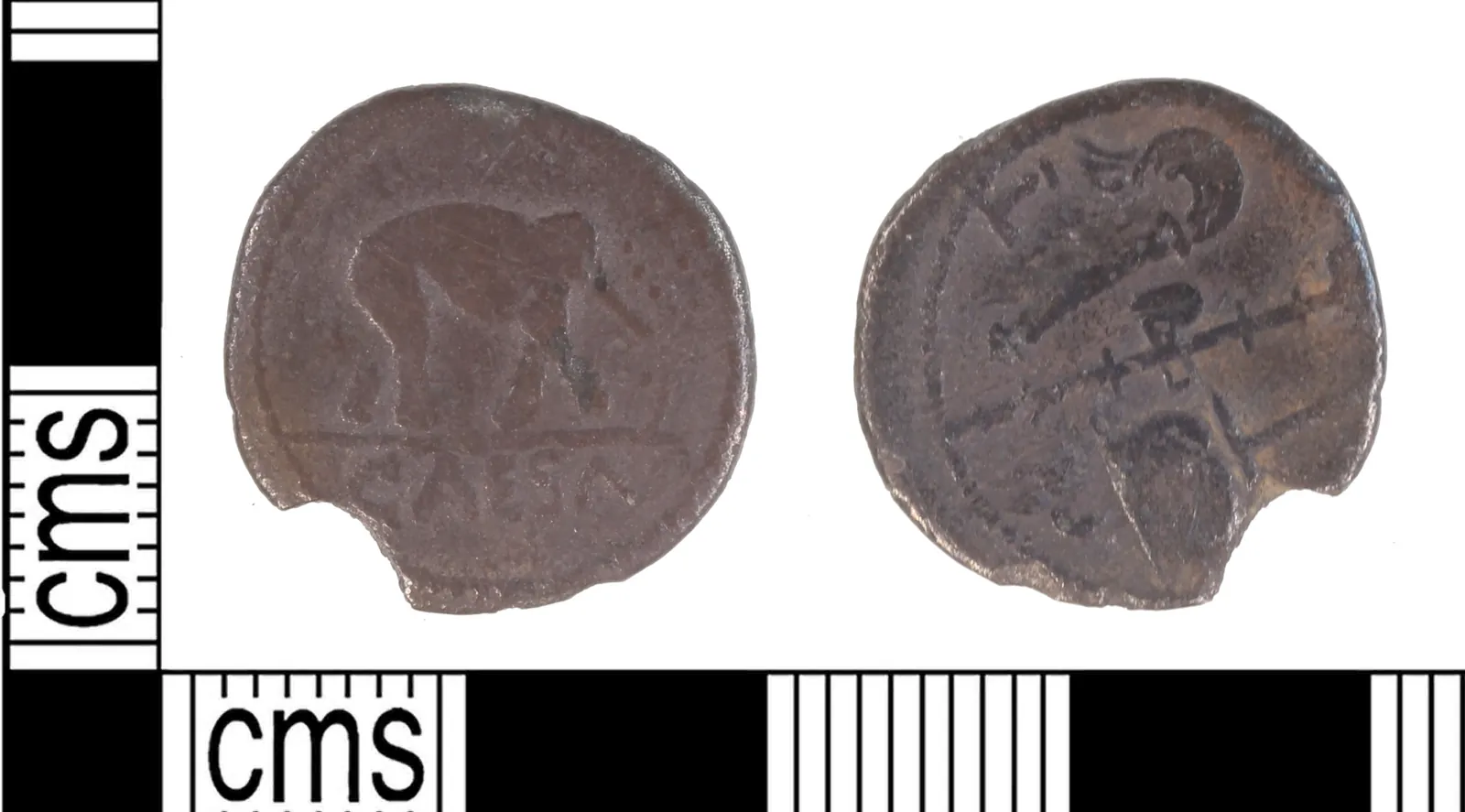
Caesar's mobile-mint coinage from early in the civil war — the elephant trampling a serpent above the legend CAESAR, with priestly emblems on the reverse. The coin circulated alongside the campaign that ended the Republic.
Within that already-broken structure, Caesar's specific contribution was both more and less than the senatorial reading claimed.
Less, in the sense that the institutional precedents he relied on were not original — extended commands, proscriptions, dictatorial authority had all been used before. More, in the sense that the specific combination of his administrative reach, his settlement of the proscribed under his own name, his programme of citizenship extension, and his open assumption of dictatorial authority for life broke the senatorial fiction in a way the previous precedents had not. Sulla had used the dictatorship to "restore" the Republic and had then resigned. Caesar held it for life. The signal could not be misread.
What the assassination revealed
The conspiracy of the Ides was an act of senatorial republicanism that assumed the Republic could be brought back simply by removing Caesar. It was wrong. The civil war the conspirators set off ran for another thirteen years; the figure who ended it was Caesar's nineteen-year-old adopted heir, who became Augustus.
The lesson the long European tradition drew from this was that a political form, once it has been hollowed out, cannot be restored by removing the individual who occupies it. The institutions have to exist that can hold the centre when the centre is removed; in late- Republican Rome, they no longer did.
Why this still matters
The figures the platform places around Caesar — Pompey, Cato, Cicero — each represent a different attempt to act inside a political order they could feel collapsing. None of their attempts succeeded as they hoped. The reasons their attempts failed are not specific to Rome; they are the conditions any republic faces when its institutional substrate has decayed faster than the public reading of it. That is why the Roman material is still alive.