The political order that followed Alexander
The Hellenistic world is the political and cultural order that emerged from Alexander's continental conquest and lasted until the Roman absorption of its last component. Alexander died at Babylon in 323 BCE; his generals — the Diadochoi — spent the next forty years fighting over the succession; by 281 BCE the three principal dynastic successor states had settled into the shape they would hold for two and a half centuries:
- The Antigonids in Macedon and Greece (with the Hellenic League of cities under shifting forms of Macedonian influence)
- The Seleucids in the bulk of the former Achaemenid empire — Syria, Mesopotamia, Iran, and at times eastern Anatolia and the trans-Indian frontier
- The Ptolemies in Egypt (with at various times Cyprus, Cyrenaica, and the southern Levant)
A number of secondary kingdoms (Pergamon, Pontus, Bithynia, Cappadocia, the Bactrian Greek kingdoms, the Greco-Indian kingdoms east of the Hindu Kush) emerged from fragments of the larger inheritance. The Roman absorption began with the defeat of Macedon at Pydna in 168 BCE and ended with the annexation of Ptolemaic Egypt in 30 BCE after the Battle of Actium.
This is the third major imperial form the platform reads (the Achaemenid being the first and the Roman the third). The Hellenistic case is distinctive: Greek-Macedonian dynasties governing largely non-Greek populations, using a Greek administrative koine, with the polis vocabulary preserved as the working form of municipal life even where political sovereignty had been replaced by royal authority.
Cosmopolitanism and the loss of polis identity
The Hellenistic period broke the working classical polis form. The independent city-state as the principal political unit of Greek life ended when Macedonian and successor royal power took the major strategic and constitutional decisions out of the cities' hands. The polis vocabulary — boulē, ekklēsia, archontes, demos — was preserved as the working form of municipal life, and the cities continued to manage their internal affairs through recognisably Greek constitutional procedures. But the principal political decisions belonged to the royal court at Pella, Antioch, Alexandria or wherever the dynasty was based.
The intellectual response was cosmopolitanism — the philosophical reframing of the citizen's identity from the polis to the kosmos. The Stoic tradition founded by Zeno of Citium at Athens in the early third century BCE made the cosmopolitan citizen of the world a working philosophical type; the Epicurean tradition under Epicurus at the Garden withdrew the political question altogether in favour of ataraxia (untroubledness). Both schools, and the Sceptic school under Pyrrho and his successors, are responses to the condition of being a Greek citizen in a world where the classical polis was no longer the working political unit.
Imperial administration
The successor monarchies inherited substantial Achaemenid administrative substrate — particularly the Seleucids, who took over the Persian satrapal organisation in its working form and ran it for the next century and a half. The Ptolemies in Egypt inherited the Pharaonic administrative state and the temple economy and ran them with a thin Greek-Macedonian elite at the top. Both dynasties produced extensive documentary records — the papyri of Egypt particularly, which preserve a working picture of an administrative state in continuous operation across centuries.
The Hellenistic administrative form is, in this register, an elaboration of the Achaemenid pattern under Greek-speaking dynasties. Local law, local cult, local administrative language were preserved within the imperial framework; royal authority sat above the local substrate; the working language of the imperial chancery was Greek (and in Egypt Greek alongside Demotic). The Roman imperial administration that absorbed all of this in the first century BCE inherited the working apparatus.
Libraries, science, and the philosophical schools
The Hellenistic period produced two of the more durable ancient intellectual institutions. The Library of Alexandria, founded under the early Ptolemies in the third century BCE, was the most considered ancient attempt to gather and catalogue the whole of Greek-language literature in a single institution; the Mouseion attached to the Library was a working research institution that produced — across two centuries — Euclid's geometry, Archimedes's physics and engineering, Eratosthenes's measurement of the earth's circumference, Aristarchus's heliocentric astronomy, and the philological-critical editing tradition that gave us the Alexandrian texts of Homer and the major canon authors.
The philosophical schools at Athens — the Lyceum, the Academy, the Stoa, the Garden — continued to operate through the Hellenistic period and were the working substrate of Roman educated philosophical life. Cicero's De Officiis draws on the Stoic Panaetius; the entire Roman philosophical tradition is a working inheritance of late-Hellenistic Greek philosophical practice. The Hellenistic schools' loss of direct surviving texts (most Hellenistic philosophy survives through Roman intermediaries) is one of the principal gaps in the platform's reading.
Visual atmosphere
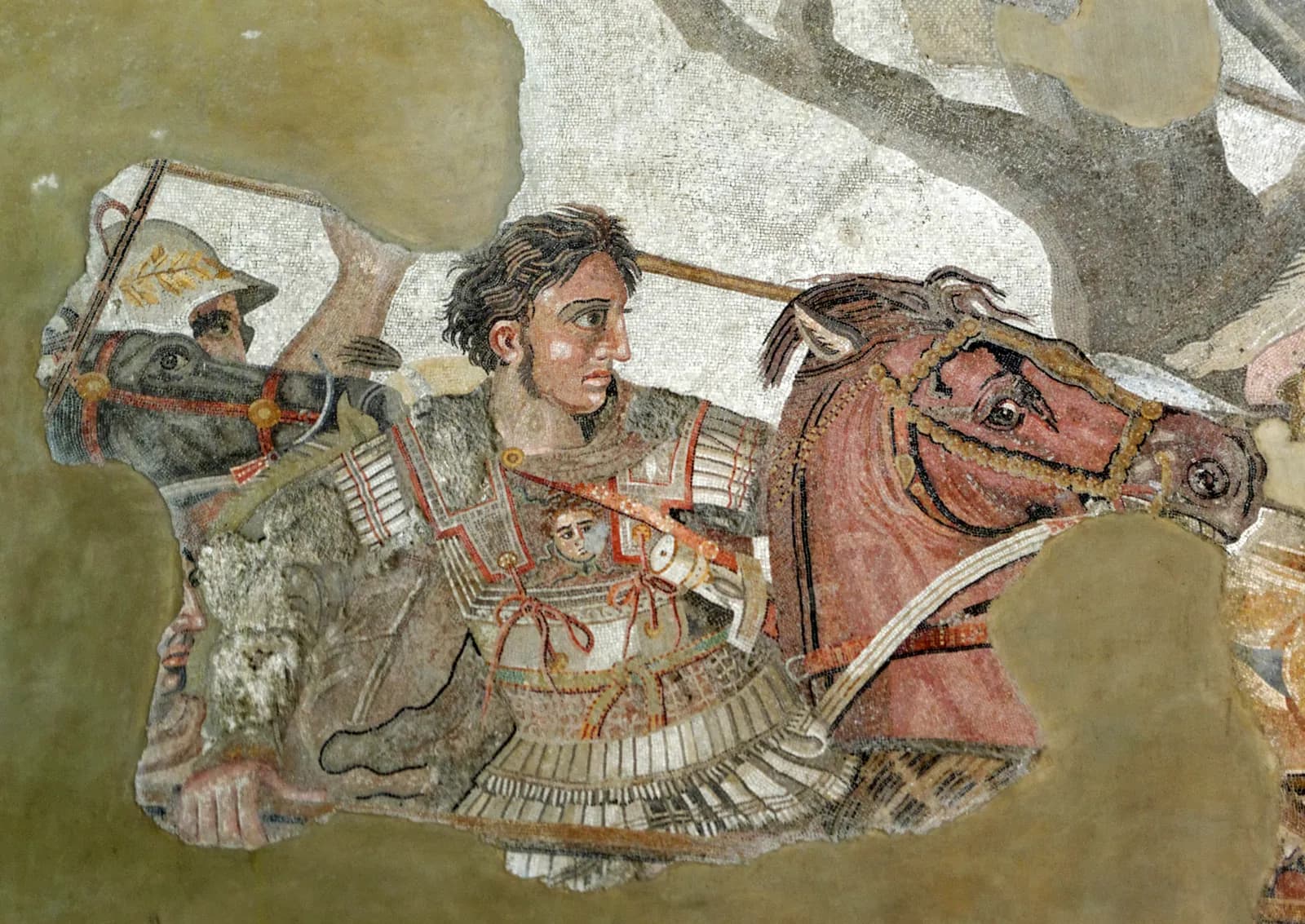
The Hellenistic period also produced the visual vocabulary the Roman world inherited and elaborated. The portrait sculpture (more individualised, more psychologically particular than the Classical type — the Alexander portraits in the Lysippan tradition are the canonical case), the floor mosaic (the Alexander Mosaic from the House of the Faun in Pompeii is a Roman copy of a late-Hellenistic Greek panel painting), the dramatic sculpture of pain and movement (the Pergamon Altar, the Laocoön) — these are Hellenistic inventions. The Roman imperial visual culture that the platform's Rome hub reads is, in large part, a continuation and an adaptation of the Hellenistic Greek inheritance.
Decline and Roman absorption
The Roman absorption of the Hellenistic world unfolded across the second and first centuries BCE. The First and Second Macedonian Wars (215–205 and 200–197 BCE), the war with Antiochus III (192–188), the Third Macedonian War and the Battle of Pydna (168) ended Macedonian and Seleucid imperial power. The Achaean and Aetolian leagues — the late Greek federal experiments — were broken in the second century. The Ptolemies survived as a client kingdom until 30 BCE.
The political form ended; the Hellenistic substrate continued. Roman administrative practice in the East ran on the Hellenistic municipal vocabulary; Greek remained the working administrative and intellectual language of the Roman East for the next thousand years (under the Byzantine state, formally until 1453 CE); the koine Greek the Hellenistic period had standardised was the working language of the New Testament and the early Christian church.
Why the platform reads the Hellenistic world
The platform reads the Hellenistic world because it is the working hinge between the Greek and the Roman political orders, and because the cultural and administrative substrate it produced is the substrate the rest of the Mediterranean world the corpus reads is built on. The Roman empire is a Hellenistic empire that fell into Latin-speaking hands. The specific Hellenistic inheritances — the philosophical schools the Romans inherited, the koine the New Testament uses, the Library at Alexandria, the working administrative practices — shape everything downstream. The platform reads the Hellenistic world with full attention to what was specifically new about it (the Greek-Macedonian dynasties governing largely non-Greek populations; the cosmopolitan philosophical schools; the integrated scientific institution at Alexandria) and with full attention to what was transitional about it (the loss of polis political form, the working substrate preparing the Roman absorption).