How the civilization read itself
Greek political life was conducted in public. The Greeks talked their constitutional questions through, in front of one another, in spaces designed for the talking — the assembly (ekklēsia), the council (boulē), the law-court (dikastērion), the gymnasium, the theatre. The political vocabulary the European tradition inherited is, almost without exception, Greek in origin: politeia, politēs, dēmos, aristokratia, tyrannis, oligarchia, demokratia, nomos, isonomia. What the Greeks invented was not "democracy" in particular but the practice of treating political life as something to be argued about, in public, by citizens who could refuse the answer.
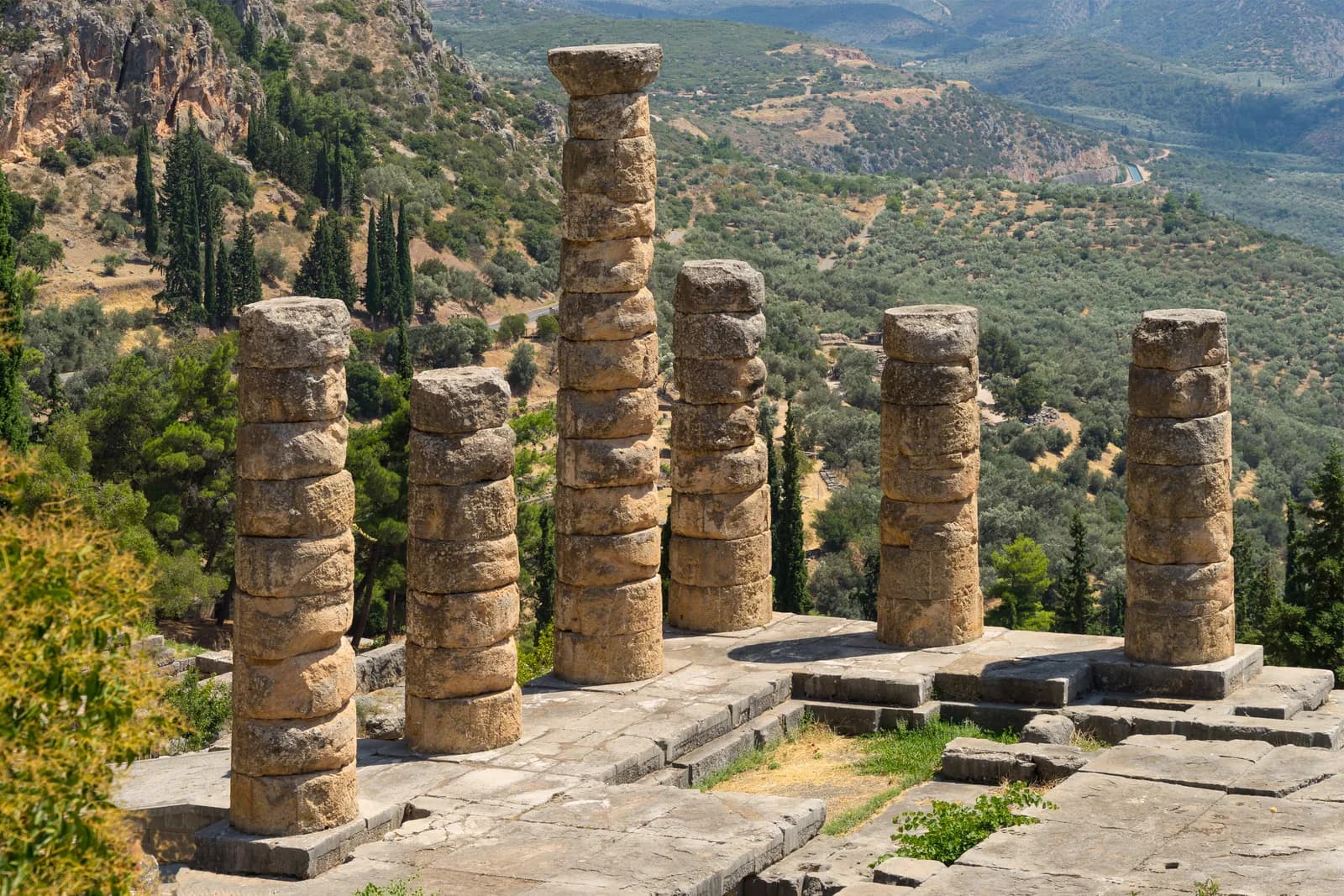
The civilization read itself through its sanctuaries as much as its cities. Delphi, Olympia, Delos, Dodona — the panhellenic shrines were the places where the Greek city-states ranked themselves against each other, consulted before war and constitutional change, and held the games and processions in which the wider Greek identity was performed. Hellenism was not a state. It was the working network of shared cult, shared language and shared agonistic culture across hundreds of small political communities.
Political structure
There was no Greek state. There were hundreds of poleis — city-states, each with its own constitution, magistracies, laws and citizen body. The principal types Aristotle catalogued in the Politics are present across the network: kingship (rare and largely Spartan, Macedonian and Molossian); aristocracy (Crete, parts of the Peloponnese); oligarchy (Corinth, many of the smaller Doric cities); democracy (Athens after Cleisthenes, parts of Ionia); mixed forms (Sparta most famously). The federal leagues — Achaean, Aetolian, Boeotian — were the late-classical and Hellenistic experiments in multi-city constitutional cooperation.
Athens is the case the European tradition has read most intensively. The Cleisthenic reforms of 508 BCE produced the fully participatory democracy in which a rotating citizen boulē prepared business, a sovereign assembly decided it, and a popular jury enforced it. Pericles's career across the mid-fifth century is the high working of the system. Thucydides's Peloponnesian War records both its capacity and its breaking-point under wartime pressure.
Sparta is the contrasting case: the Lycurgan order of mixed constitutional form (two kings, the gerousia, the ephorate, the apella), property held in common across the citizen body, and a specifically educational discipline (the agōgē) intended to produce citizen-soldiers of unusual cohesion. Plutarch's Life of Lycurgus and Xenophon's Constitution of the Lacedaemonians are the main surviving readings.
Military structure
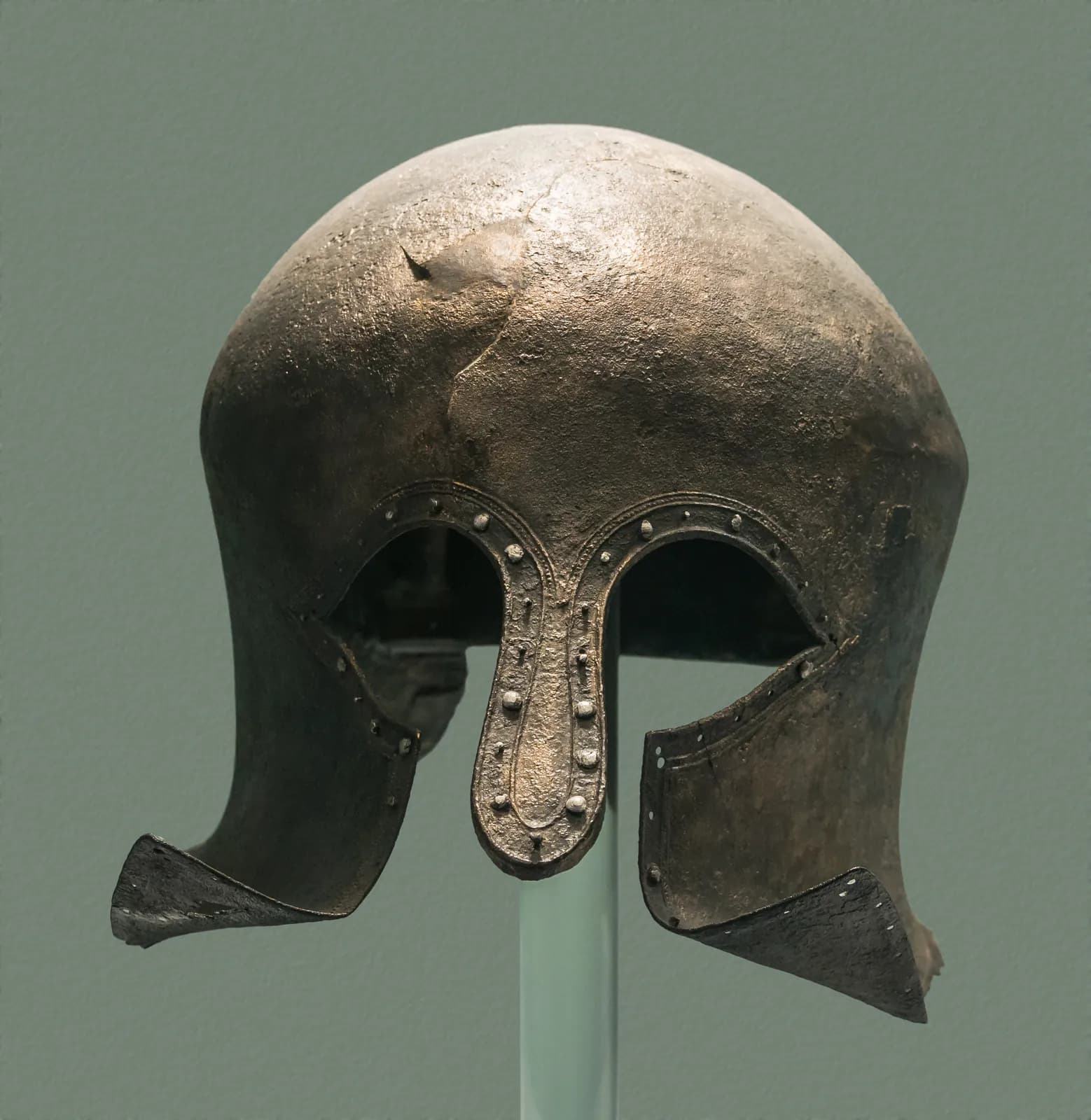
Greek military life was, for most of the classical period, the hoplite — the heavy-infantry citizen-soldier in his bronze panoply, fighting in close formation in the phalanx with men who were his political fellow-citizens. The phalanx was the constitutional form of the army: cohesion at close quarters required cohesion in civic life, and the political and the military were the same body of men in different roles. The Persian Wars (490–479 BCE) — Marathon, Salamis, Plataea — were the working test that the form passed; the Peloponnesian War (431–404 BCE) was the test that broke it.
Late-classical and Hellenistic warfare moved beyond the hoplite — the Theban innovations under Epaminondas, the Macedonian phalanx and combined-arms reforms under Philip II, and the Alexandrian campaigns that broke the eastern world. By the Hellenistic period the armies that fought across the eastern Mediterranean were professional, multinational, and no longer the polity in arms.
Architectural identity
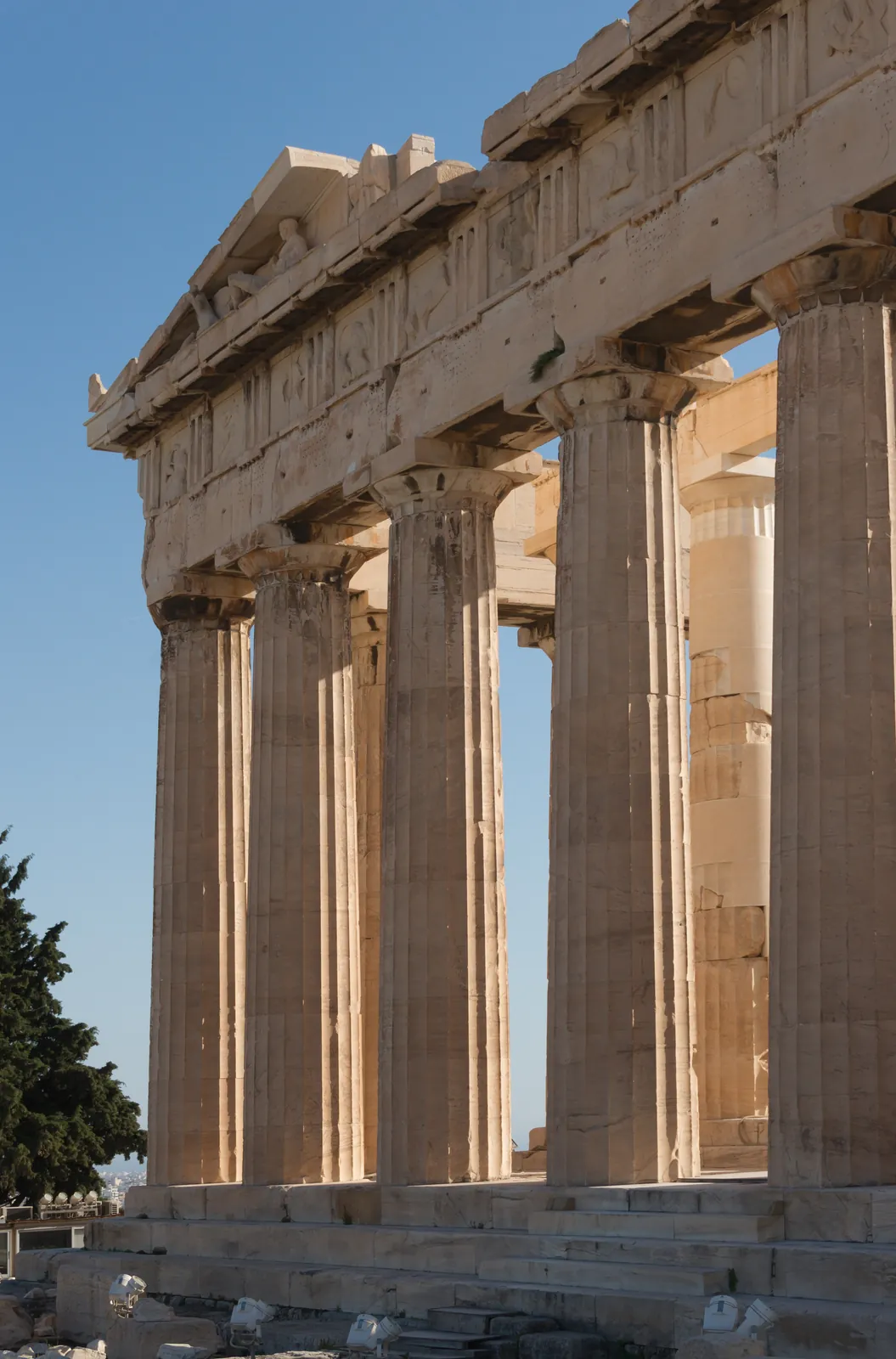
The Greek architectural vocabulary is the working form of its civic life. The temple and the agora are the two principal public types. The Doric order of the Parthenon — built under Pericles in Pentelic marble between 447 and 432 BCE — is the classical type at its full reach; the Ionic and Corinthian orders carried the same vocabulary in different registers across the rest of the network. The Greek theatre, semicircular and open to the sky, was the form in which the political community watched itself perform tragedy and comedy as part of the civic year. The stoa, the bouleuterion, the council-house — each public building was a specific institutional space rather than a generic monument.
The panhellenic sanctuaries (Delphi, Olympia, Delos) carry the same vocabulary in concentrated form: the temple, the treasury, the stadium, the processional way. Survivals are partial; what the Roman, Byzantine and Ottoman periods did not reuse is what we have. Even partial, the working of the form is legible.
Decline and continuity
The Greek city-states lost their political independence to Macedonian power in the fourth century BCE, to the Hellenistic kingdoms in the third and second, and finally to Rome in the second and first. The political form ended; the civilization continued. Greek became the working administrative and intellectual language of the eastern Mediterranean for a thousand years. Greek philosophy, mathematics, medicine and historiography were the substrate of Roman, Byzantine and medieval Islamic intellectual life. Plato, Aristotle and Plutarch were read continuously through late antiquity, the medieval Greek and Arabic traditions, and the Latin Renaissance. The European tradition's political vocabulary is Greek; its intellectual practices, including the practice of arguing about political life, are Greek.
Why the platform reads Greece
The platform reads Greece because the civilization invented the practices the rest of the corpus depends on — the practice of political argument, the practice of historical inquiry, the practice of constitutional comparison, and the practice of philosophical examination of the well-ordered life. The figures, books and essays grouped on this hub are the platform's working approach to that reading.