A brief orientation
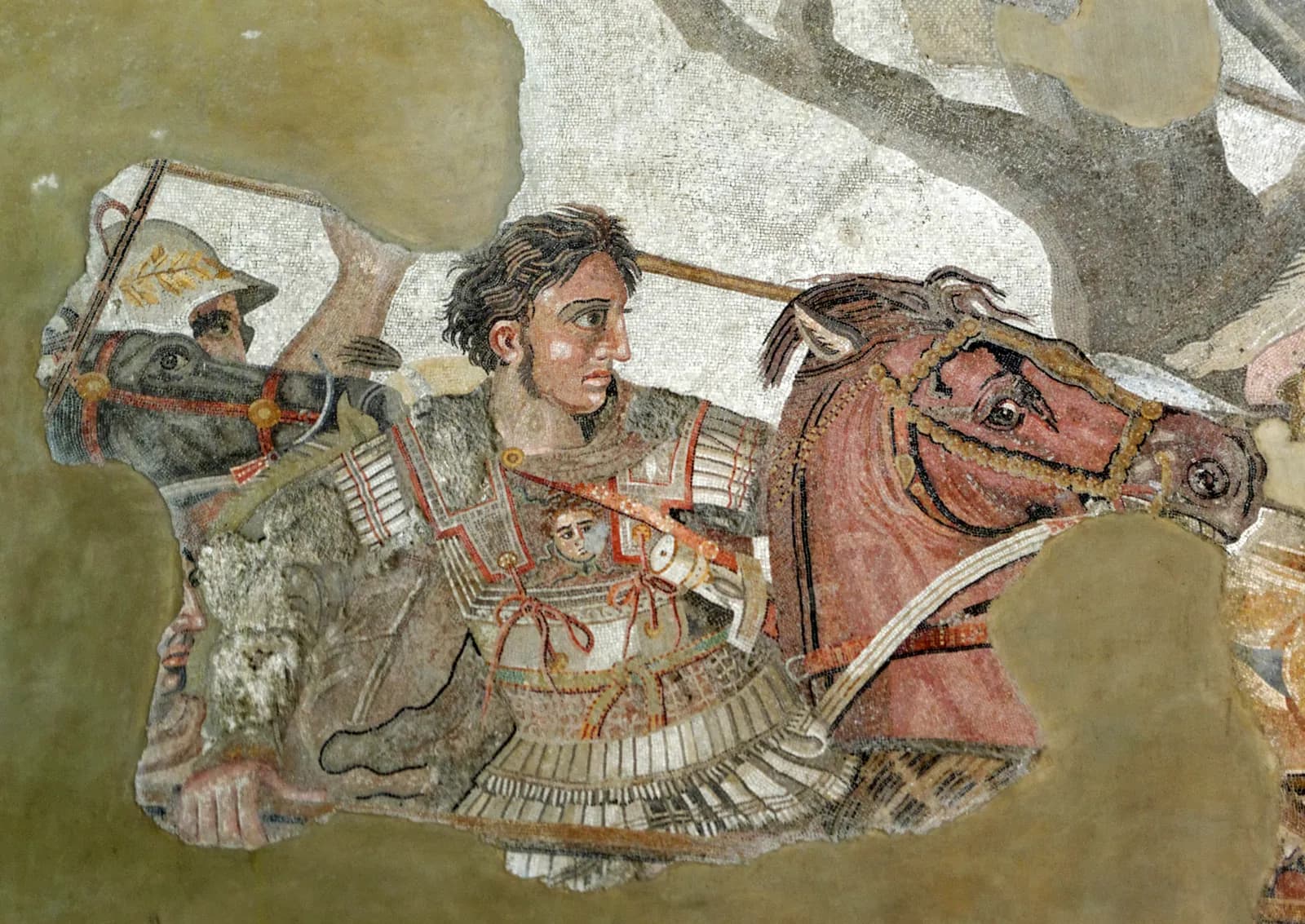
Alexander III of Macedon — Alexander the Great — was the son of Philip II of Macedon and the Epirote princess Olympias. He inherited a kingdom that his father had built into the hegemon of the Hellenic League (under the League of Corinth, 337 BCE), with the planned Persian campaign already in preparation when Philip was assassinated in 336. Alexander was twenty.
He spent the next thirteen years (336–323 BCE) on a continuous military campaign. The principal events: the punitive destruction of Thebes (335); the crossing of the Hellespont into Asia Minor (334); the battle of the Granicus (334); the liberation of the Greek cities of the Anatolian coast; the battle of Issus and the defeat of Darius III (333); the siege of Tyre and the conquest of the Phoenician coast (332); Egypt and the foundation of Alexandria (331); the battle of Gaugamela and the effective end of the Achaemenid state (331); the entry into Babylon, Susa, Persepolis (with the deliberate burning of the royal palace) and Pasargadae; the pursuit of Darius and his murder by Bessus (330); the Bactrian and Sogdian campaigns; the Indian campaign as far as the Hyphasis (326); the long return through Gedrosia (325); the death at Babylon in June 323. He was thirty-two.
What kind of figure he was
The European reading tradition has read Alexander in three parallel registers across two thousand years, and the registers do not fully reconcile.
The first is the military register — Alexander as the most considered commander of pre-Roman antiquity. The Macedonian combined-arms reforms his father had begun (the sarissa-armed phalanx, the disciplined Companion cavalry, the integrated artillery, the road and engineering corps) Alexander commanded with unusual tactical clarity and unusual personal courage. Granicus, Issus, Gaugamela, the Hydaspes — each is studied in the modern military academies as a working example of what disciplined combined arms can do.
The second is the political register — Alexander as the figure who broke the Achaemenid imperial order and created the conditions for the Hellenistic world. The conquest did not build a stable successor state; what it did was open the eastern Mediterranean and Iran to two centuries of Greek-Macedonian political and cultural penetration under the dynasties his generals founded (the Ptolemies in Egypt, the Seleucids in Asia, the Antigonids in Macedon).
The third is the characterological register — Alexander as the figure on whom the ancient and the European tradition have spent the most ink trying to read what unbounded personal power did to the person holding it. The court at Babylon, the adoption of Persian dress and proskynesis, the killing of Cleitus and the execution of Philotas and Callisthenes, the worsening of his physical condition under the strain — Arrian, Plutarch, Curtius, Diodorus all walk this material with care, and the European tradition has continued to. The reading does not yield a single conclusion.
What survives in the ancient sources
The principal surviving narratives are all later than the events. Arrian's Anabasis, second-century CE, working from the now-lost first-century BCE Ephemerides and the lost accounts of Ptolemy and Aristobulus who travelled with the expedition, is the most cautious. Plutarch's Life of Alexander (c. 100 CE) is the most biographically interesting. Curtius Rufus's Historiae Alexandri Magni (mid-1st century CE) is the most rhetorically elaborated. Diodorus Siculus's universal history Book XVII covers the campaign more thinly. The Alexander Romance tradition (a working medieval European and Iranian-Islamic literary form) is later still and not historical in the modern sense.
What is missing from this is the Achaemenid perspective — the Persian sources for the conquest do not survive, and the European reading is therefore mediated almost entirely through the Greek and Roman successors of the campaign. The platform reads with this asymmetry in view.
The relation to Aristotle
Alexander was tutored, as a boy of thirteen to sixteen, by Aristotle. The ancient sources record the relationship extensively (Plutarch's Alexander 7-8 is the principal account); the modern reception has read it in nearly every direction. The simplest defensible reading is that the tutorial gave Alexander a working Greek philosophical and literary education (the Iliad in the Calanus recension, the treatises Aristotle was composing in those years, the medical and natural-philosophical material the Lyceum was producing) without, by itself, determining how the political authority he inherited would be used. Aristotle's Politics is a careful work of constitutional analysis written contemporaneously with his pupil's continental conquest; the two works do not articulate each other.
What later civilizations made of him
The Alexander tradition is one of the more extraordinary European cultural inheritances. The Roman political reading (Caesar's reported tears at the Heracles statue in Cadiz; the imperial-period iconography that treated Alexander as the prototype of the world-conqueror) sits next to the philosophical reading (the Stoic and Cynic tradition's debate over whether Alexander represented the cosmopolitan citizen or the case of unbounded power) and the literary reading (the Romance that circulated in medieval Europe, the medieval Islamic Iskandar tradition, the Persian Iskandarnameh of Nizami). Each picks up a different strand. None exhausts the figure.
The European tradition's persistent reading of Alexander is that the case is irreducible. The military mastery is real; the political consequences are world-historical; the characterological cost is also real. The platform reads him across all three registers without collapsing any into the others.
Why the platform reads him
The platform reads Alexander because the case sits at the working hinge between the classical Greek civic order and the Hellenistic and Roman imperial orders that followed. Without Alexander the Mediterranean world the platform's other entries inhabit does not exist in the form it actually took. The question the figure presses — what kind of political and human capacity is required for a campaign of this scale, and what does the campaign do to the polity that produced it — is the question the Hellenistic World hub reads through, and which the platform's reading of empire as a recurring ancient form is partly trying to answer.