How the empire read itself
Early imperial China understood its own founding as the end of an age of division — the closing of the long Warring States period, in which a plurality of contending kingdoms had fought for five centuries, and the restoration of the unity that the sage-kings of high antiquity were believed to have enjoyed. The platform reads it as the East Asian counterpart to the great Mediterranean experiments in governance at scale: an order that, like Rome and Achaemenid Persia, had to solve the problem of governing vast territory and many peoples, and that solved it by building the most fully developed administrative apparatus of the ancient world.
The Legalist machine
The unification of 221 BCE under Qin Shi Huang was the political triumph of Legalism — the doctrine, theorised by Han Fei and put into practice from the Book of Lord Shang, that a state should rest on uniform published law, administrative method, and the ruler's guarded authority rather than on virtue or custom. The First Emperor abolished the hereditary feudal order, replaced it with commanderies and counties run by appointed officials, and standardised the script, currency, weights, measures and even cart-axle widths across the realm. The platform reads this as the founding of the administrative state in East Asia.
One of thousands — standardised production that still produced distinct faces.
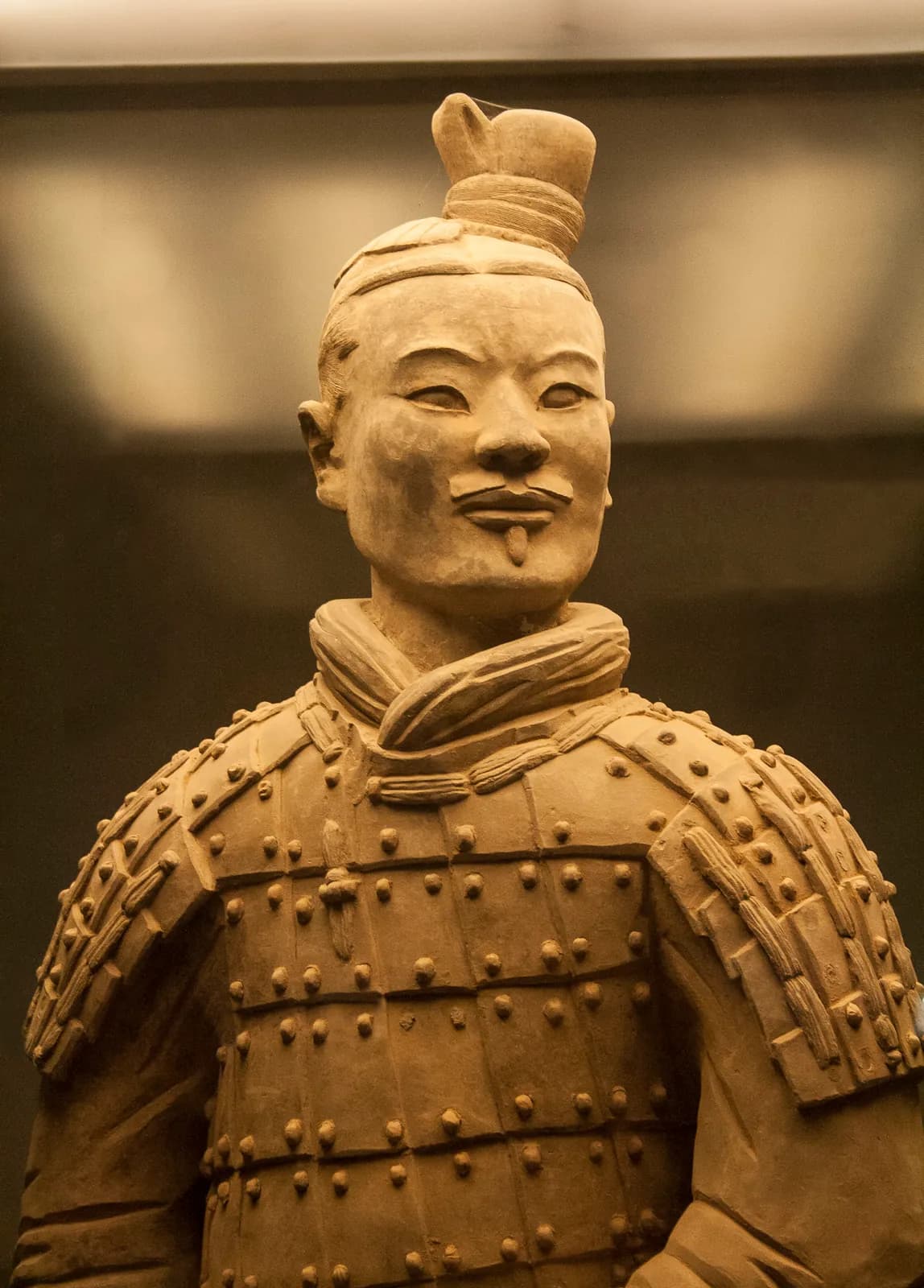
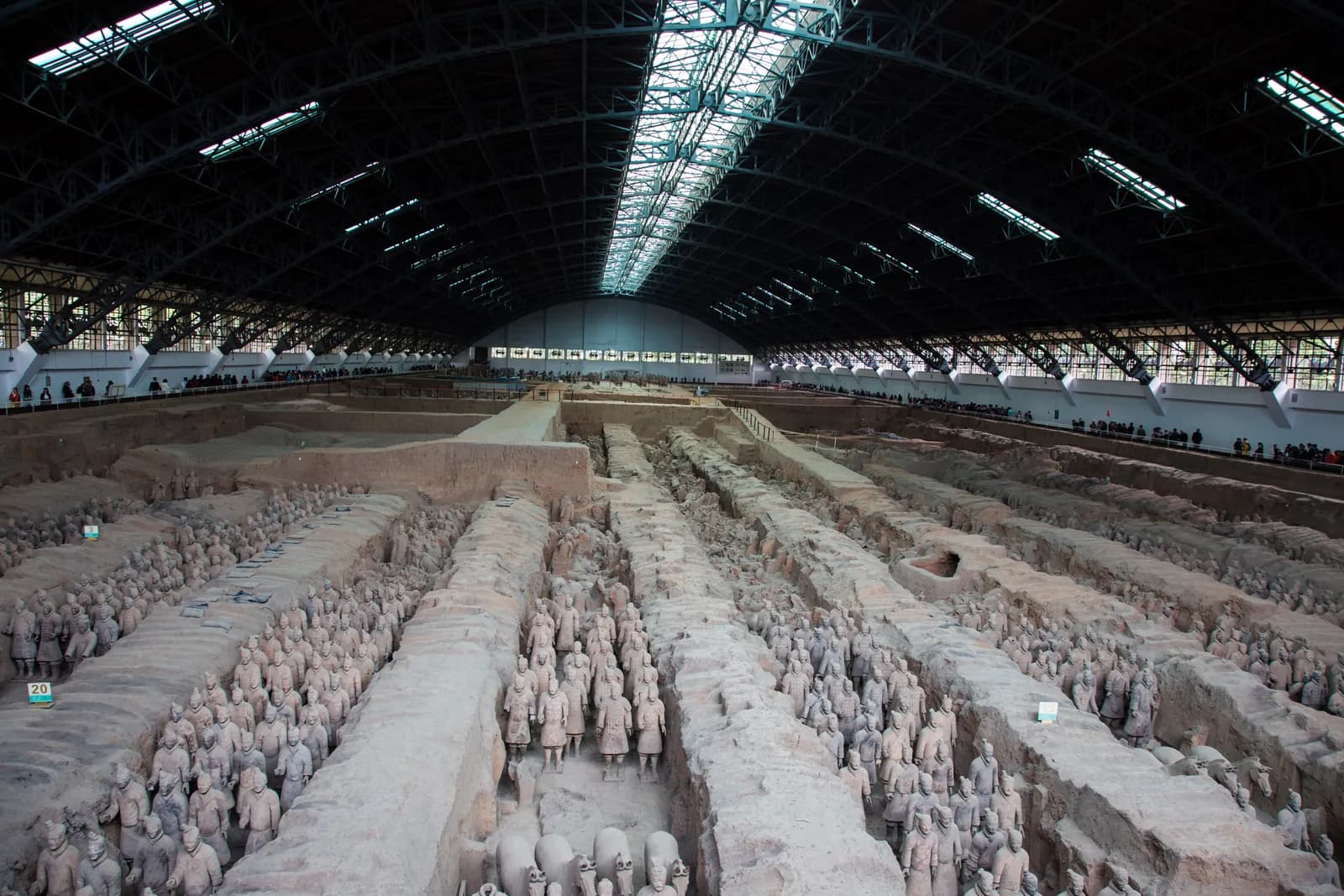
The scale of what the centralised state could command is visible in the buried Terracotta Army and in the integration of the northern frontier walls — the first unification of the defensive lines later ages would rebuild as the Great Wall. The cost was severity: harsh law, vast conscript labour, and a hostility to the Confucian reverence for antiquity that the tradition remembered as the burning of books. The regime's brutality bred the revolt that destroyed it within four years of the First Emperor's death in 210 BCE.
The Confucian counter-order
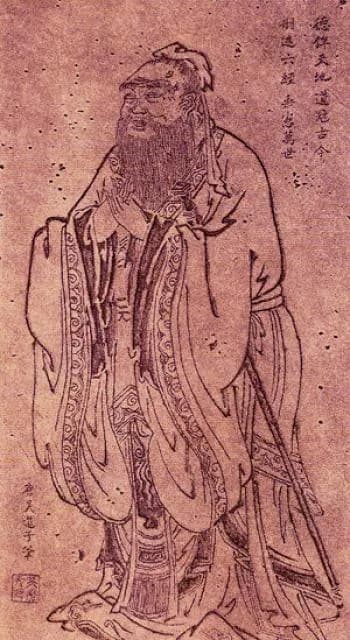
Against the Legalist machine stood the older vision of Confucius, preserved in the Analects: that good order rests on the virtue of rulers and the ritual formation of character, not on law and punishment. "Lead the people by laws and keep order by punishments," Confucius had said, "and they will avoid wrongdoing but feel no shame." The platform reads the swift collapse of the Qin as history's sharpest test of the two doctrines — the Legalist apparatus could conquer and unify, but order built on punishment alone could not hold.
The synthesis that lasted
The decisive achievement of early imperial China was not the Qin but the synthesis the Han dynasty reached after it. The Han kept the centralised administrative structure almost intact — the commanderies, the appointed magistracy, the standardised law and measures — but housed it inside a Confucian moral frame, recruiting and forming its officials in the classical virtues and tempering the Legalist severity with the language of humane rule. The platform reads this as one of history's most consequential institutional settlements: a bureaucratic state married to a moral tradition, the combination that gave Chinese civilization a continuity of governing form unmatched anywhere else, two thousand years in recognisable descent from the Qin unification.
Why the platform reads early imperial China
The platform reads early imperial China because it stages, more clearly than any other civilization in the corpus, the cluster's deepest question: whether durable order should be built on good institutions or on good men. The Western tradition tends to set the constitution against the tyrant; the Chinese tradition set the Legalist machine against the Confucian sage, and then — uniquely — built something lasting out of both. The story of how that apparatus outlived the dynasty that made it is told in how institutions outlive rulers and the birth of the administrative state.