Authority hub
Homer
The poet the Greeks placed at the head of their literature — what ancient tradition claimed, what modern scholarship has argued for two centuries, and what remains genuinely unknown about the composition of the Iliad and the Odyssey.
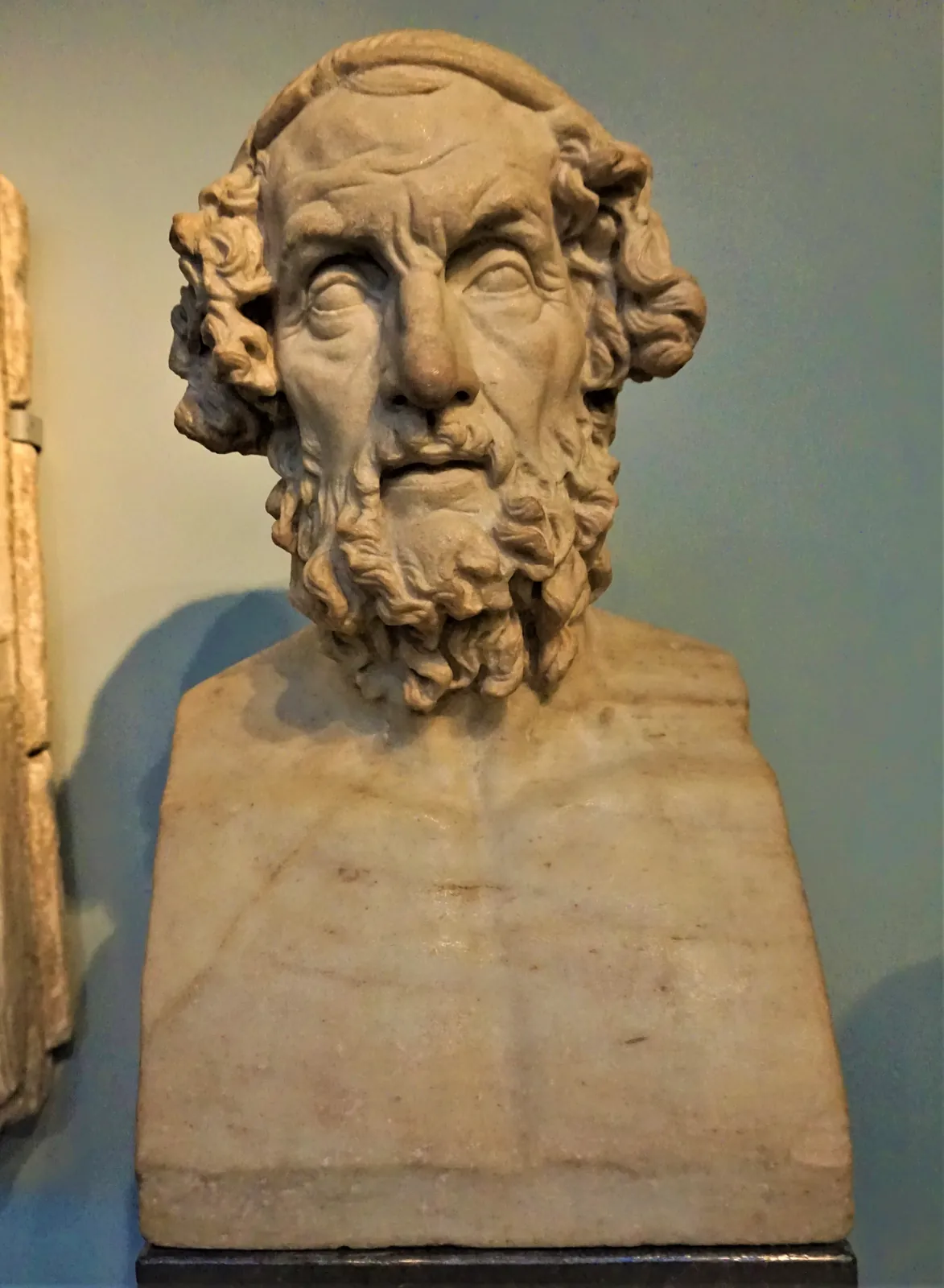
Almost everything a reader is usually told about Homer belongs to one of three categories, and the categories are worth keeping apart. There is what ancient tradition said about him, which is abundant, late and mutually contradictory. There is what modern scholarship has argued since the end of the eighteenth century, which is powerful but unsettled. And there is what can actually be established, which is very little, and almost all of it is about the poems rather than the poet.
This hub keeps those three registers separate. Where a claim is ancient tradition, it is labelled as ancient tradition. Where it is a modern hypothesis, it is labelled as a hypothesis, with the name of the person who proposed it. Where specialists disagree, the disagreement is described rather than resolved in favour of whichever side reads more cleanly. And where the answer is not known, the page says that it is not known.
What can be said with confidence
Two long poems in dactylic hexameter survive in Greek, divided in the transmitted text into twenty-four books each: the Iliad, of roughly 15,700 lines, and the Odyssey, of roughly 12,100. They are the earliest substantial works of European literature to come down to us. From at least the sixth century BCE they were the common property of Greek culture: recited at festivals, quoted in law courts, learned by schoolboys, argued with by philosophers, and treated by most Greeks as the work of a single poet named Homer.
That the poems exist, that they are old, that they stand at the head of the tradition, and that the Greeks attributed them to Homer — these are secure. Nearly everything else about their origin is inference.
What ancient tradition claimed
The ancient biographical tradition is rich and untrustworthy. Several cities claimed Homer as their own; the competing claims were proverbial by the Hellenistic period, and the lists of claimant cities do not agree with each other. He was said to have been blind — an association reinforced by the blind Phaeacian bard Demodocus in Odyssey 8, which is a literary character rather than a self-portrait, though ancient readers often took it as one. The surviving Lives of Homer are late compilations, and the pseudo-Herodotean life is not by Herodotus.
The most useful ancient datum is also the most cautious. Herodotus, writing in the fifth century BCE, says that Hesiod and Homer lived some four hundred years before his own time and not more — which would put them around the middle of the ninth century BCE (Histories 2.53). He states this as his own opinion, against people who thought them older. The conventional modern dating of the poems to the eighth or early seventh century BCE is a scholarly inference from language, material culture and historical reference, not a transmitted fact.
Whether a poet named Homer existed at all is not something the evidence settles. The honest position is that the name is securely attested as the tradition’s attribution from an early date, and that what stands behind the name is unknown.
The Homeric Question
Since Friedrich August Wolf’s Prolegomena ad Homerum of 1795, the argument about how the poems came to be has run continuously. Wolf argued that they were assembled from shorter songs and that writing was not available in the form the composition of a long poem would require. The nineteenth century divided into Analysts, who tried to identify the seams between originally separate lays, and Unitarians, who argued from the poems’ architecture that a single designing mind was at work.
The decisive intervention came from Milman Parry in the late 1920s and early 1930s, who demonstrated that Homeric diction is a highly economical traditional system — that the fixed noun-epithet phrases are distributed according to metrical need with a thrift no individual writer would impose on himself. Parry and Albert Lord then studied living oral epic singers in the Balkans, and Lord set out the results in The Singer of Tales (1960). The effect was to move the question away from “one author or many?” and toward the relationship between a traditional medium and a monumental composition within it.
That question remains open. The Homeric Question page sets out the positions in full, including the ones this platform does not hold.
How the poems reached us
A sung tradition became a fixed text by a route that is only partly recoverable. Ancient tradition reports that the Peisistratids at Athens regulated the recitation of Homer at the Panathenaia so that the poems were performed in order, and a later tradition credits Peisistratus with having the poems written down or arranged. The historicity of a “Peisistratean recension” is disputed among modern specialists and should not be repeated as established fact.
What is better attested is the scholarly work done at Alexandria. Zenodotus of Ephesus, Aristophanes of Byzantium and Aristarchus of Samothrace produced editions and commentaries, developed a system of critical signs for marking suspect or disputed lines, and left a body of scholarship that survives indirectly in the scholia — the marginal annotations preserved in medieval manuscripts, above all the tenth-century Venetus A of the Iliad. The division of each poem into twenty-four books, lettered with the Greek alphabet, is probably Alexandrian rather than original.
Homer as the foundation of Greek education
For as long as there was a Greek paideia, Homer was at the centre of it. Boys learned him by heart; Xenophon has a character in the Symposium say that his father made him learn the whole of both poems. The philosophical tradition is unintelligible without this. When Plato devotes long stretches of the Republic to whether Homer should educate the young, and finally excludes most poetry from the ideal city, the seriousness of the argument is a measure of the position Homer actually held. Aristotle, by contrast, treats him in the Poetics as the model of epic construction.
This is why the poems sit in this library among the philosophers rather than in a separate literary annexe. The classical inquiry into courage, honour, hospitality, kingship and the shape of a good life begins with Homer and proceeds by arguing with him. To read the philosophers without the poems is to read the second half of a conversation.
Homer and later Europe
Greek Homer was largely inaccessible in the Latin West through the medieval period, where knowledge of the Trojan story ran mainly through Latin intermediaries and the late prose accounts attributed to Dictys and Dares. Byzantium never lost him; Eustathius of Thessalonica’s twelfth-century commentaries are enormous. The Greek text was printed in Florence in 1488. George Chapman’s English verse translations appeared between 1598 and 1616, and Alexander Pope’s between 1715 and 1726 — both are in the public domain and both are period interpretations as much as translations.
The modern history of Homer in English is a history of translation choices, and choosing a translation is the single most consequential decision a reader makes. The Odyssey page discusses the principal options and what each one costs.
What this cluster does not claim
It does not claim that Homer was one person, or that he was several. It does not claim that the Trojan War happened, or that it did not. It does not treat the poems as a transparent window onto any single historical period — the reasons are set out at Homer and history. And it does not treat the mythological tradition as a record of events. The characters of the poems are collected under Figures of the tradition, kept deliberately apart from the historical people in the Philosophers layer, because a tradition preserving a character is not the same thing as a record attesting a person.