Historicity of this figure
Belongs to poetic or mythological construction rather than to history. This page describes a figure of a literary and mythological tradition. Where the tradition disagrees with itself, the disagreement is set out rather than resolved.
In the Odyssey
She lives in a stone house in a forest clearing on Aeaea, with wolves and lions around it that fawn instead of attacking. She is introduced by genealogy: daughter of Helios the Sun and of the Oceanid Perse, and sister of Aeetes — which places her in the family of the Argonautic myth.
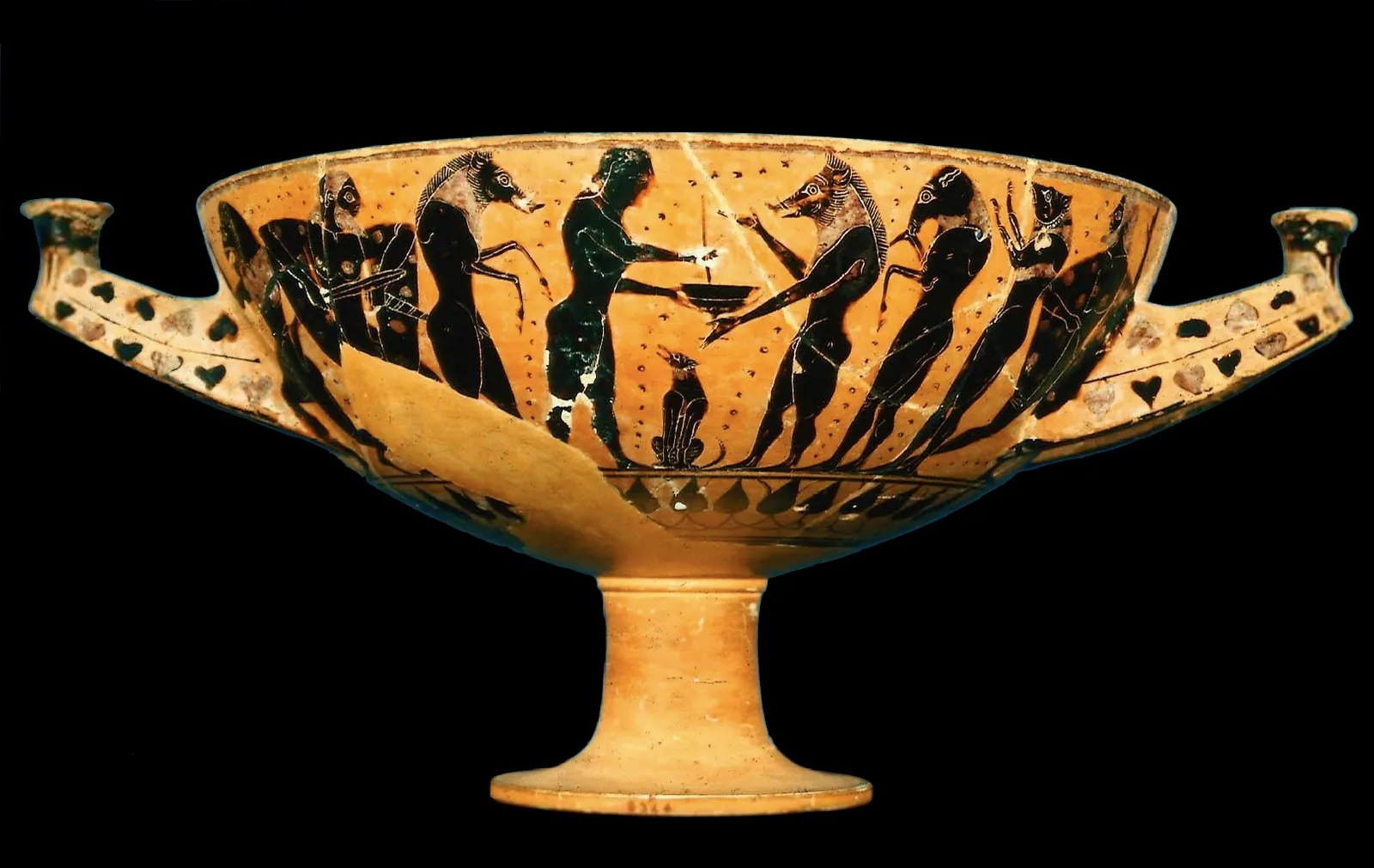
A scouting party under Eurylochus reaches the house and hears her singing at a great loom. She feeds them a drugged mixture, strikes them with a wand, and they become swine, keeping their human minds. Only Eurylochus, who stayed outside suspecting a trap, escapes.
Odysseus goes to rescue them and is met by Hermes, who gives him the herb moly — black at the root, white in flower, hard for mortals to dig — and precise instructions: when she strikes at him, draw the sword and rush at her as though to kill, and when she offers her bed, make her swear a great oath that she will not harm him.
He does exactly this. The oath is sworn, the men are restored to human form and made younger and taller than before, and the whole company remains on Aeaea for a year until the crew urge departure. She then tells Odysseus that he must go to the house of Hades to consult Tiresias, and on his return she gives the sailing directions that get him past the Sirens and through the strait.
What the poem does and does not say
It is worth being exact, because this episode is rewritten more freely than almost any other.
The poem does not say she hates men, or that she was wronged by soldiers, or that her magic reveals a true nature rather than imposing a false one — the swine keep their human minds and weep, and are restored by an ointment. Those are modern additions, some of them very good ones, but they are additions.
The poem also does not present the sexual relationship as straightforwardly consensual or straightforwardly coerced. Hermes instructs Odysseus to accept the bed in order to secure her help, and to extract an oath first. The oath is a safety mechanism, not a courtship. The poem gives the arrangement a year and then moves on without comment.
Other ancient traditions
The Telegony of the Epic Cycle made her the mother of Odysseus's son Telegonus, who eventually kills his father without knowing him. Ovid's Metamorphoses added the transformations of Picus and of Scylla. Neither is Homeric, and neither is folded into the account above.
Later reception
She was allegorised early and persistently as appetite: the enchantress who reduces men to beasts, read as pleasure degrading reason. That reading is ancient and durable and is not what the text says — her victims are not represented as having deserved it.
Modern fiction has reversed the polarity. Madeline Miller's Circe (2018) narrates her life from the inside and made her, for a large readership, a figure of exile and self-possession rather than of temptation.
In modern adaptation
The 2026 film's Circe follows the modern reworking rather than the Homeric text: an isolated woman transforming men out of fear, whose magic is presented as exposing what they are. We regard this as a defensible interpretation with a clear literary lineage, and as a change from the poem rather than a rendering of it. See what the film changed.
What this page does not claim
Circe is a figure of poetry and myth. No historical claim is made or implied.