Historicity of this figure
Belongs to poetic or mythological construction rather than to history. This page describes a figure of a literary and mythological tradition. Where the tradition disagrees with itself, the disagreement is set out rather than resolved.
In the Odyssey
The Cyclopes are introduced politically rather than physically: they have no assemblies and no established rights, they do not plough or plant, and each gives law to his own wife and children and takes no account of the others. The poem's definition of savagery is the absence of institutions.
Odysseus takes twelve men into the cave, against advice, because he wants to see what its owner will give him — a guest-gift. Polyphemus returns, rolls a stone across the entrance, and asks who they are. Odysseus asks for hospitality in Zeus's name. Polyphemus replies that the Cyclopes care nothing for Zeus, seizes two men, and eats them.
Asked for his name, Odysseus says Outis — Nobody. Polyphemus's guest-gift, he announces, will be to eat Nobody last.
Odysseus gets him drunk on unmixed wine, and with four men drives a sharpened and fire-hardened olive stake into his single eye. The other Cyclopes, hearing him shout that Nobody is killing him by treachery, conclude that he is ill and go away. In the morning the men escape tied under the bellies of the rams; Odysseus goes last, under the great ram that Polyphemus stops to talk to.
From the ship, and against the pleading of his crew, Odysseus shouts his real name and patronymic. Polyphemus prays to his father Poseidon that Odysseus may never reach home, or reach it late, in another's ship, having lost all his companions, to find trouble in his house. That prayer is the plot of the remaining fifteen books.
The trick, and why it does not survive translation
The pun works twice over in Greek and not at all in English. Outis, "nobody", is the name given; and mē tis, the other way of saying "no one", is a homophone of mētis, cunning intelligence. The poem is saying that Odysseus escapes by being nobody and by being cunning, in the same breath, using the same sound.
This is why the Cyclops episode is the poem's purest demonstration of what its hero is for, and why an adaptation that drops the name trick — however spectacular its monster — has removed the reason the episode is in the poem.
Other ancient traditions
Euripides' satyr play Cyclops retells the episode for comedy. A completely separate literary tradition, developed by Theocritus and taken up by Ovid, makes Polyphemus a lovesick pastoral giant courting the sea-nymph Galatea. That figure shares a name and nothing else, and is not blended into the account above.
Later reception
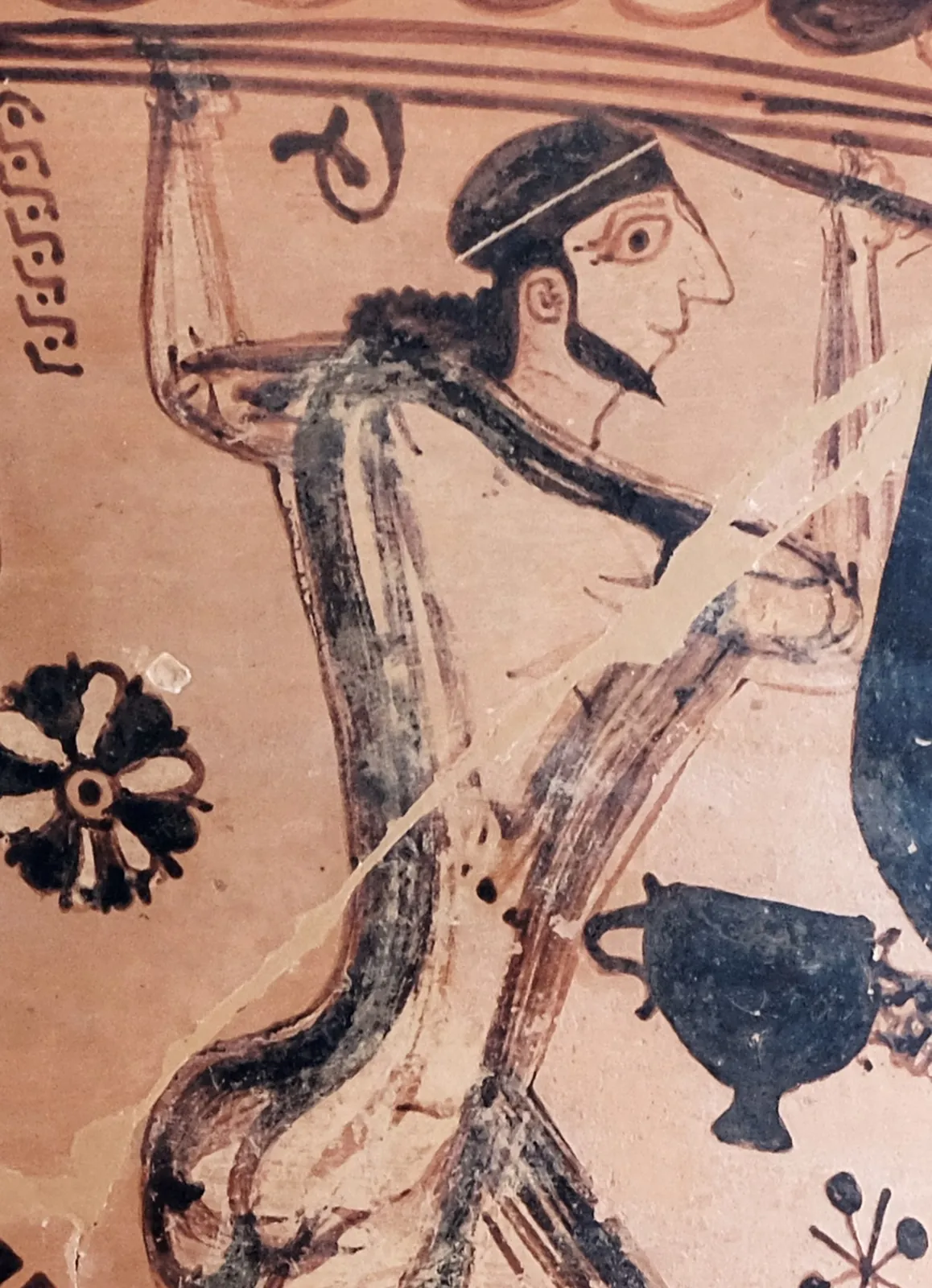
The episode is among the most frequently illustrated in Greek art from an early date — the blinding appears on vases and on a well-known seventh-century BCE amphora — and it has remained the single most recognisable thing in the poem.
In modern adaptation
The Cyclops is the sequence adaptations most reliably include and most reliably reduce to spectacle, because the visual is easy and the wordplay is impossible. See Homer versus the film.
What this page does not claim
Polyphemus is a figure of poetry. The occasional suggestion that the Cyclops myth originated in observation of fossil elephant skulls is a modern hypothesis, not an established finding, and is not asserted here.