Why this matters
Screen adaptations are judged on their material culture more than on anything else, and the judgements are usually made against a standard that does not exist. There is no single correct look for the world of the Odyssey, because the poem does not describe a single world.
This guide sets out what the poem actually says, item by item, and what the record actually holds.
Metals
The poems use bronze for weapons and iron for tools, and this mixture belongs to no single period.
Weapons are characteristically bronze — an archaism, since a poet of the eighth century knew iron weapons. Tools and agricultural implements are frequently iron, and iron is used as a measure of value. Iron only becomes the working metal in Greece after roughly 1000 BCE. Both metals sit in the same text.
Throughout the Iliad and Odyssey
The archaism is deliberate in the way traditional poetry is deliberate: the heroic past is bronze because the formulae are bronze.
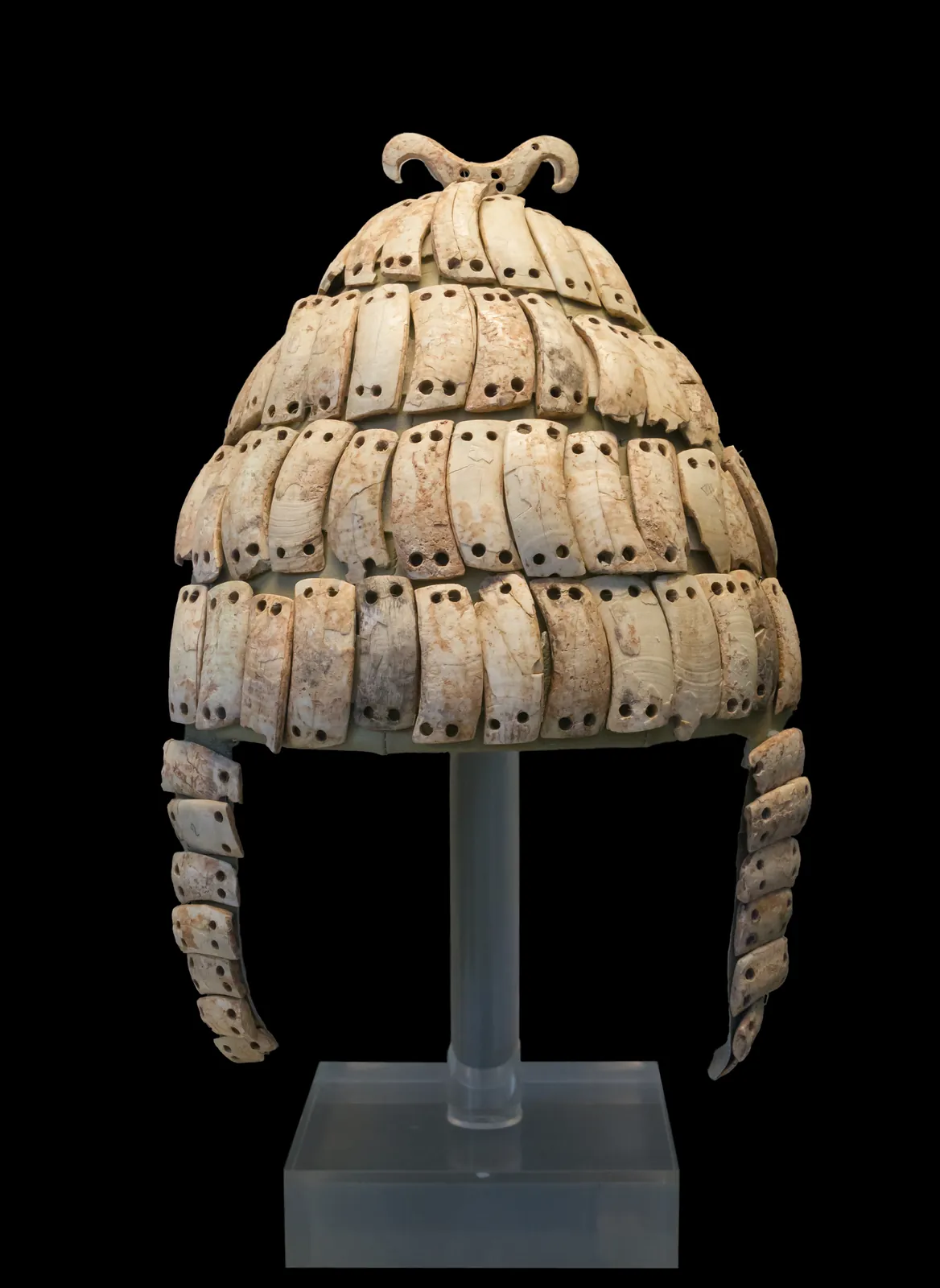
The boar's-tusk helmet
The Iliad describes a helmet type excavated from Mycenaean contexts and out of use for centuries before the poem.
Iliad 10.261-265 describes a cap of leather with rows of split boar's tusks sewn to it. Excavated examples match closely. It is the single strongest piece of evidence that the tradition transmitted genuine Bronze Age material.
Iliad 10.261-265; excavated examples, National Archaeological Museum, Athens
What the helmet proves about transmission.
Iliad 10, the Doloneia, is widely regarded as among the latest material in that poem, which makes it an awkward vehicle for the oldest surviving detail. Some scholars read this as evidence that antiquarian material could enter the tradition late, from other sources, rather than being carried continuously through it.
Scholarship on the Doloneia and on Homeric archaism
Shields and armour
The poems describe both the enormous body-shield — Ajax's, likened to a tower — and the smaller round shield with a central boss, which belongs to a later period. Both are present. The metal-plate corslet familiar from later Greek warfare is uncertainly attested in the poems, and the famous Dendra panoply, an excavated Mycenaean full suit of bronze plate, corresponds to nothing the poems describe.
The poems' shield descriptions include types belonging to different periods.
Tower shields and smaller round bossed shields both appear. There is no single Homeric panoply.
Throughout the Iliad; Odyssey 22 for the arming of the suitors
Chariots
Homeric chariots are used as transport to and from the fighting rather than as fighting platforms.
Warriors drive up, dismount, fight on foot, and are driven away. This does not correspond to Bronze Age chariot warfare as attested elsewhere in the Near East, and the Linear B tablets record chariot inventories on a scale implying a serious chariot arm.
Iliad throughout; Linear B chariot tablets, Knossos
The usual explanation is that the tradition retained chariots as heroic equipment after the tactical knowledge of how they were used had been lost. It is a reasonable inference and it is an inference.
Ships
The Odyssey's ships are open, oared, sailed, drawn up on beaches at night, and dark or black — a standing epithet, most plausibly referring to pitch. Crew numbers are given: a ship of fifty, and elsewhere twenty rowers.
The poem's ships broadly reflect early Iron Age Greek vessels rather than Bronze Age ones.
Depictions on Geometric pottery correspond reasonably well to what the poem describes. Direct evidence for Late Bronze Age Aegean hulls is limited; the Uluburun wreck off the Turkish coast is a Bronze Age trading vessel with a rich cargo, and it is a merchantman rather than anything like a Homeric warship.
Geometric-period ship depictions; the Uluburun wreck
The Phaeacian ships that need no steersman and know their destination.
Explicitly marvellous within the poem, and not a description of any vessel.
Odyssey 8.556-563
Halls and palaces
The poem's great hall broadly corresponds to the Mycenaean megaron plan.
A large rectangular hall with a central hearth, columns and a throne is compatible with the excavated megara at Pylos, Mycenae and Tiryns. The correspondence is general. The poem's halls are also doing narrative work — the doorway, the threshold and the storeroom in Book 22 are staged as much as described.
Excavated megara at Pylos, Mycenae and Tiryns
The Phaeacian palace of Book 7, with bronze walls, a frieze of blue glass paste, golden doors and immortal gold and silver dogs made by Hephaestus, is not a description of a building. It is a description of a wonder, and the poem says so.
What follows for adaptation
There is no configuration of costume and equipment that is simultaneously faithful to Homer and accurate to the Late Bronze Age, because Homer is not accurate to the Late Bronze Age. A production must choose which it is being faithful to, and the useful critical question is whether it chose coherently and whether it said so.
Criticism that treats a single anachronism as disqualifying, without noticing that the poem is built out of anachronisms, is not applying a standard. See costumes and material culture in the 2026 film.
How to read the evidence labels
Evidence levels used on this page
- Evidence level: Documented
- Supported by a named primary text or by excavated material evidence.
- Evidence level: Probable
- Supported by strong inference that most specialists accept.
- Evidence level: Disputed
- Substantial specialist disagreement exists; competing readings are stated.
- Evidence level: Literary
- Belongs to poetic or mythological construction rather than to history.
- Evidence level: Mythological
- Belongs to shared religious or mythic tradition rather than to any single text.
- Evidence level: Unknown
- The available evidence is insufficient to decide.
These labels describe the status of the evidence, not our confidence in a conclusion. A claim marked Literary is not a claim we doubt; it is a claim about what kind of thing a poem is.