Sea power as a form of state
A naval empire is a distinctive kind of state: one whose power rests on the control of the sea rather than of territory, and whose wealth flows through the sea lanes it commands. The platform reads naval empire through its supreme ancient example — the Athenian archē, the maritime empire that grew out of the Delian League after the Persian Wars and became the basis of Athenian power in the Peloponnesian War. Built on the trireme fleet, the tribute of allied cities, and the control of the Aegean, it was a new thing in the Greek world, and Thucydides understood it as the engine of the whole conflict.
The Olympias, a modern reconstruction of an Athenian trireme — the warship on which the whole naval empire rested.
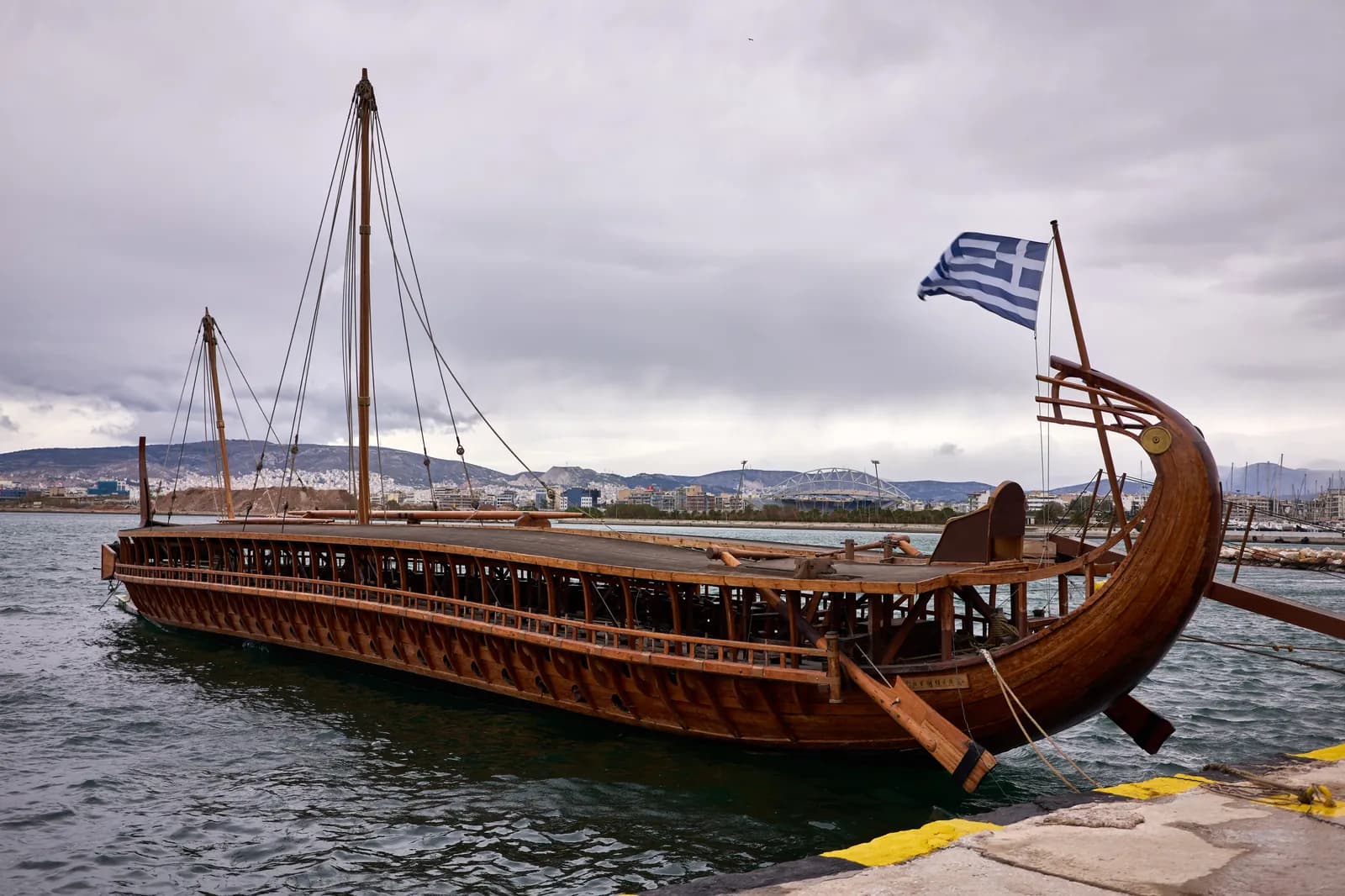
The trireme and the rower
The platform reads the naval empire as inseparable from its instrument, the trireme, and from the men who rowed it. The Athenian fleet of some two hundred warships required tens of thousands of rowers, drawn largely from the poorer citizens — and the platform reads this as a fact with deep political consequences: the navy tied the power of the state to the labour of the common people, and so bound naval empire to democracy. Pericles' strategy in the war rested on the fleet: abandon the land, hold the city behind its walls, and use sea power to outlast Sparta. The empire was a maritime machine, and its citizens were its crew.
The strategic logic and its limit
The platform reads naval empire as carrying a characteristic strategic logic and a characteristic vulnerability. Sea power gave Athens reach, revenue and mobility that no land power could match; it also tempted the city toward overextension — the fatal reaching across the sea to Sicily that Thucydides reads as the turning point of the war. The empire that the sea made possible the sea also made fragile: dependent on tribute that subject cities resented, on a fleet that one disaster could cripple, on lines of supply an enemy could eventually learn to cut. Sparta won the war, in the end, only by building a navy of its own with Persian gold.
Why it matters for Virtue & Power
This theme makes the Peloponnesian War legible as a contest of two kinds of power — the sea power of Athens against the land power of Sparta — and connects the platform's reading of Athens to the strategic questions the war posed. Naval empire is read at length in Pericles and grand strategy and in the account of why the maritime city finally lost in why Athens lost.