Where the site is
A shallow open basin north-west of the Acropolis, crossed diagonally by the Panathenaic Way running from the Dipylon Gate up to the sanctuary. Low, level and on the through route — the opposite of the Acropolis in every respect, which is roughly the point.
- Ancient region
- Attica
- Modern country
- Greece
- Position
- 37.976° N, 23.722° E — The Temple of Hephaestus
- Given to three decimal places, about a hundred metres. It locates the named feature, not the extent of the site.
What survives
The Temple of Hephaestus stands almost complete on the west ridge — the best-preserved Doric temple anywhere, because it served as a church from the seventh century until the 1830s and was therefore roofed and maintained.
The square itself survives as foundations: the Bouleuterion, the Tholos, the Metroon, the Royal Stoa, the law courts, and the boundary stones still in place reading “I am the boundary of the Agora”.
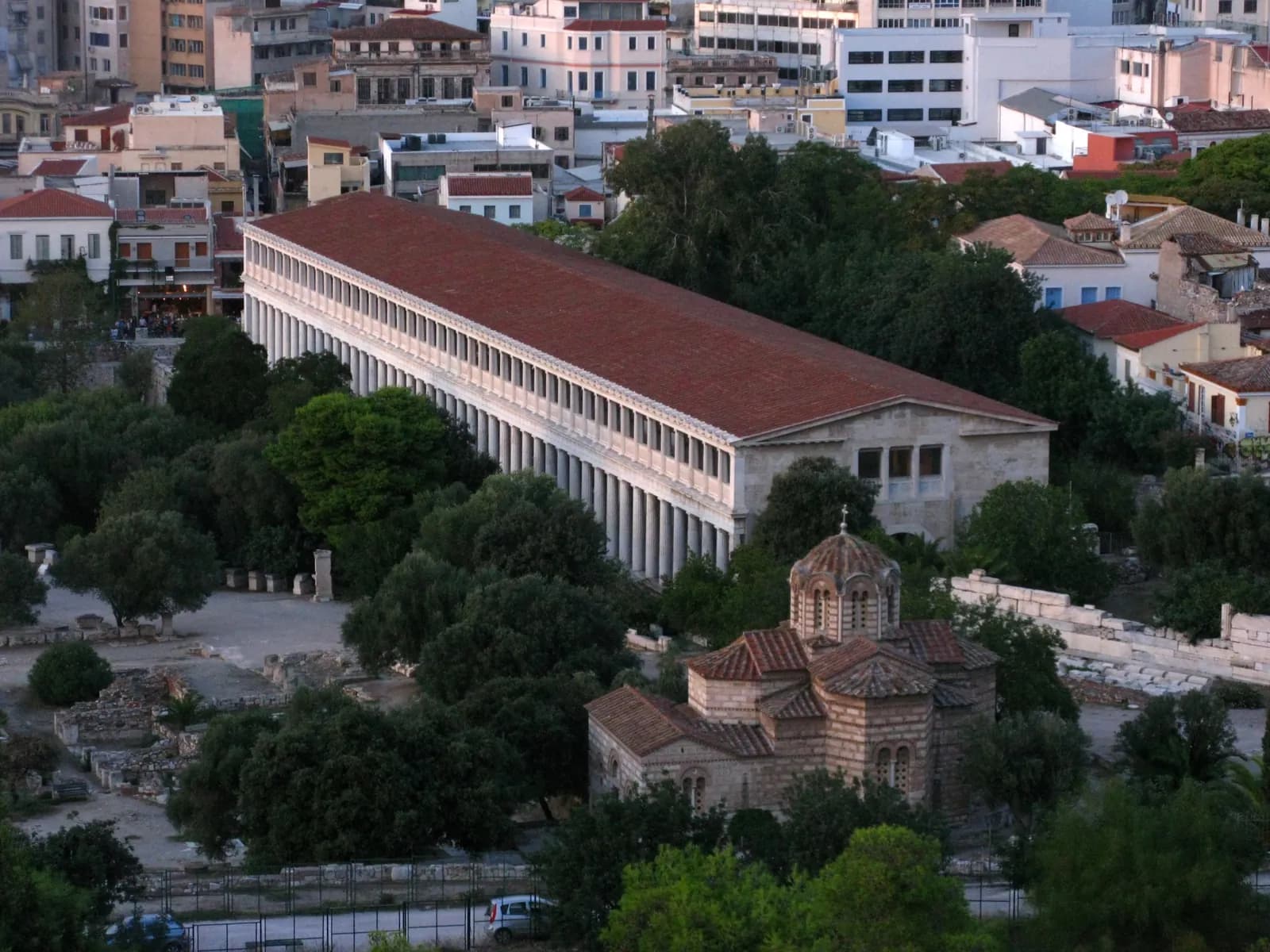
The Stoa of Attalos is a full-scale reconstruction, built in 1953–1956 on the ancient foundations using the surviving fragments as the model, and functions as the site museum. It is a reconstruction and is not presented as anything else.
Occupation and chronology
Dates below are stored as signed years and rendered with the precision they actually carry. c. 600 BCE is approximate; 267 CE is fixed.
6th century BCE
Formation
Earlier burials and wells are cleared and the area is laid out as public space. The archaeology of the square begins roughly where the constitutional reforms do.
5th–4th centuries BCE
The democratic square
Council house, round house, archive, law courts, stoas, and the boundary stones that marked where public space began. Everything the Constitution of the Athenians describes had a building here.
3rd century BCE – 267 CE
Hellenistic and Roman
Royal benefactions fill the edges — the Stoa of Attalos above all — and under Rome an odeon and a temple are moved into the middle of the open space, which changes what the square is for.
267 CE
Destruction
The Herulian raid burned the square. A late wall was built afterwards out of its rubble, which is why so much sculpture and inscription survives: it was recycled as building stone and thereby preserved.
History of excavation
Who recovered the evidence, when, and by what method. Where an excavation destroyed as much as it found, the entry says so.
- Evidence level: Documented
1931–present
The American School of Classical Studies at Athens
One of the longest continuous excavations anywhere. It required the purchase and demolition of around four hundred houses in the Monastiraki district — a large and irreversible intervention in a living neighbourhood, made for archaeology.
- Evidence level: Documented
1931–1967
T. Leslie Shear Sr. and Homer Thompson
The main clearance of the square and the identification of the civic buildings against the ancient descriptions.
- Evidence level: Documented
1980s–present
T. Leslie Shear Jr., John Camp and successors
Extension north of the railway line, where the Painted Stoa — the Stoa Poikile, the building Stoicism is named after — has been partly uncovered.
Principal structures
The evidence level answers how we know what a structure looked like, not whether it existed.
- Evidence level: Documented
c. 449–415 BCE
The Temple of Hephaestus
Standing with its roof, walls, colonnades and much of its sculpture in place. It survives because it was converted, not because it was lucky.
- Evidence level: Documented
Old c. 500 BCE, New late 5th century BCE
The Bouleuterion
The council house of the five hundred. Foundations only; the seating arrangement is inferred from the plan and from the parallel at other cities.
- Evidence level: Documented
c. 465 BCE
The Tholos
A round building where the fifty councillors on duty ate at public expense and a third of them slept, so that the state was never without officials. Its foundations, and the standard weights and measures kept there, both survive.
- Evidence level: Documented
c. 500 BCE
The Royal Stoa
Seat of the archon basileus, and where the laws were displayed. A large unworked stone in front of it is generally identified with the stone on which magistrates swore their oath.
- Evidence level: Documented
c. 150 BCE; rebuilt 1953–1956
The Stoa of Attalos
A two-storey commercial stoa given by Attalos II of Pergamon. The modern rebuilding is complete and explicit, and the ancient foundations and some original blocks are incorporated.
Finds and where they went
Almost nothing recovered from these sites is still on them. Where an object has a full provenance record on this platform, it is linked.
- Evidence level: Documented
Ostraka
Many thousands of inscribed potsherds used as ballots in ostracism votes, from the Agora and from the Kerameikos. One Kerameikos deposit of a hundred and ninety sherds naming Themistocles was written by a small number of hands — evidence that someone was preparing ballots in advance.
Agora Museum, Athens, and the Kerameikos Museum
- Evidence level: Documented
The kleroterion
A stone frame slotted to hold jurors' identity tickets in columns, with a tube down the side releasing black and white balls to select or reject whole rows at random. The Constitution of the Athenians describes the procedure; the object shows it worked.
Agora Museum, Athens
- Evidence level: Documented
Klepsydra and jurors' equipment
A water clock that empties in about six minutes, used to time speeches in court, together with bronze voting ballots with solid and pierced hubs and inscribed bronze identity tickets.
Agora Museum, Athens
- Evidence level: Documented
Official weights and measures
Bronze and clay standards stamped as public property and kept in the Tholos, against which traders' equipment could be checked. Market regulation as a physical object.
Agora Museum, Athens
Ancient testimony
What ancient authors say about the place, and how far it can be trusted.
Pausanias, Description of Greece 1.2–17
Pausanias walks the square in the second century CE and names the buildings and the statues, in an order that has been the excavators' main navigational aid for ninety years.
Aristotle, The Constitution of the Athenians 43–69
The council's rota, the allotment of jurors, the water clock, the ballots and the courts, described as working procedure. Attributed to Aristotle or his school. The text was lost until papyri carrying it reached Europe and were first published in 1891, which is to say it was read forty years before most of the objects were dug up.
How the site has been interpreted
The Agora is the site where a constitutional text and an excavation confirm each other in detail. The Constitution of the Athenians describes allotment machines, water clocks, ballots and identity tickets; the excavation produced all of them. That kind of correspondence is rare and it is worth being precise about what it does and does not show: it shows the procedures existed and were used, not that they always worked as intended.
It also shows how much of the machinery was designed against corruption rather than for efficiency. Jurors were allotted late, in public, by a randomising device nobody could predict; speeches were timed by water; ballots were designed so that a voter's choice could not be seen but the count could be checked. These are the artefacts of a system that assumed it would be manipulated.
The square's later history is a slow enclosure. Hellenistic kings filled the edges with stoas and Rome put buildings in the middle, and the open ground where the citizen body could gather steadily became a monumentalised civic park. The archaeology of the fill is a fair record of what happened to the politics.
Unresolved
Which building is which?
Several identifications rest on matching foundations to Pausanias's route and to scattered references, rather than on inscriptions found in place. The Tholos and the Bouleuterion are secure; the Stoa Poikile is now secure by position; some of the smaller structures on the west side have been reassigned more than once. Where a label is an argument rather than a fact, it should be read as one.
Where did the law courts actually sit?
Athenian juries of several hundred needed large enclosures, and the identification of specific court buildings in the square has been contested for decades. Some courts certainly met in buildings on the north-east side; others may have used temporary arrangements in the open. The equipment survives more securely than the venues.
How to read the evidence labels
- Evidence level: Documented
- Supported by a named primary text or by excavated material evidence.
- Evidence level: Probable
- Supported by strong inference that most specialists accept.
- Evidence level: Disputed
- Substantial specialist disagreement exists; competing readings are stated.
- Evidence level: Literary
- Belongs to poetic or mythological construction rather than to history.
- Evidence level: Mythological
- Belongs to shared religious or mythic tradition rather than to any single text.
- Evidence level: Unknown
- The available evidence is insufficient to decide.
These labels describe the status of the evidence, not our confidence in a conclusion. A claim marked Literary is not a claim we doubt; it is a claim about what kind of thing a poem is.