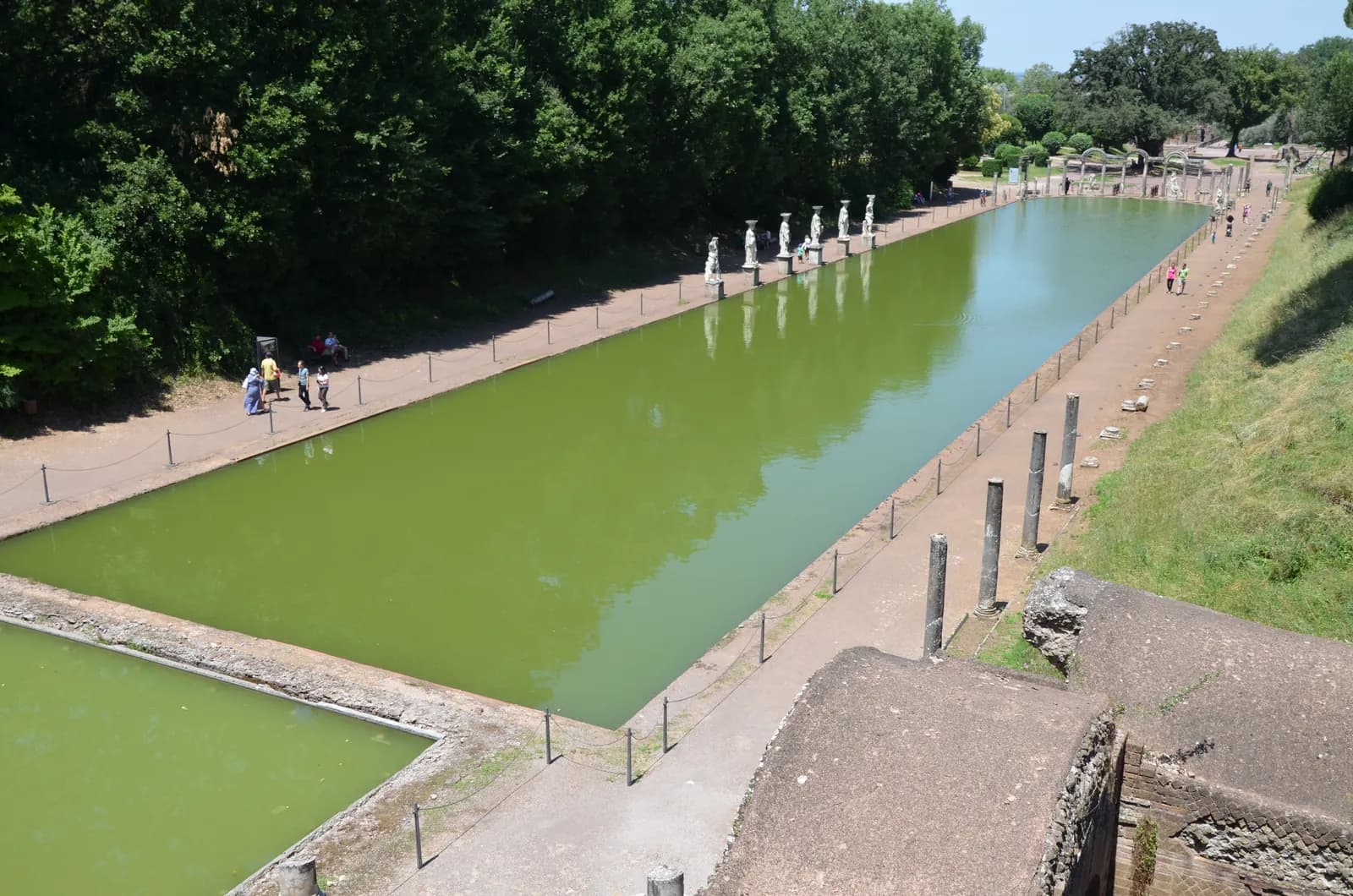
Where the site is
On sloping ground below Tibur, some twenty-eight kilometres east of Rome, with abundant water from the Aniene and its aqueducts and travertine quarries close by. Far enough from the city to be a retreat and close enough to govern from, which is precisely what it was for.
- Ancient region
- Latium
- Modern country
- Italy
- Position
- 41.941° N, 12.774° E — The Canopus
- Given to three decimal places, about a hundred metres. It locates the named feature, not the extent of the site.
What survives
Brick and concrete on an enormous scale across a landscape rather than a site: bath buildings with their vaults standing, the long pool of the Canopus with its curved colonnade re-erected, the Maritime Theatre's circular island and moat, the Piazza d'Oro's octagonal vestibule, and terrace after terrace of substructure.
Almost none of the marble facing survives. What is visible is the structure behind the finish, which is why the villa is more useful for the history of construction than almost any complete building.
Below ground is a network of service tunnels and carriage roads large enough for vehicles, running under the whole complex so that the running of the villa was invisible from it.
Occupation and chronology
Dates below are stored as signed years and rendered with the precision they actually carry. c. 118 CE is approximate; 138 CE is fixed.
1st century BCE
The Republican villa
An earlier villa on the site, incorporated into the imperial complex rather than demolished. Parts of its opus reticulatum survive within later structures.
c. 118–138 CE
The Hadrianic building campaign
Two decades of continuous construction, dated by brick stamps, which is why the phasing here is unusually secure for a Roman site.
2nd–4th centuries CE
Later imperial use
Used by later emperors and progressively stripped; the evidence is scattered and the sequence poorly resolved.
15th–19th centuries
Quarry and excavation
Marble burned for lime, sculpture removed for collections, and a series of digs undertaken specifically to supply Roman palaces and, later, European museums.
History of excavation
Who recovered the evidence, when, and by what method. Where an excavation destroyed as much as it found, the entry says so.
- Evidence level: Documented
1550s–1560s
Pirro Ligorio for Cardinal Ippolito II d'Este
Excavation to furnish the Villa d'Este with sculpture, accompanied by the first survey plan and by Ligorio's naming of the parts. He took the list of names from the Historia Augusta and matched them to ruins; the names stuck.
- Evidence level: Documented
18th century
Giuseppe Fede, Count Fede and the antiquities dealers
Systematic digging for the collectors' market. Much of the villa's best sculpture entered the Vatican, the Capitoline and, through Gavin Hamilton and others, collections across Europe in this period, with little or no record of findspot.
- Evidence level: Documented
1870–present
The Italian state
Acquisition, survey, consolidation and selective excavation. The Canopus and its Serapeum were excavated and partly re-erected in the 1950s under Salvatore Aurigemma.
Principal structures
The evidence level answers how we know what a structure looked like, not whether it existed.
- Evidence level: Documented
c. 125–138 CE
The Canopus and Serapeum
A long pool flanked by columns and closed at one end by a half-domed dining chamber with water running behind the diners. The half-dome is segmented like an umbrella, a form the villa uses repeatedly and which appears in Rome only later.
- Evidence level: Documented
c. 118–125 CE
The Maritime Theatre
A circular colonnade around a moat with a small self-contained residence on the island, reached by swing bridges. A private retreat inside a private retreat.
- Evidence level: Documented
c. 125 CE
The Pecile
An enormous rectangular portico around a pool, with a surviving wall down the middle so that one could walk in sun or shade at any hour. Named by Ligorio after the Painted Stoa at Athens.
- Evidence level: Documented
c. 125–133 CE
The Great and Small Baths
Two bath buildings of very different character, one grand and one refined, both preserving vaults that are the best surviving evidence for Hadrianic concrete engineering.
- Evidence level: Documented
c. 118–138 CE
The service tunnels
Kilometres of underground corridors and vehicle roads. The villa's operation — deliveries, staff, waste — was routed entirely below the level anyone was meant to see.
Finds and where they went
Almost nothing recovered from these sites is still on them. Where an object has a full provenance record on this platform, it is linked.
- Evidence level: Documented
The Antinous sculptures
Several portraits of Antinous, including the colossal Braschi Antinous, came from the villa. The commemoration of Hadrian's companion after his death in the Nile in 130 CE is unusually visible here.
- Evidence level: Documented
The Furietti centaurs
A pair of grey marble centaurs signed by Aristeas and Papias of Aphrodisias, found in 1736. Signed Roman sculpture is rare, and these name their sculptors and their city.
- Evidence level: Documented
Mosaics and coloured marble
Figured emblemata and vast quantities of imported coloured stone — Egyptian granite, Numidian yellow, Phrygian purple — which document the reach of the imperial quarry system as clearly as any inscription.
- Evidence level: Disputed
Egyptian and Egyptianising sculpture
Statuary in Egyptian style and material, much of it made in Italy rather than imported, from the Canopus area. What it represents is argued: an evocation of the Nile, a memorial to Antinous, a cult installation, or several at once.
Ancient testimony
What ancient authors say about the place, and how far it can be trusted.
Historia Augusta Hadrian 26.5
The passage listing the villa's supposed names — Lyceum, Academy, Prytaneum, Canopus, Poikile, Tempe and an underworld. A late, anonymous and demonstrably unreliable compilation, and the single source for the villa's most repeated claim.
Cassius Dio, Roman History 69.4
Cassius Dio on Hadrian's quarrel with Apollodorus of Damascus and the architect's death.
How the site has been interpreted
The villa is best read as an experimental building site. Curved and countercurved walls, segmented domes, half-domes on unequal supports, and vaults springing from points that would not carry a stone architrave — these are things concrete makes possible and stone does not, and Hadrian's builders did them here before they were done in Rome. The Pantheon's dome is contemporary with this work and the relationship is not accidental.
The familiar names are a Renaissance overlay. The Historia Augusta says Hadrian named parts of the villa after Lyceum, Academy, Prytaneum, Canopus, Poikile and Tempe, and even built an underworld; the Historia Augusta is a late compilation with a well-documented habit of invention, and Ligorio distributed its list across the ruins by inference. Whether Hadrian named anything in the villa after anything is not established, and the notion that the complex was a miniature tour of the empire is a modern narrative built on that Renaissance guess.
It is also the clearest single case of an archaeological site functioning as a quarry for museums. A large proportion of the classical sculpture in the Vatican, the Capitoline and several other collections came out of this ground in the sixteenth to eighteenth centuries, almost none of it with a recorded findspot, which is why the villa's own sculptural programme cannot be reconstructed.
Unresolved
Was Apollodorus of Damascus executed over the villa?
Cassius Dio reports that Hadrian had Trajan's architect put to death after Apollodorus criticised his designs. The story is told long after the fact, has the shape of an anecdote about imperial vanity, and is not corroborated. It is repeated constantly in accounts of this villa and should be labelled as what it is.
How much did Hadrian design?
Ancient sources present Hadrian as personally engaged in architecture, and the villa's unusual forms are often attributed to him directly. There is no building inscription naming a designer and no drawing. Attributing the invention to the emperor is a plausible reading of a court culture, not a documented fact about who worked out the geometry.
How to read the evidence labels
- Evidence level: Documented
- Supported by a named primary text or by excavated material evidence.
- Evidence level: Probable
- Supported by strong inference that most specialists accept.
- Evidence level: Disputed
- Substantial specialist disagreement exists; competing readings are stated.
- Evidence level: Literary
- Belongs to poetic or mythological construction rather than to history.
- Evidence level: Mythological
- Belongs to shared religious or mythic tradition rather than to any single text.
- Evidence level: Unknown
- The available evidence is insufficient to decide.
These labels describe the status of the evidence, not our confidence in a conclusion. A claim marked Literary is not a claim we doubt; it is a claim about what kind of thing a poem is.