What it is
The Arch of Titus — the spoils relief, the triumph of 71 CE, the arch's medieval life inside a fortress, and Valadier's deliberately legible restoration.
Built Erected after Titus's death in 81 CE, under Domitian. The principal date, shortly after 81 CE, is approximate.
71 CE
The triumph
Vespasian and Titus celebrated a joint triumph for the Jewish war, described at length by Josephus, who was present in Rome. The arch commemorates it a decade later.
after 81 CE
The arch
The dedication reads DIVO TITO — to the deified Titus — so it postdates his death and consecration and was put up under his brother Domitian.
11th–12th centuries
The Frangipane fortress
Built into a family stronghold, which walled up the bay and preserved the reliefs while destroying the outer piers.
1821
Valadier's restoration
The medieval accretions removed and the missing outer bays rebuilt in travertine, deliberately plainer than the ancient marble.
Who ordered it built
Each attribution carries what supports it. Ancient buildings are routinely credited to people on the authority of writers centuries later, and that is not the same claim as an inscription on the building.
- Evidence level: Probable
Commissioned by
Domitian
No source names the builder. The dedication to the deified Titus places it after 81 CE, and Domitian is the obvious patron on grounds of date and dynastic interest. It is an inference from the inscription, not a record.
- Evidence level: Unknown
Sculptor
Unknown
No ancient source names a sculptor and no signature survives.
What it was for
A commemorative and funerary monument in one: an arch over the Sacra Via at the highest point of the processional route, dedicated to an emperor after his consecration as a god.
It is not a triumphal arch in the strict sense — Titus's triumph was ten years earlier and was marked by a different arch in the Circus Maximus, now lost and known from its inscription. This one commemorates the man rather than the event, and uses the event to do it.
How it was built
A single barrel-vaulted bay between two piers, with engaged composite columns — among the earliest surviving uses of the composite order — and a coffered vault carrying a relief of Titus carried up by an eagle.
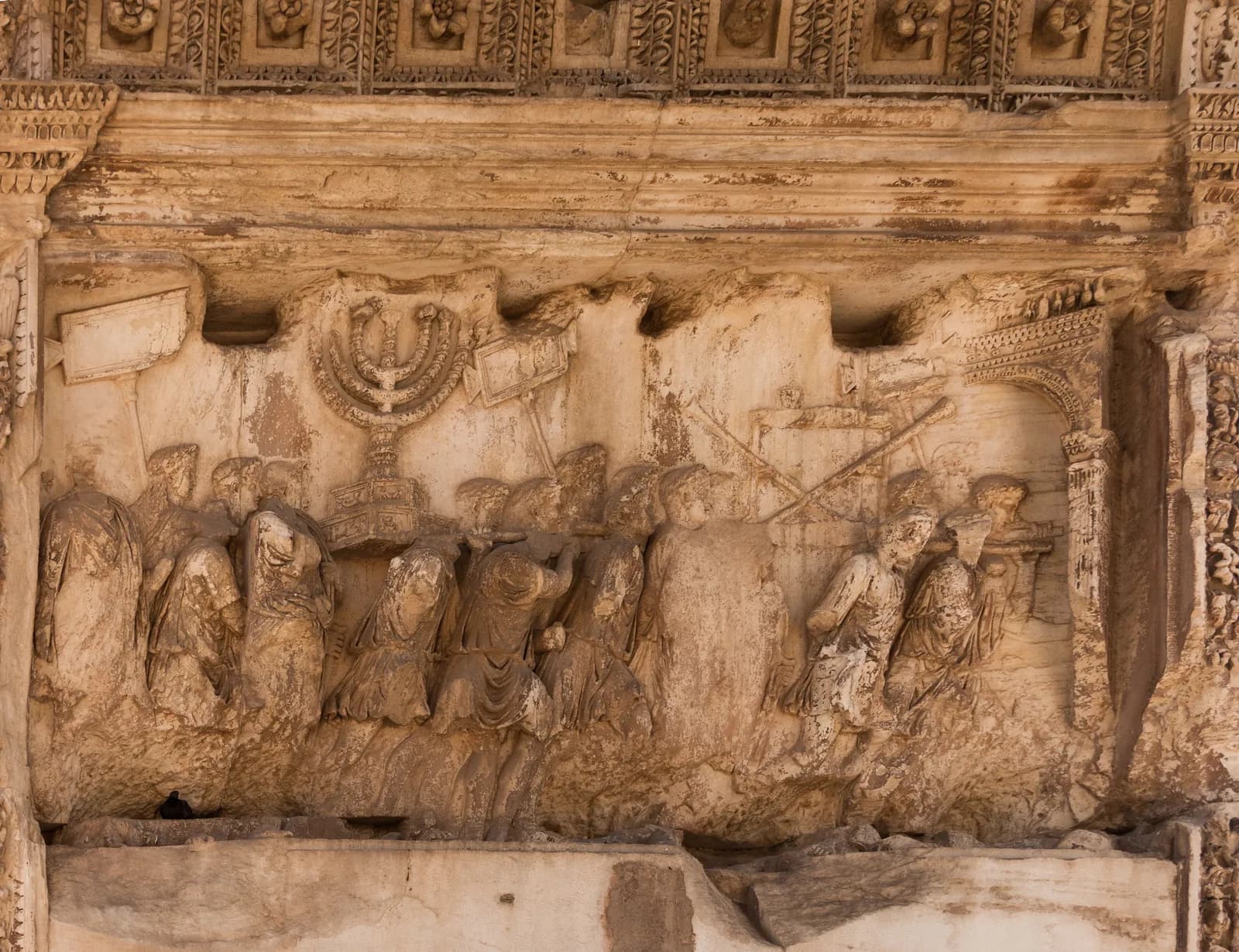
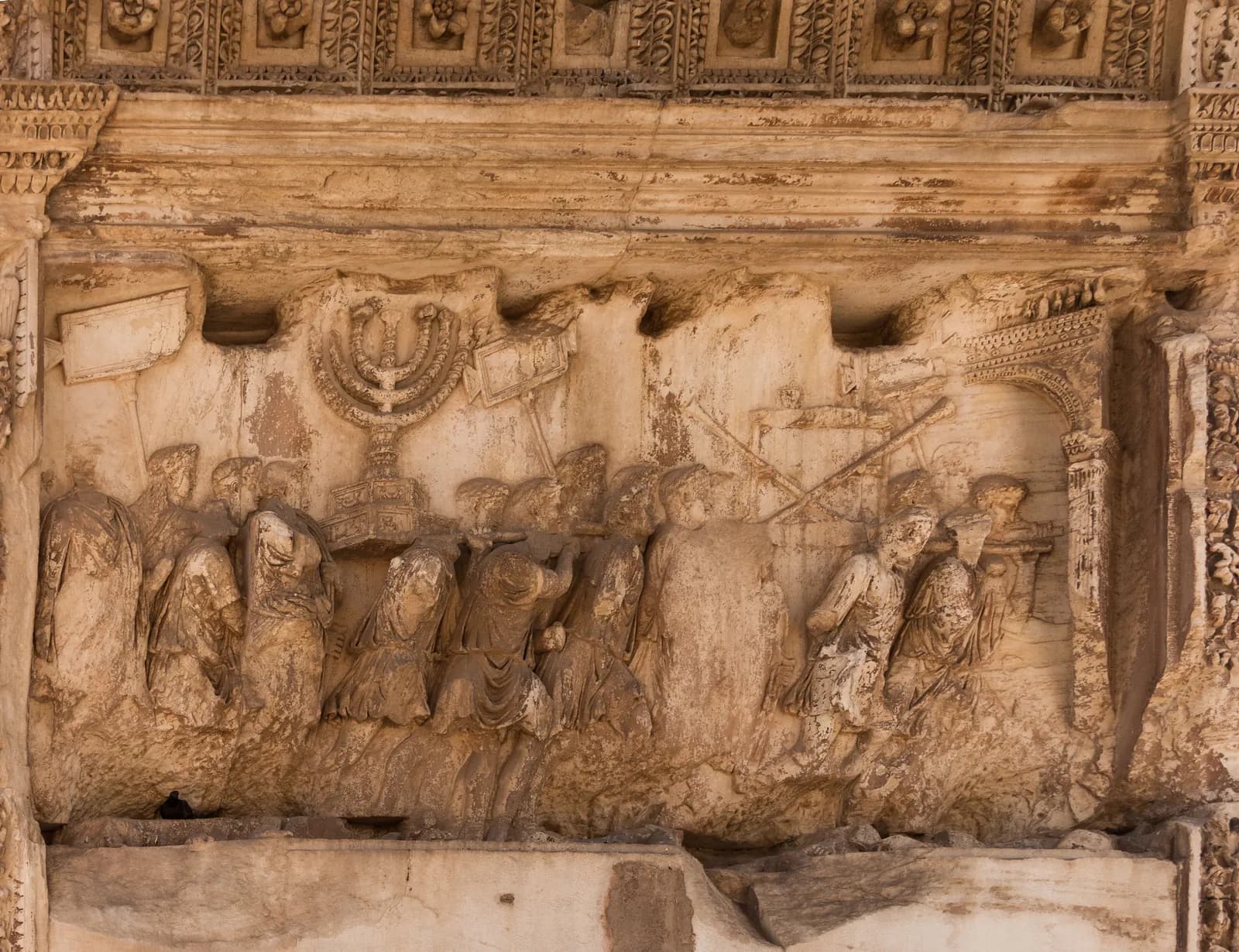
The two great panels face each other inside the bay. On one, the triumphal chariot with Roma at the horses' heads and a Victory crowning Titus; on the other, the procession carrying the spoils. Both are carved in high relief with figures at different depths, so that the procession appears to turn a corner and pass out of the arch — an illusionistic device that is one of the reasons this arch matters to the history of Roman sculpture.
Materials
- Evidence level: Documented
Pentelic marble
The ancient fabric, including the reliefs and the inscription
- Evidence level: Documented
Travertine
Valadier's 1821 reconstruction of the outer bays and much of the attic
Measured
Every figure states what it rests on. A modern survey, an ancient text, a conversion from an ancient unit and a modern estimate are four different kinds of statement and are not interchangeable.
Height
about 15.4 m
Modern survey of the restored monument, which includes Valadier's rebuilt attic.
Bay width
about 5.4 m
Modern survey of the ancient piers.
What it meant
The Jewish war paid for the Flavian building programme. The same spoils appear as booty on this arch and, on Alföldy's reading, as the funding recorded in the Colosseum's dedicatory inscription. The two buildings are a hundred and fifty metres apart and were paid for by the same campaign.
The arch is also dynastic housekeeping. Domitian's position rested on being the third Flavian, and consecrating and monumentalising his brother made the family a line rather than an episode.
The consecration of a dead emperor as divus is a state act with a procedure, and the vault relief showing Titus carried up by an eagle is its standard image. The arch is a piece of that machinery rather than a private commemoration.
Jewish tradition has long avoided walking under the arch, on the ground that it celebrates the destruction of the Temple. That is a modern and early-modern custom rather than an ancient one, and it is a fact about how the monument has been received.
After antiquity
Absorbed into the Frangipane fortifications in the eleventh or twelfth century. The bay was blocked and the arch became a gate tower, which is why the reliefs inside it are among the best preserved in Rome and why almost nothing of the outer faces survived.
Freed and restored under Pius VII in 1821 by Giuseppe Valadier, working with Raffaele Stern's design: the medieval masonry removed, the ancient fragments reset, and everything missing rebuilt in plain travertine with simplified profiles. The principle — that a restoration should be visible as one — is now standard and was not then.
Condition today
Standing
Standing and complete in outline. The bay, its two great reliefs and the vault are ancient marble; the outer bays, most of the attic and the entablature ends are Valadier's travertine, and the difference is visible at a glance.
Valadier's 1821 work is the reference case for legible restoration. He did not copy the ancient carving, did not attempt to blend the new stone, and did not invent detail: the new bays carry the same profiles reduced to plain blocks, so that a reader of the building can separate the two at any distance.
The arch's foundations and the line of the Sacra Via beneath it have been examined in the twentieth century, establishing the relationship between the arch, the road and the Flavian rebuilding of the Velia.
Traces of ancient polychromy on the reliefs have been investigated with non-contact imaging, and a yellow pigment has been reported on the menorah. The finding is published and is not universally accepted.
Scattered fragments
What has left the building, and where it is now. Where a holding is contested, the museum page says so.
- Evidence level: Documented
The lost Circus Maximus arch of Titus, known only from its inscription copied in a medieval manuscript
Text only; the monument is gone
That inscription, not this arch, records the triumph itself.
Written about in antiquity
Josephus, The Jewish War 7.123–157
Josephus's eyewitness description of the triumph of 71 CE: the order of the procession, the spoils carried, the golden table and the lampstand, and the execution of Simon bar Giora at the end. The text the spoils relief is always read against.
Suetonius, The Twelve Caesars Titus 5–11
Suetonius on Titus's command in Judaea, his brief reign and his death, and the consecration that the arch's dedication presupposes.
Still argued
Does the spoils relief show the actual Temple lampstand?
The relief shows a lampstand on a stepped, panelled base carrying figured decoration, which is difficult to reconcile with the description of the Temple menorah in Jewish sources and with the prohibition on such imagery. Explanations include a Roman sculptor working from description, a stand added for the procession, a different object, and a Herodian menorah unlike the earlier one. The image has shaped every later depiction of the menorah, which makes the question more than antiquarian.
How to read the evidence labels
- Evidence level: Documented
- Supported by a named primary text or by excavated material evidence.
- Evidence level: Probable
- Supported by strong inference that most specialists accept.
- Evidence level: Disputed
- Substantial specialist disagreement exists; competing readings are stated.
- Evidence level: Literary
- Belongs to poetic or mythological construction rather than to history.
- Evidence level: Mythological
- Belongs to shared religious or mythic tradition rather than to any single text.
- Evidence level: Unknown
- The available evidence is insufficient to decide.
These labels describe the status of the evidence, not our confidence in a conclusion. A claim marked Literary is not a claim we doubt; it is a claim about what kind of thing a poem is.