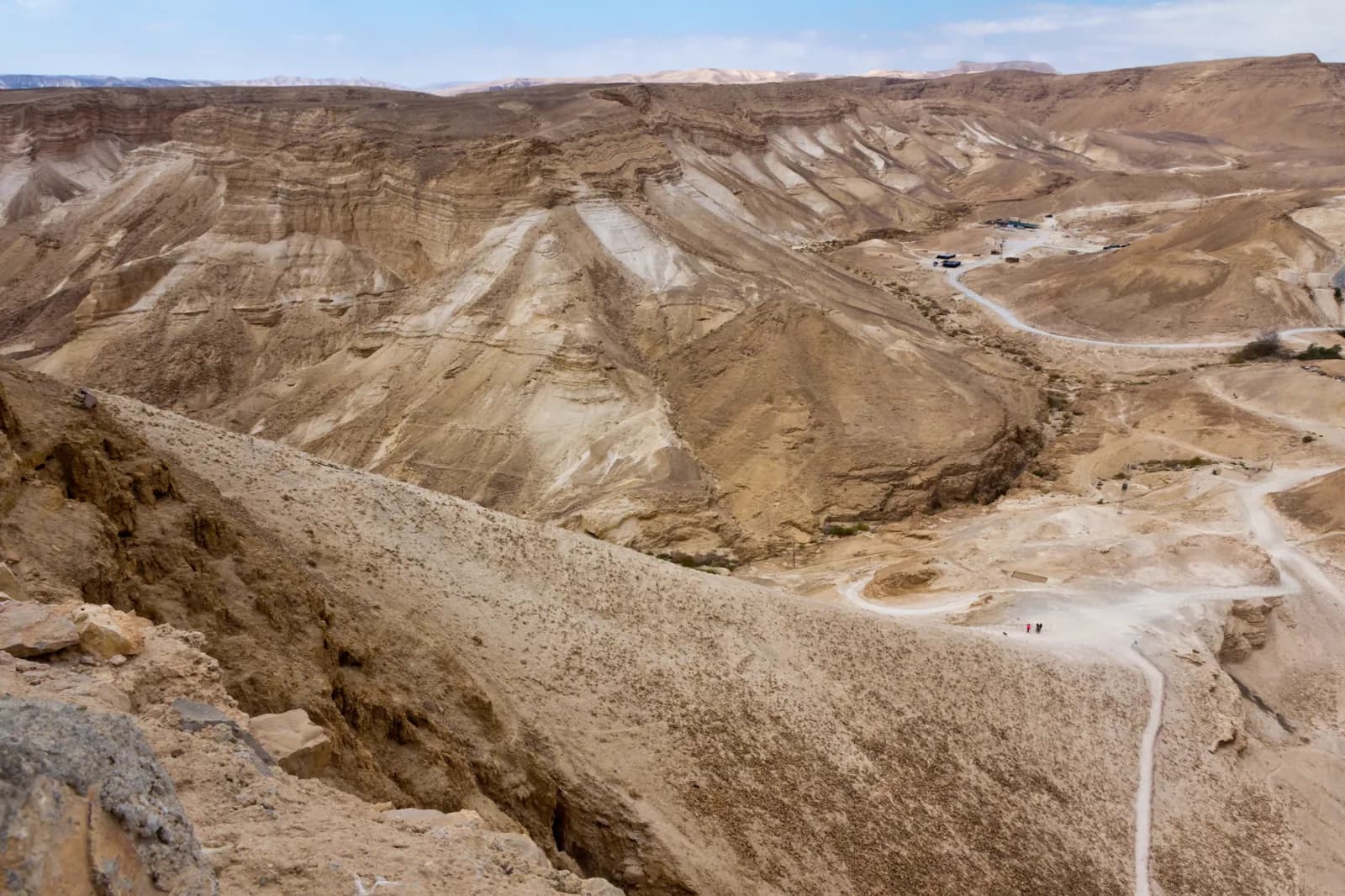
For most of Greek history, taking a walled city meant starving it. Classical Greek armies were citizen levies that could not stay in the field indefinitely and had little engineering capacity; sieges were blockades and often failed.
The change came with Philip and Alexander, who fielded torsion artillery and a professional engineering corps, and with the Hellenistic kingdoms, whose siege trains became famously elaborate. Alexander's mole at Tyre — a causeway built out to an island city — is the emblematic operation.
Roman practice combined all methods and added scale and persistence: circumvallation to seal a place off, ramps to bring engines to the wall, mining, and the willingness to spend months. The archaeological signature of Roman siege is unusually clear because the works were earth and stone and survive.
What the evidence supports
Roman siege works survive as earthworks.
The circumvallation and ramp at Masada, and the siege lines at Alesia and Numantia, are visible and excavated. Ancient siege is among the best-attested military activities archaeologically.
Torsion artillery transformed siege capability in the fourth century BCE.
Attested in technical writers and in finds of torsion-spring washers and bolt heads.
Classical Greek armies mostly could not take walls.
Thucydides' account of the long blockades of the Peloponnesian War illustrates the limitation directly.
Archaeology
Masada preserves the most complete Roman siege system anywhere: camps, circumvallation wall and assault ramp. Numantia in Spain preserves Scipio Aemilianus's lines. Both allow written accounts to be checked against ground.
Primary sources
Julius Caesar, The Gallic War 7.68-90
The double lines at Alesia.
Josephus, The Jewish War 3, 7
Roman siege method described by an eyewitness on the other side, including Jotapata and Masada.
Aeneas Tacticus, On the Defence of Fortified Positions
A fourth-century BCE manual on withstanding siege.
Battles
52 BCE
Alesia
Caesar besieged Vercingetarix inside a hilltop stronghold while simultaneously defending his own siege lines against a relief army, and ended organised Gallic resistance.
How to read the evidence labels
- Evidence level: Documented
- Supported by a named primary text or by excavated material evidence.
- Evidence level: Probable
- Supported by strong inference that most specialists accept.
- Evidence level: Disputed
- Substantial specialist disagreement exists; competing readings are stated.
- Evidence level: Literary
- Belongs to poetic or mythological construction rather than to history.
- Evidence level: Mythological
- Belongs to shared religious or mythic tradition rather than to any single text.
- Evidence level: Unknown
- The available evidence is insufficient to decide.
These labels describe the status of the evidence, not our confidence in a conclusion. A claim marked Literary is not a claim we doubt; it is a claim about what kind of thing a poem is.