The man who rebuilt the state
Where Aurelian saved the empire by arms, Diocletian (reigned 284–305 CE) saved it by reorganisation — and in doing so abolished the political world Augustus had built three centuries before. The platform reads Diocletian as the second founder of Rome: the emperor who admitted, in structure if not in words, that the Principate's fiction of a restored Republic was dead, and who built in its place the open, militarised, bureaucratic monarchy that historians call the Dominate. The empire that entered the modern imagination as "the late Roman Empire" is substantially his creation.
The Tetrarchy
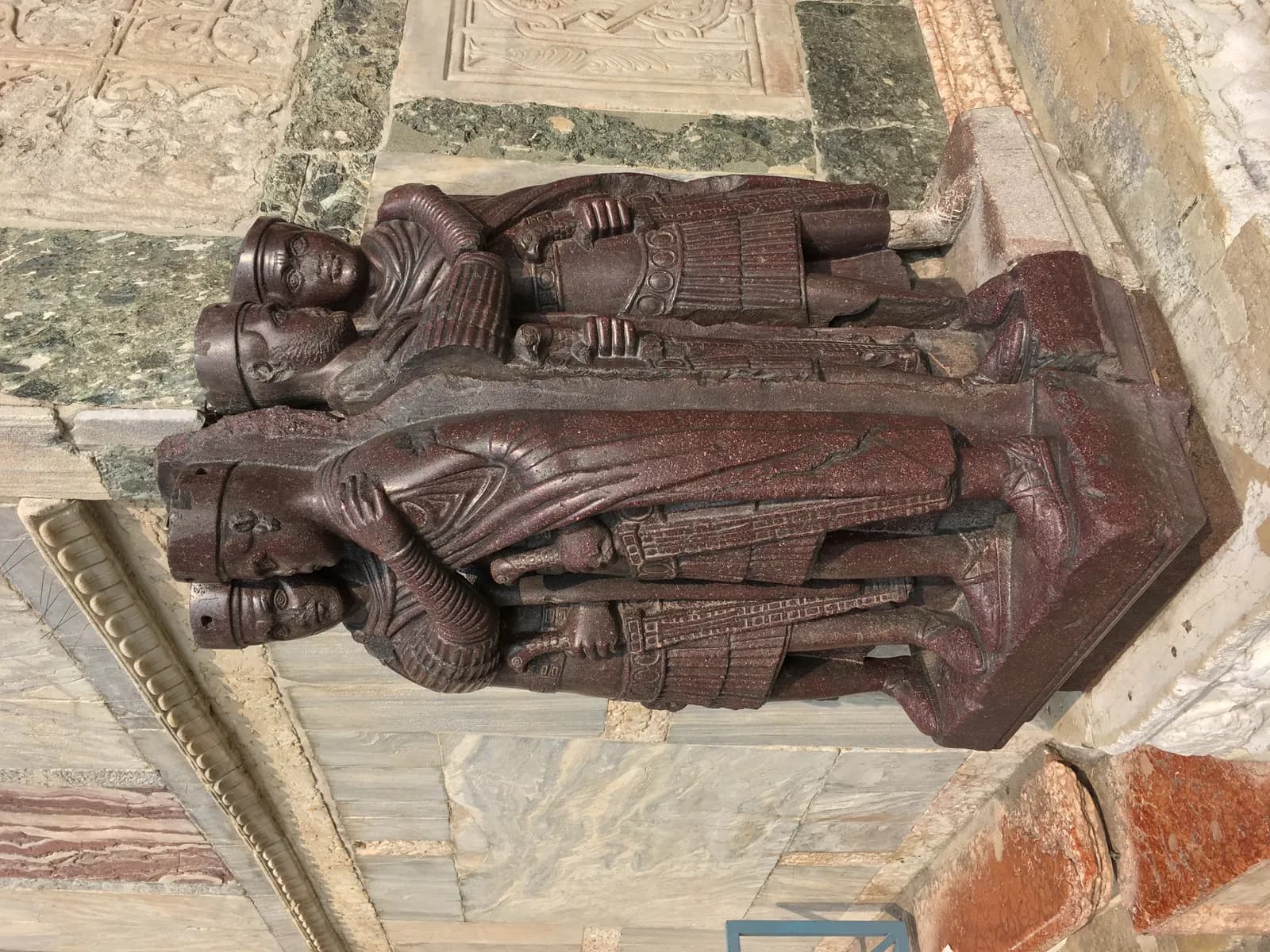
Diocletian's boldest invention addressed the deepest weakness of the imperial system: the succession and the impossibility of one man governing the whole empire under constant frontier pressure. He divided the office. Two senior emperors (Augusti), one in the west and one in the east, each with a designated junior colleague and successor (Caesar) — the Tetrarchy, the rule of four. The arrangement distributed military command across the empire's fronts and, in principle, built the succession into the structure: each Caesar would in time become Augustus and appoint his own junior. It was the most ambitious constitutional engineering the empire ever attempted. Under the imperial-succession theme it is also the most instructive failure — it depended entirely on Diocletian's personal authority, and collapsed into civil war within a year of his abdication.
The reordered empire
Diocletian's administrative reforms were permanent in a way the Tetrarchy was not. He roughly doubled the number of provinces, grouped them into larger dioceses, and separated civil from military command throughout — so that no single official again held both the troops and the taxes of a region, the combination that had made usurpation easy. He expanded the army and the bureaucracy enormously, reformed the tax system onto a regular assessment (capitatio-iugatio), and attempted, in the Edict on Maximum Prices (301), to halt inflation by decree — an experiment that failed but documents the scale of the crisis. The whole apparatus the platform reads under imperial-administration reaches its mature late-Roman form here: larger, more intrusive, more expensive, and strong enough to hold the empire together for another century in the west and far longer in the east.
The Dominate and the persecution
Diocletian also transformed the style of rule. The emperor was no longer princeps, first among citizens, but dominus — lord — surrounded by an elaborate court ceremonial of prostration, purple and sacred distance, modelled in part on Persian and Hellenistic monarchy. Under the state-and-religion theme this sacralised autocracy made the refusal of the Christians intolerable, and Diocletian's reign ended in the Great Persecution of 303 — the last and most systematic Roman attempt to destroy the church, and the one that failed most completely. His final act was unique among emperors: in 305 he voluntarily abdicated and retired to his fortified palace at Split, the only Roman emperor to lay down supreme power and walk away.
Why the platform reads him
The platform reads Diocletian because he is the clearest ancient case of a state being deliberately reinvented to survive. He took the lessons of the third-century catastrophe — that the army made emperors, that the succession had no rule, that one man could not hold the whole — and built structures to contain each. Most of the structures outlived him even as his central invention, the Tetrarchy, failed at once. He is read here as the bridge between crisis and the Christian empire: the man who made the late-Roman state, beside Aurelian who saved it and Constantine who inherited and transformed it.