What happened
Darius brought the royal army west and, by moving through the mountain passes behind Alexander, placed himself across the Macedonian line of communication. Alexander turned about and marched back to meet him.
The Persians drew up behind the Pinarus with the Greek mercenaries in the centre facing the Macedonian phalanx, cavalry massed on the seaward flank, and light troops in the foothills.
Alexander led the Companion cavalry against the Persian left at the foot of the hills, broke it, and wheeled inward toward the Persian centre and the king. The phalanx, crossing the riverbed under fire, was disordered and suffered badly against the mercenaries.
Darius left the field as the Macedonian cavalry closed on him. His departure ended the battle. His mother, wife and children were taken in the camp and, on the ancient accounts, treated with conspicuous courtesy.
Tactics
The Macedonian system in its characteristic form: the phalanx fixes and absorbs, the heavy cavalry finds the flank and drives at the enemy command. The choice of ground favoured Alexander decisively, and the ancient sources are unanimous that it was Darius who chose it — a narrow plain where the larger army could not deploy or use its cavalry advantage.
Consequence
The Persian field army was broken and its king had fled twice from the same enemy. Alexander turned south to take the Levantine coast and Egypt rather than pursuing Darius inland, a decision that secured the Mediterranean seaboard and the fleet bases before the campaign moved east.
Location
The coastal plain at the river Pinarus, near Issus in Cilicia
Modern: The plain of Issus near Dörtyol, Hatay province, Turkey
The general location is agreed; which modern watercourse is the Pinarus is disputed, and the coastline has advanced since antiquity.
Archaeology
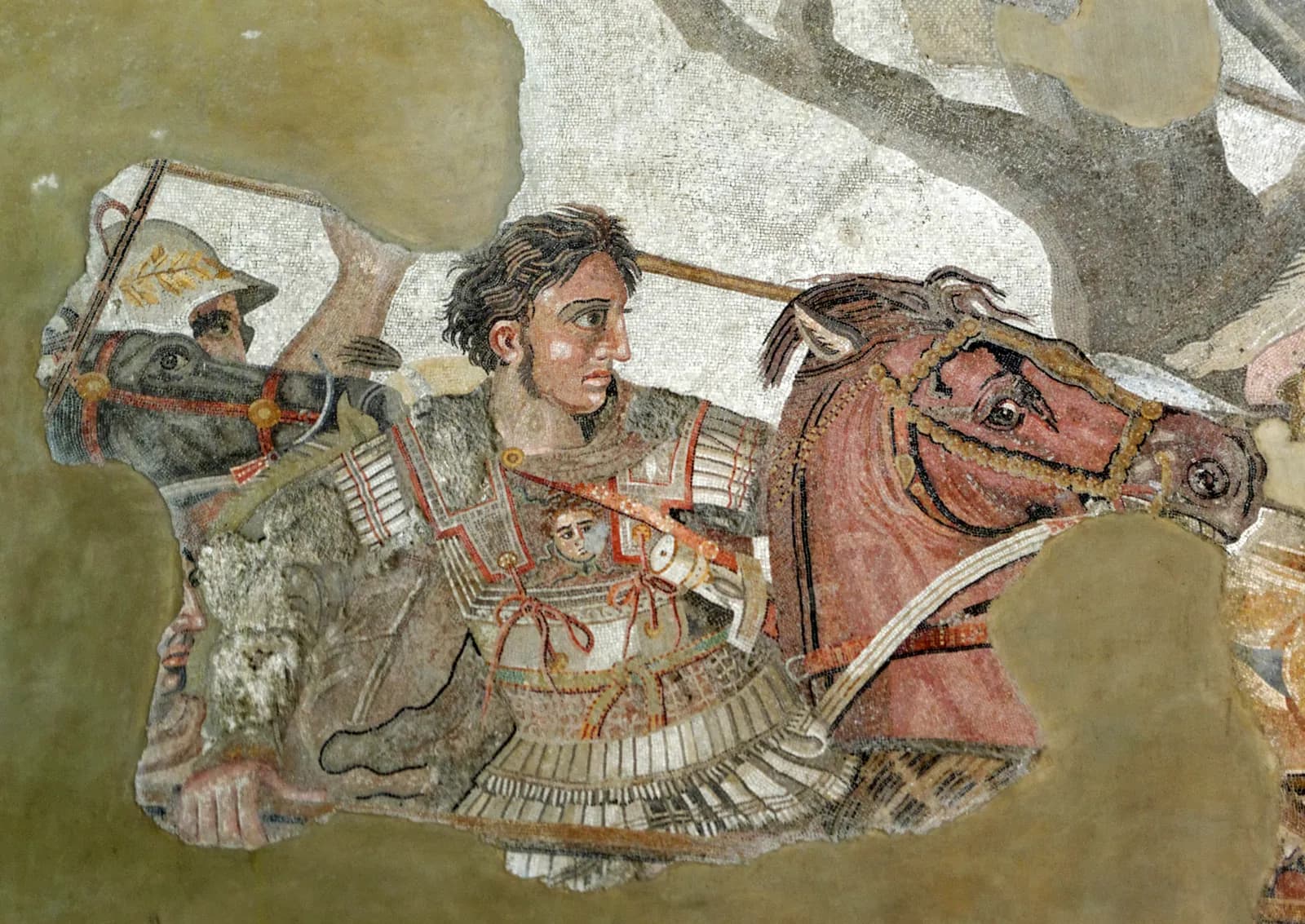
The Alexander Mosaic from the House of the Faun at Pompeii, a Roman floor mosaic of about 100 BCE thought to copy a Hellenistic painting, shows Alexander charging toward a Persian king in a chariot. It is usually identified with Issus and sometimes with Gaugamela; the mosaic carries no label and the identification is an art-historical inference.
Open questions
Does the Alexander Mosaic depict Issus?
The scene fits both Issus and Gaugamela, and the mosaic names nothing. Most scholars favour Issus on the grounds of the terrain and the composition; the question is not settled and the image should not be captioned as though it were.
Did Darius flee prematurely?
The Greek and Roman sources are hostile to Darius and present his withdrawal as cowardice. A Persian king's death or capture would have ended the empire's ability to resist, and withdrawal to raise another army is a defensible decision. The sources' framing is a product of their perspective.
Primary sources
Arrian, Anabasis of Alexander 2.6-12
The principal narrative.
Diodorus Siculus, Library of History 17.32-39
An independent tradition.
Quintus Curtius Rufus, History of Alexander 3.8-12
A rhetorical Latin account preserving further detail.
How to read the evidence labels
- Evidence level: Documented
- Supported by a named primary text or by excavated material evidence.
- Evidence level: Probable
- Supported by strong inference that most specialists accept.
- Evidence level: Disputed
- Substantial specialist disagreement exists; competing readings are stated.
- Evidence level: Literary
- Belongs to poetic or mythological construction rather than to history.
- Evidence level: Mythological
- Belongs to shared religious or mythic tradition rather than to any single text.
- Evidence level: Unknown
- The available evidence is insufficient to decide.
These labels describe the status of the evidence, not our confidence in a conclusion. A claim marked Literary is not a claim we doubt; it is a claim about what kind of thing a poem is.