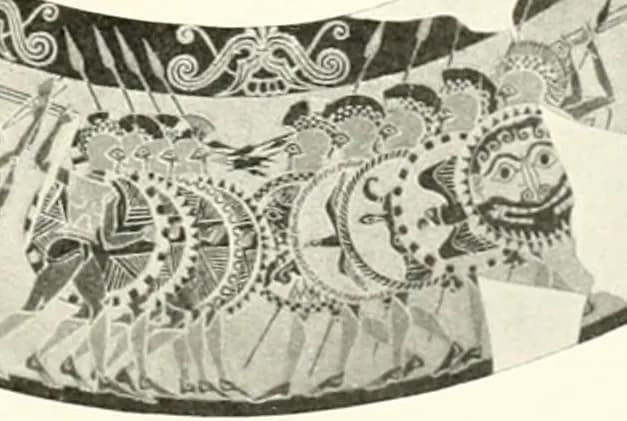
A hoplite was a heavy infantryman who fought in close order with a thrusting spear and a large round shield. He was not a professional. In most Greek states he was a citizen of sufficient property to buy his own equipment, who farmed for most of the year and campaigned in the season when he could be spared.
The defining object is the shield, the aspis: roughly ninety centimetres across, wooden, faced in bronze, and gripped by a central armband and a handgrip at the rim. That grip is the whole tactical logic. It made the shield heavy and awkward to carry alone, and it meant that its right-hand portion covered the man to the right. A hoplite line protected itself only by staying closed.
The panoply otherwise varied more than reconstructions suggest. Bronze bell cuirasses give way to composite linen armour; helmet types change; greaves come and go. There was no standard issue because there was no issuing authority.
What the evidence supports
The shield's double grip is the basis of the formation.
The porpax-and-antilabe arrangement is well attested in surviving shields, vase painting and text. Thucydides notes that hoplite lines drift rightward as each man edges toward the cover of his neighbour's shield.
Hoplite status was tied to property.
Census classes at Athens and comparable arrangements elsewhere tied military role to wealth, because equipment was self-purchased.
How hoplite battle was decided is disputed.
The 'orthodox' reconstruction has the lines meet and physically push; the 'heretical' view has them fight at spear's length in a looser order. Both readings are defended by serious scholars from the same passages.
Terms
- hoplon / aspis
- The round shield. The soldier is probably named from his equipment generally rather than from the shield specifically.
- doru
- The thrusting spear, roughly two to two and a half metres, with a butt-spike as a secondary point.
- othismos
- 'Pushing'. Whether this is literal massed shoving or a metaphor is the central dispute in the field.
Archaeology
Surviving shields, helmets and greaves are numerous, many dedicated at sanctuaries such as Olympia. The Chigi vase of the seventh century BCE is the earliest clear depiction of hoplites in formation with a piper.
Open questions
Was othismos a literal push?
The orthodox reading takes Greek battle as a collision of masses decided by shoving, with depth as the decisive variable. The alternative holds that men cannot fight while being crushed, and reads the language of pushing as figurative. The dispute is unresolved and touches every reconstruction of Greek battle.
Primary sources
Thucydides, History of the Peloponnesian War 5.71
The observation that hoplite lines drift to the right as men seek the cover of the shield beside them.
Xenophon, Anabasis
A campaigning soldier's account of hoplites in practice over a long retreat.
Battles
490 BCE
Marathon
An Athenian and Plataean hoplite force defeated a Persian expedition on the coast of Attica, and the Greek world learned that a Persian army could be beaten.
480 BCE
Thermopylae
A Greek force held a coastal pass in central Greece for three days against the army of Xerxes, and was destroyed when the position was turned by a mountain path.
479 BCE
Plataea
The largest hoplite battle of the Persian Wars, which destroyed the Persian field army in Greece and ended the invasion.
371 BCE
Leuctra
A Theban army under Epaminondas broke the Spartan phalanx in open battle, and with it the assumption that Spartan infantry could not be beaten.
362 BCE
Mantinea (362 BCE)
The largest hoplite battle fought between Greek states, won by Thebes and rendered indecisive by the death of the commander who won it.
How to read the evidence labels
- Evidence level: Documented
- Supported by a named primary text or by excavated material evidence.
- Evidence level: Probable
- Supported by strong inference that most specialists accept.
- Evidence level: Disputed
- Substantial specialist disagreement exists; competing readings are stated.
- Evidence level: Literary
- Belongs to poetic or mythological construction rather than to history.
- Evidence level: Mythological
- Belongs to shared religious or mythic tradition rather than to any single text.
- Evidence level: Unknown
- The available evidence is insufficient to decide.
These labels describe the status of the evidence, not our confidence in a conclusion. A claim marked Literary is not a claim we doubt; it is a claim about what kind of thing a poem is.