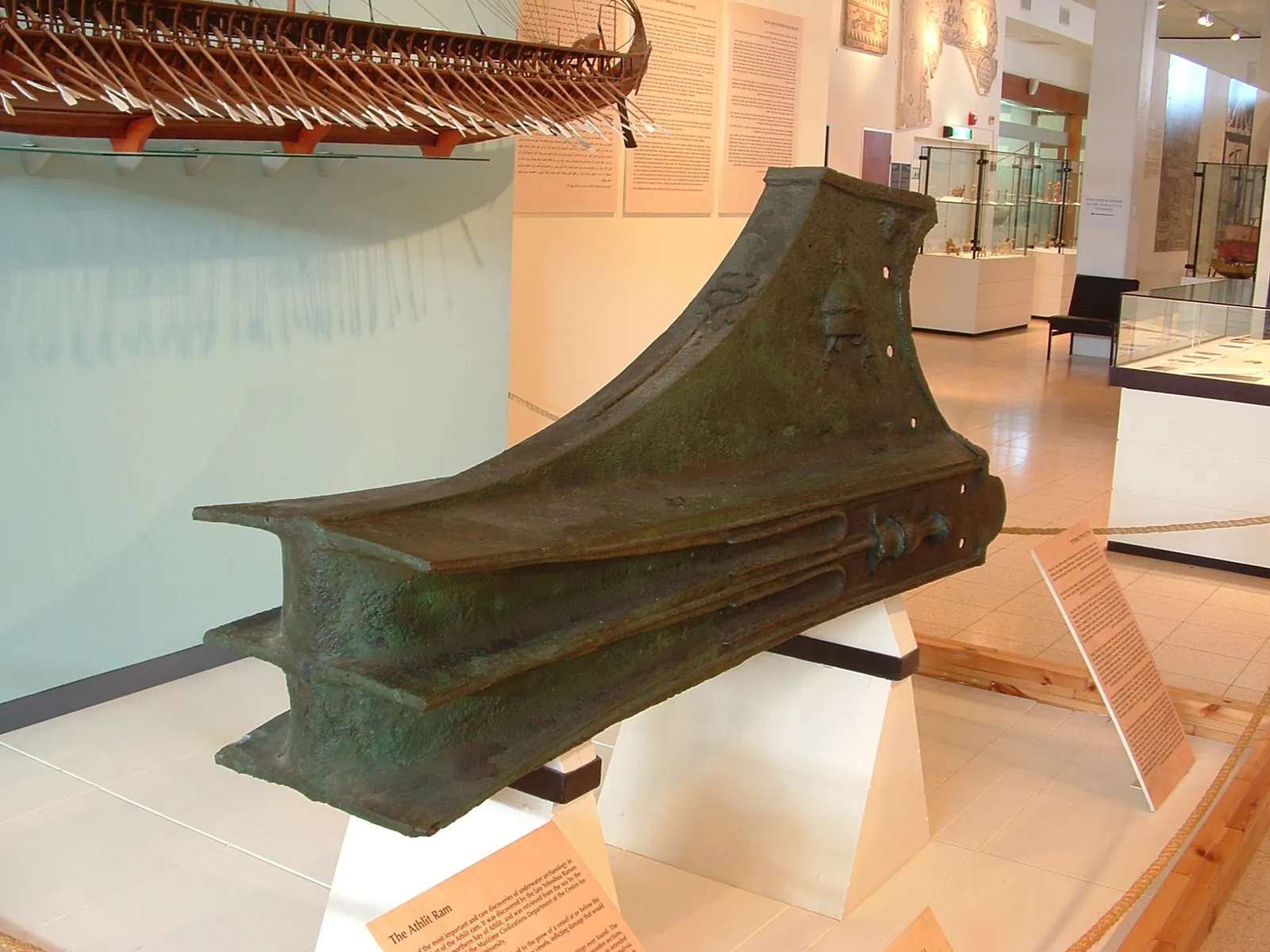
Two doctrines competed. The Greek approach treated the warship as a ram and sought to sink or disable by manoeuvre, which required highly trained crews and favoured light, fast hulls. The alternative treated the ship as a platform for infantry and sought to grapple and board, which favoured heavier ships, larger marine complements and less skilled rowers.
Rome adopted the second by necessity. Lacking naval tradition in the First Punic War, it built a fleet and fitted the corvus, a boarding bridge with a spike, which converted a naval engagement into an infantry fight Rome could win. The device is reported to have made the ships dangerously unstable and disappears from the record.
The binding constraint on ancient fleets was not combat but water. Oared warships carried little and their crews drank heavily in hot weather; fleets beached nightly and operated within reach of supply. Most naval campaigns are therefore contests over bases and coastlines rather than over open sea.
What the evidence supports
The diekplous and periplous are attested manoeuvres.
Breaking through the enemy line and rounding its flank are named and described in Greek narrative, and countermeasures such as the defensive circle are described with them.
Rome used a boarding bridge in the First Punic War.
Polybius describes the corvus and its effect. Its later disappearance is usually explained by instability in heavy weather, which is an inference from the loss of fleets to storms.
Fleets were constrained by water supply and beaching.
Follows from the ships' construction and is visible in narrative wherever a fleet's movements are described in detail.
Primary sources
Polybius, Histories 1.20-64
The Roman construction of a fleet, the corvus, and the naval war with Carthage.
Thucydides, History of the Peloponnesian War 7.36-41, 8
Naval tactics and their adaptation.
Battles
480 BCE
Salamis
A naval battle fought in the straits between Attica and the island of Salamis, and the engagement that broke the Persian campaign.
31 BCE
Actium
A naval battle off western Greece that ended the civil wars, delivered the Roman world to Octavian, and was immediately rewritten by the winner.
How to read the evidence labels
- Evidence level: Documented
- Supported by a named primary text or by excavated material evidence.
- Evidence level: Probable
- Supported by strong inference that most specialists accept.
- Evidence level: Disputed
- Substantial specialist disagreement exists; competing readings are stated.
- Evidence level: Literary
- Belongs to poetic or mythological construction rather than to history.
- Evidence level: Mythological
- Belongs to shared religious or mythic tradition rather than to any single text.
- Evidence level: Unknown
- The available evidence is insufficient to decide.
These labels describe the status of the evidence, not our confidence in a conclusion. A claim marked Literary is not a claim we doubt; it is a claim about what kind of thing a poem is.