Where the site is
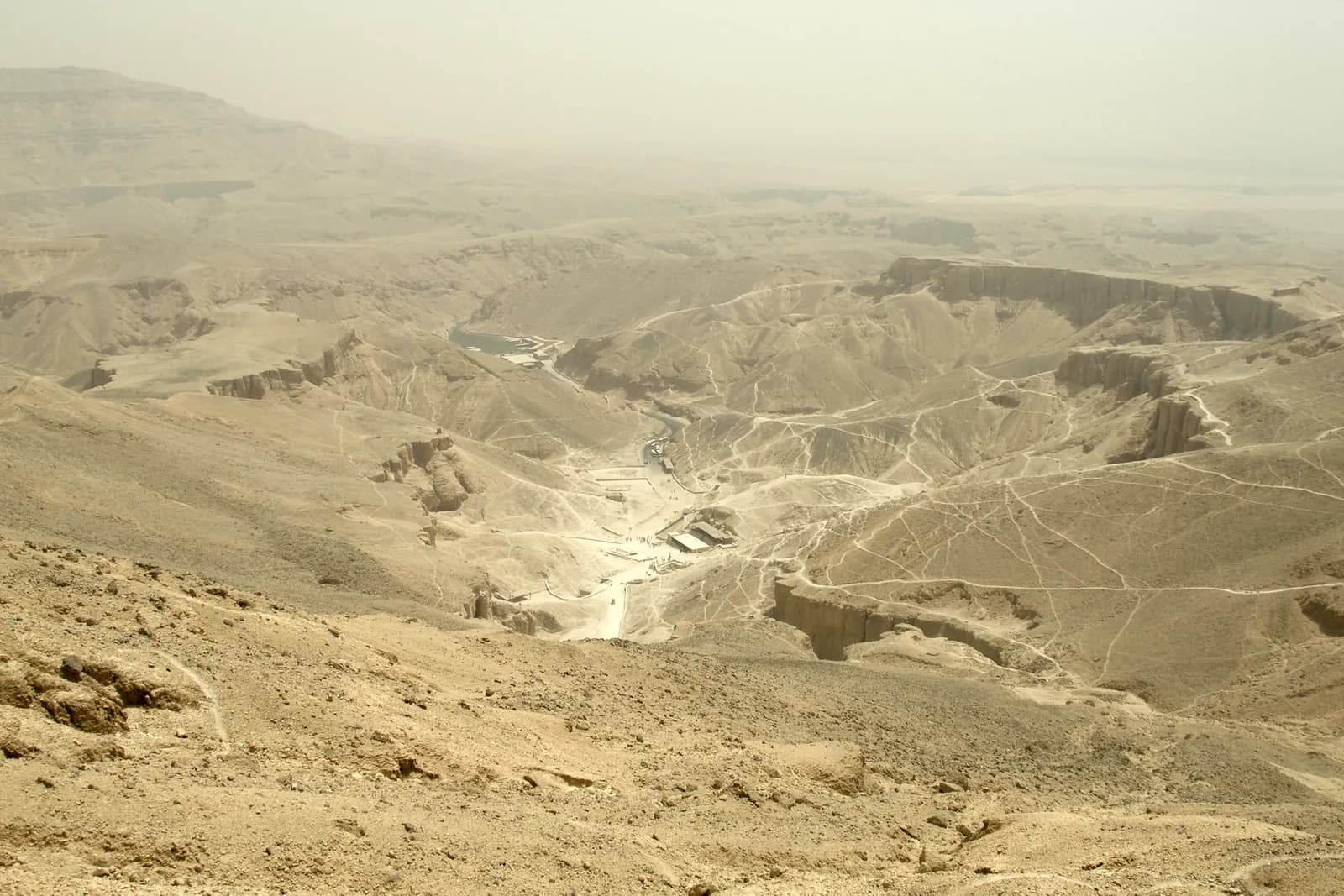
A dry wadi behind the cliffs of the west bank at Thebes, out of sight of the river and overlooked by a natural pyramid-shaped peak called el-Qurn. The choice of a concealed valley over a visible pyramid is the whole strategy: the New Kingdom kings separated the tomb from the mortuary temple and hid the first while monumentalising the second.
- Ancient region
- Upper Egypt, western Thebes
- Modern country
- Egypt
- Position
- 25.740° N, 32.601° E — The entrance to KV62
- Given to three decimal places, about a hundred metres. It locates the named feature, not the extent of the site.
What survives
Sixty-five numbered tombs and pits, most of them cut as descending corridors through limestone into chambers with pillared halls, and most of them decorated with funerary compositions — the Amduat, the Book of Gates, the Litany of Re — painted or carved directly on plastered rock.
The colour is the point. In tombs like Seti I's, and in the Valley of the Queens nearby, the paint is essentially as applied, because the tombs were sealed, dark and dry. No other body of ancient painting survives in this condition at this scale.
What does not survive is the contents. Every tomb in the valley was robbed except one, and the one exception, KV62, was small, obstructed by later debris and robbed twice in antiquity before being resealed.
Occupation and chronology
Dates below are stored as signed years and rendered with the precision they actually carry. c. 1539 BCE is approximate; c. 1075 BCE is approximate.
c. 1539–1292 BCE
Eighteenth Dynasty
The valley comes into use. Early tombs are irregular and hidden; the plans become progressively more regular and more axial.
c. 1292–1075 BCE
Nineteenth and Twentieth Dynasties
Long straight corridor tombs with fully decorated walls, including the largest of all — the tomb built for the sons of Ramesses II.
c. 1100–950 BCE
Robbery and reburial
Systematic plundering, official investigations, and then the removal of the royal mummies by the Theban priesthood into two hidden caches, where they stayed for nearly three thousand years.
Ptolemaic – Byzantine
Visitors and hermits
Greek and Latin graffiti in the open tombs, and Coptic occupation of some of them. Several tombs were never lost at any point.
History of excavation
Who recovered the evidence, when, and by what method. Where an excavation destroyed as much as it found, the entry says so.
- Evidence level: Documented
1799 and 1817
The French expedition, then Giovanni Belzoni
Belzoni opened Seti I's tomb, made wax impressions of its reliefs for exhibition in London, and removed the alabaster sarcophagus, which is in Sir John Soane's Museum. His methods were of their time and the tomb has deteriorated since exposure.
- Evidence level: Documented
1827
John Gardner Wilkinson
Painted numbers at the tomb entrances. The KV numbering still in use is his, extended by later work.
- Evidence level: Documented
1881 and 1898
The Antiquities Service, and Victor Loret
The two royal caches. The first, at Deir el-Bahari, had been found by the Abd el-Rassul family around 1871 and quietly worked for a decade before the authorities traced objects on the market. The second was in the tomb of Amenhotep II. Between them they contained most of the New Kingdom's kings.
- Evidence level: Documented
1902–1914
Theodore Davis, with Howard Carter and Edward Ayrton
A concession that produced a series of tombs and ended with Davis's published conclusion that the valley was now exhausted.
- Evidence level: Documented
1917–1922
Howard Carter for Lord Carnarvon
Five seasons of clearing the valley floor to bedrock in the area Davis had abandoned. On 4 November 1922 the first step of KV62 appeared under the huts of the workmen who had built a later tomb.
- Evidence level: Documented
1987–present
Kent Weeks and the Theban Mapping Project
Rediscovery and clearance of KV5, known to Burton in 1825 and then lost, which proved to have over a hundred and twenty chambers and to be the burial place of sons of Ramesses II. Also a complete survey and mapping of the valley.
Principal structures
The evidence level answers how we know what a structure looked like, not whether it existed.
- Evidence level: Documented
c. 1279 BCE
KV17, the tomb of Seti I
The longest and finest tomb in the valley, over a hundred metres of decorated corridor and chamber with an astronomical ceiling. Damaged by exposure and by nineteenth-century casting, and largely closed.
- Evidence level: Documented
c. 1323 BCE
KV62, the tomb of Tutankhamun
Four small rooms, decorated only in the burial chamber. Its importance is entirely a function of its contents, not its architecture — it is a modest tomb, probably not designed for a king.
- Evidence level: Documented
c. 1250 BCE
KV5
The largest tomb in the valley, with a pillared hall opening onto corridors of small chambers. Flooded repeatedly, filled with debris, and still being cleared.
- Evidence level: Documented
c. 1479 BCE
KV20 and the early tombs
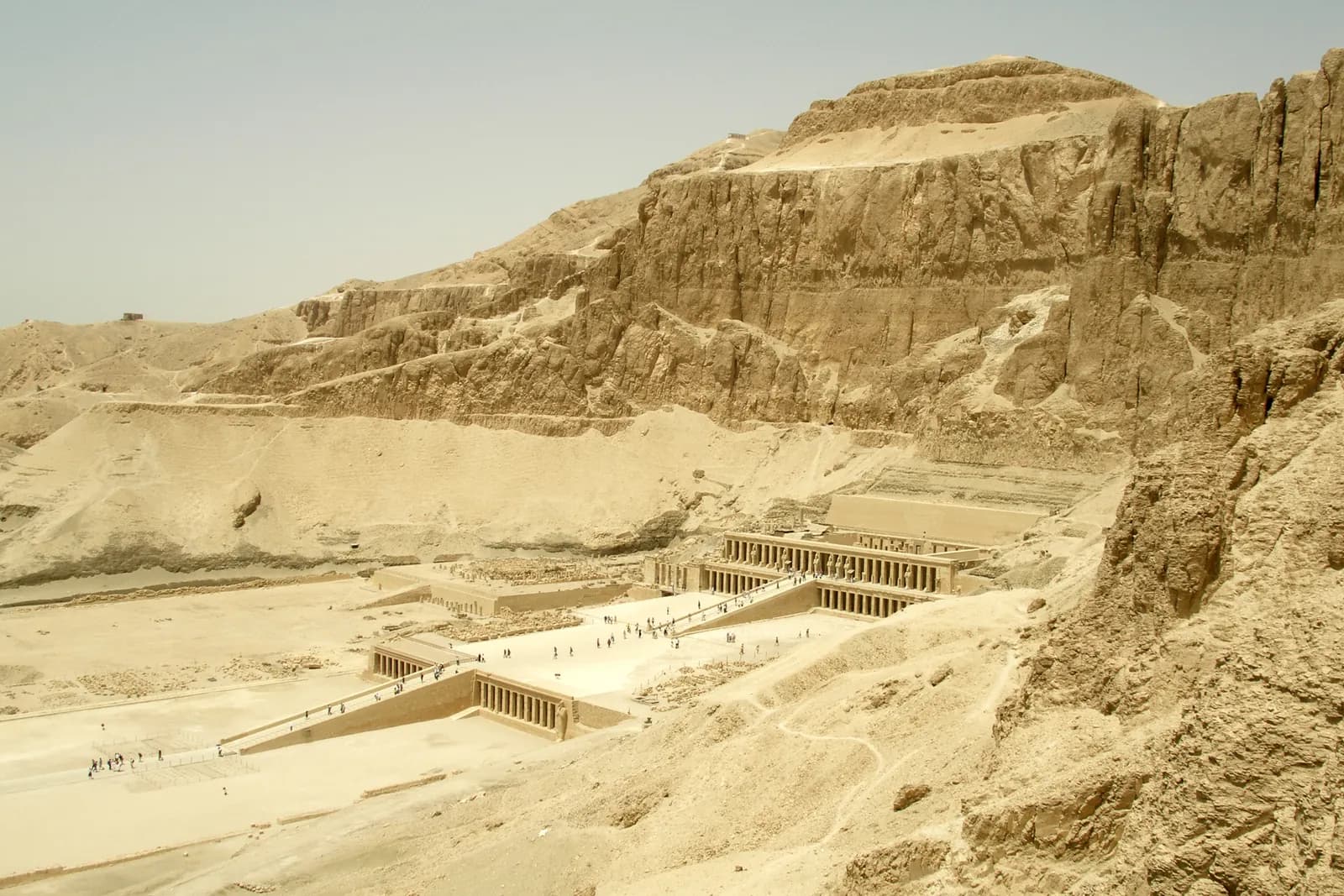
Irregular, spiralling and steeply cut, driven through poor rock. The tomb associated with Hatshepsut runs over two hundred metres into the cliff towards her mortuary temple on the other side.
Finds and where they went
Almost nothing recovered from these sites is still on them. Where an object has a full provenance record on this platform, it is linked.
- Evidence level: Documented
The Tutankhamun assemblage
Some five thousand objects: nested shrines and coffins, the gold mask, chariots, beds, weapons, clothing, food, and a folding camp bed. The only royal burial to survive substantially intact, and therefore the only measure of what the robbed tombs contained.
Grand Egyptian Museum, Giza
- Evidence level: Documented
The royal mummies
From the two caches: Seti I, Ramesses II, Thutmose III and many others, with the priests' docket labels recording when and by whom each was rewrapped and moved.
National Museum of Egyptian Civilization, Cairo
- Evidence level: Documented
The tomb robbery papyri
Twentieth Dynasty records of investigations into thefts from the royal necropolis: inspections, denunciations, confessions extracted under beating, and lists of what was taken and melted down. Egyptian criminal procedure, documented from inside.
- Evidence level: Documented
Seti I's alabaster sarcophagus
Translucent calcite, carved inside and out with the Book of Gates, removed by Belzoni and bought by the architect John Soane after the British Museum declined the price.
Sir John Soane's Museum, London
Ancient testimony
What ancient authors say about the place, and how far it can be trusted.
Papyrus Abbott and the tomb robbery papyri
Twentieth Dynasty records of the inspection of the royal tombs, the commission's findings, and the trial of the thieves. Contemporary Egyptian administrative and legal documents about the site itself.
Strabo, Geography 17.1.46
Strabo records about forty tombs of kings cut in the rock above Thebes, worth seeing. Confirmation that a substantial number were open and visited in the first century BCE.
Herodotus, Histories 2.86–89
Herodotus on Egyptian embalming, in three grades by price. The best surviving external description of the practice, and broadly consistent with what the mummies show.
How the site has been interpreted
The valley is usually presented as a story of secrecy defeated by thieves. The documents show something more interesting: an Egyptian state that knew the tombs were being robbed, investigated systematically, prosecuted, and eventually gave up defending the tombs and instead evacuated the bodies. The reburial dockets are administrative records of a controlled retreat.
Tutankhamun's tomb is a poor guide to royal burial and an indispensable one at the same time. He was a minor king who died young and was buried in a small tomb, probably not his own, with equipment partly reused from other burials. If that is the low end of the range, the contents of Seti I's or Ramesses II's tomb are almost unimaginable — and everything about them has to be inferred from robbery inventories.
The curse is a newspaper story. Carnarvon died in Cairo in April 1923 of an infected mosquito bite complicated by pneumonia, and the exclusive Carnarvon had sold to The Times gave every other paper an incentive to run a different angle. There is no curse text in the tomb.
Conservation is now the valley's central problem. Humidity from visitors' breath, carbon dioxide, and salt crystallisation behind the plaster are actively destroying paint that survived three thousand years in sealed darkness. Several tombs are permanently closed, a facsimile of KV62 has been built nearby, and the underlying trade-off between access and survival has no comfortable answer.
Unresolved
Is there another chamber beyond KV62?
A proposal that the north wall of the burial chamber concealed a further room, possibly Nefertiti's, prompted several rounds of radar survey from 2015. Results have been contradictory: some scans indicated a void, later independent surveys did not confirm it. The question has not been resolved and no excavation has been permitted.
Whose body is in KV55?
A damaged coffin and a skeleton from a small tomb near KV62, associated with Amarna-period material. The remains have been identified as Akhenaten, as Smenkhkare, and as an otherwise unattested figure; genetic work published in 2010 identified the individual as the father of Tutankhamun, which most read as Akhenaten but which does not settle the name. Age-at-death estimates from the skeleton conflict with the length of Akhenaten's reign.
How to read the evidence labels
- Evidence level: Documented
- Supported by a named primary text or by excavated material evidence.
- Evidence level: Probable
- Supported by strong inference that most specialists accept.
- Evidence level: Disputed
- Substantial specialist disagreement exists; competing readings are stated.
- Evidence level: Literary
- Belongs to poetic or mythological construction rather than to history.
- Evidence level: Mythological
- Belongs to shared religious or mythic tradition rather than to any single text.
- Evidence level: Unknown
- The available evidence is insufficient to decide.
These labels describe the status of the evidence, not our confidence in a conclusion. A claim marked Literary is not a claim we doubt; it is a claim about what kind of thing a poem is.