Where the site is
A limestone plateau on the west bank, above the floodplain and immediately across the river from the area of Memphis. The plateau supplied most of the core stone; the finer casing limestone came from Tura on the east bank and the granite from Aswan, eight hundred kilometres upstream. A canal system brought both to the foot of the plateau during the inundation.
- Ancient region
- Lower Egypt, the Memphite necropolis
- Modern country
- Egypt
- Position
- 29.979° N, 31.134° E — The Great Pyramid of Khufu
- Given to three decimal places, about a hundred metres. It locates the named feature, not the extent of the site.
What survives
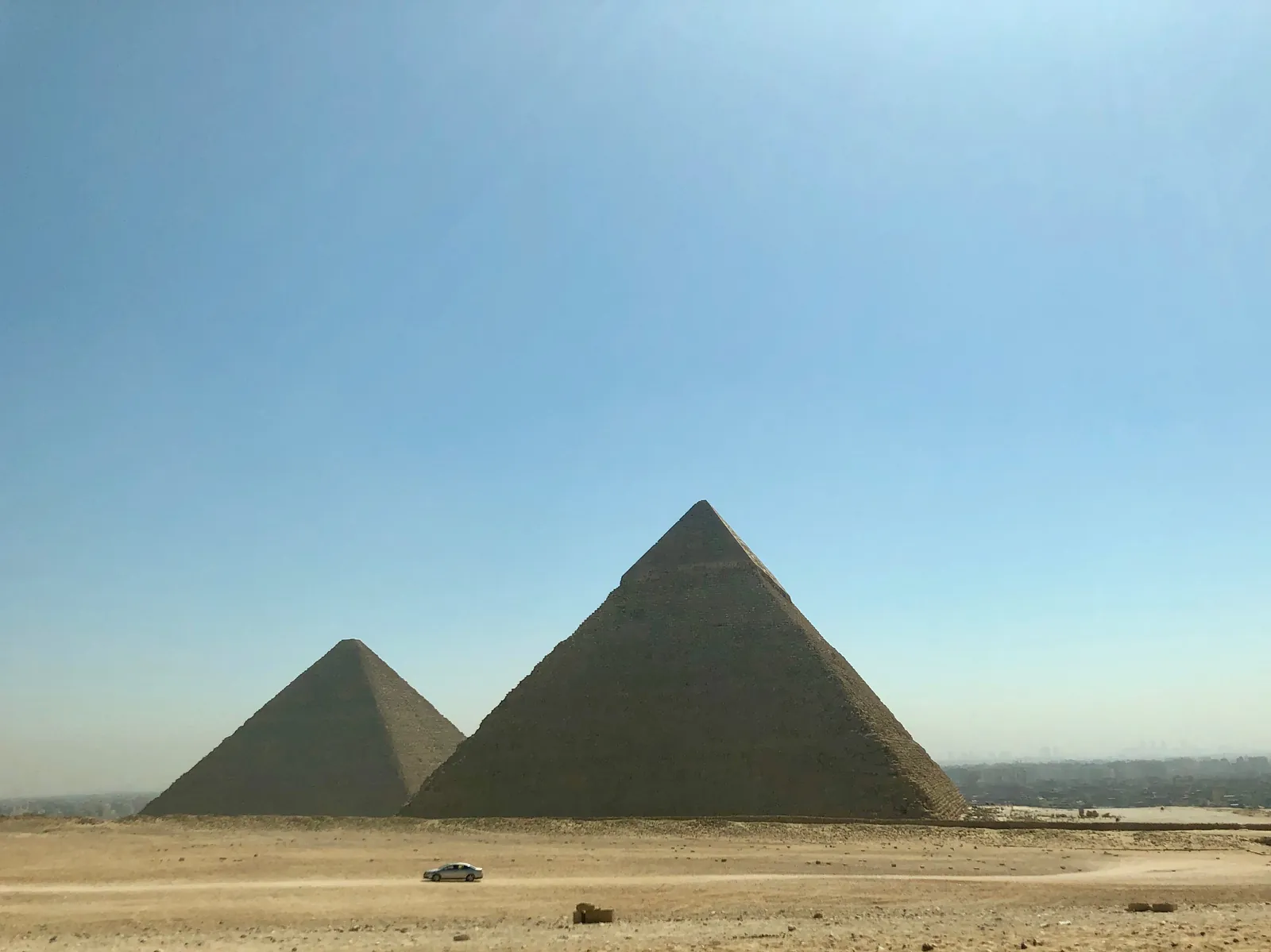
The three pyramids, stripped of most of their casing, with their internal chambers and passages accessible. The Great Pyramid retains its granite burial chamber, the relieving chambers above it and the corbelled Grand Gallery; nothing was found in it and nothing about its interior explains itself.
Around them, an enormous planned cemetery: rows of mastaba tombs laid out on a grid for officials and relatives, the queens' pyramids, causeways, the valley temple of Khafre in granite and alabaster, and boat pits.
South-east of the plateau, on lower ground, is the settlement: bakeries with bread moulds in quantity, a brewery, a building for processing fish, a set of long galleries interpreted as accommodation, and beyond it a cemetery of workers' tombs with small mudbrick superstructures.
Occupation and chronology
Dates below are stored as signed years and rendered with the precision they actually carry. c. 2600 BCE is approximate; the Roman period is approximate.
c. 2600–2500 BCE
The Fourth Dynasty field
Khufu, Khafre and Menkaure build in sequence, with their queens' pyramids, causeways, valley temples, boat pits and the planned mastaba cemeteries of the court laid out around them.
Old Kingdom to Late Period
Continuing use
Burial in the private cemeteries continues long after the royal pyramids stop. The Sphinx acquires a cult, and Thutmose IV of the Eighteenth Dynasty sets up a stela between its paws recording a dream and a clearance of the sand.
Medieval
Quarry
The fine limestone casing was stripped for building in Cairo, which is why the pyramids are stepped rather than smooth. A little survives at the apex of Khafre's.
History of excavation
Who recovered the evidence, when, and by what method. Where an excavation destroyed as much as it found, the entry says so.
- Evidence level: Documented
1837
Howard Vyse and John Perring
Exploration by gunpowder. They blasted into the relieving chambers above the King's Chamber and recorded the quarry marks there, including cartouches of Khufu — the only inscriptions in the pyramid, and painted by the work gangs rather than carved.
- Evidence level: Documented
1880–1882
Flinders Petrie
The survey. Petrie measured the pyramids to a precision nobody had attempted, and his figures — base lengths, angles, the accuracy of the levelling — remain the standard reference. He also demolished the numerological theories he had come to test.
- Evidence level: Documented
1902–1940s
George Reisner, Harvard–Boston expedition, with Hermann Junker and Selim Hassan
Systematic excavation of the mastaba fields under a division of the plateau between three expeditions. Reisner found the burial equipment of Hetepheres, mother of Khufu, in a sealed shaft in 1925.
- Evidence level: Documented
1954
Kamal el-Mallakh
A sealed pit beside the Great Pyramid containing a dismantled cedar boat, over forty metres long, in more than twelve hundred pieces. Reassembled over years by Ahmed Youssef Moustafa.
- Evidence level: Documented
1988–present
Mark Lehner and the Ancient Egypt Research Associates, with Zahi Hawass
The settlement and the workers' cemetery: bakeries, a gallery complex, faunal remains showing large-scale meat supply, and burials of workers whose skeletons show healed fractures and treated injuries. This is the evidence that ended the slave story as a serious position.
- Evidence level: Documented
2013
Pierre Tallet and Gregory Marouard at Wadi al-Jarf
Not at Giza, but decisive for it. Papyri at a Red Sea harbour recorded the daily log of a boat crew under an inspector named Merer, ferrying Tura limestone to the pyramid of Khufu. They are the oldest inscribed papyri known and the only contemporary account of the work.
Principal structures
The evidence level answers how we know what a structure looked like, not whether it existed.
- Evidence level: Documented
c. 2560 BCE
The Great Pyramid of Khufu
Originally about 146 metres high on a base of about 230 metres, built of some two and a quarter million blocks. The base is level to within a few centimetres across thirteen acres, which is the measurement that says most about the surveying.
- Evidence level: Documented
c. 2530 BCE
The Pyramid of Khafre
Slightly smaller and built on higher ground, so it looks larger. Retains its casing at the top, which is the only place a visitor can see what the finished surface was.
- Evidence level: Probable
Fourth Dynasty, probably c. 2500 BCE
The Great Sphinx
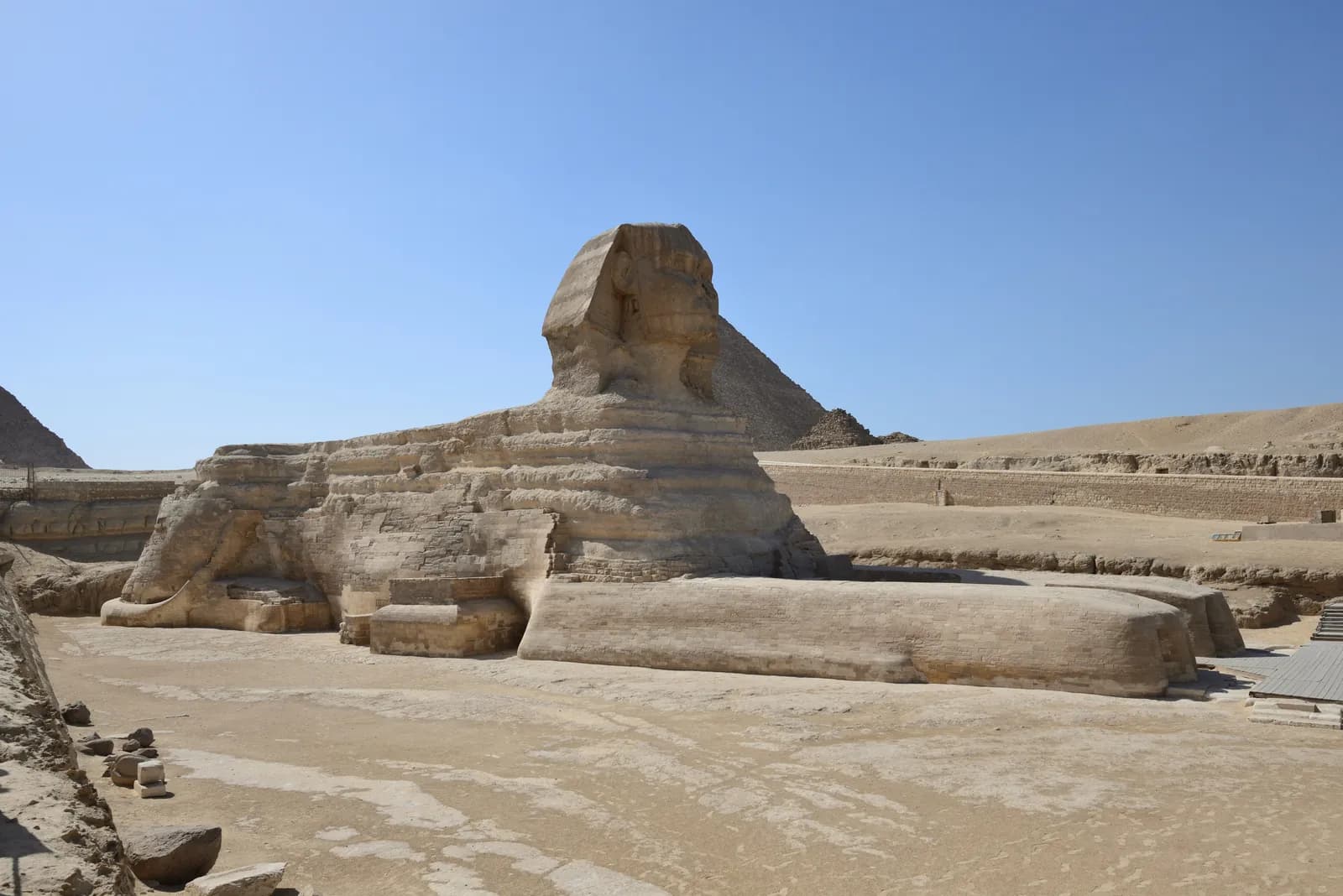
Carved from a single outcrop of bedrock left standing in a quarry. No contemporary inscription names its maker or its subject; the attribution to Khafre rests on its position within his causeway and valley temple complex.
- Evidence level: Documented
c. 2530 BCE
Khafre's valley temple
Massive granite piers and alabaster paving, standing. The plainest and most impressive Old Kingdom building to survive, and the source of the diorite seated statue of Khafre.
- Evidence level: Documented
c. 2550–2490 BCE
The settlement at Heit el-Ghurab
Bakeries, a brewery, galleries interpreted as barracks, and administrative buildings. The bread moulds alone imply catering on an industrial scale.
Finds and where they went
Almost nothing recovered from these sites is still on them. Where an object has a full provenance record on this platform, it is linked.
- Evidence level: Documented
The Merer papyri
The logbook of a boat crew, recording trips carrying limestone from Tura to the Great Pyramid, with dates by cattle count and the names of officials. Contemporary documentary evidence for the construction, found four hundred kilometres away.
Egyptian Museum, Cairo
- Evidence level: Documented
Khufu's ship
A full-size cedar vessel, dismantled and buried in a sealed pit beside the pyramid, its timbers lashed rather than nailed. Reassembled and now moved to the Grand Egyptian Museum.
Grand Egyptian Museum, Giza
- Evidence level: Documented
The seated Khafre
A diorite statue from the valley temple, with a falcon enfolding the king's head from behind. One of the defining objects of Old Kingdom sculpture.
Egyptian Museum, Cairo
- Evidence level: Disputed
The Hetepheres burial equipment
Gilded furniture, a carrying chair and a canopy from a sealed shaft, together with an alabaster sarcophagus that proved to be empty. Whose burial it was and why the body was absent has never been resolved.
Egyptian Museum, Cairo
- Evidence level: Documented
The workers' skeletons
Burials from the workers' cemetery showing heavy physical stress, healed fractures, and at least one amputation that healed — that is, injured workers who were treated and survived. Not a slave population's skeletal profile.
Studied on site
Ancient testimony
What ancient authors say about the place, and how far it can be trusted.
Herodotus, Histories 2.124–135
Herodotus on the building of the pyramids: the hundred thousand men, the twenty years, the ramps, the causeway, and the tale of Cheops as a tyrant. Written two millennia after the event and dependent on informants; the tyrant tradition is Late Period, not Old Kingdom.
Strabo, Geography 17.1.33–34
Strabo's description of the pyramids as they stood under Rome, including a hinged entrance stone. A first-hand traveller's account, and evidence for what was accessible in the first century BCE.
How the site has been interpreted
The most important thing modern excavation has established about Giza is social rather than architectural. A settlement with bakeries and breweries at this scale, cattle and sheep brought in from estates, gallery accommodation, and a cemetery where workers were buried with small tombs and grave goods near their king describes a large organised workforce, provisioned by the state and rotating through service. It does not describe chattel slavery, and the older story descends from Herodotus and from much later religious narrative rather than from any Egyptian evidence.
How the blocks were raised is still unknown, and it is worth saying so plainly. Straight ramps, spiral ramps, internal ramps and lever systems have all been proposed; each has a serious objection, usually to do with the volume of ramp material required or the geometry at height. No ramp has been excavated at Giza in a state that settles it. The Egyptians did not describe the method and no depiction survives.
What is documented is the logistics. The Merer papyri show boats, crews, inspectors, a canal system reaching the plateau, and delivery scheduled by administrative date. The organisational achievement is at least as remarkable as the engineering one, and it is much better evidenced.
Herodotus is the source of almost everything popularly believed about the pyramids and he is a poor one for this purpose. He visited some two thousand years after they were built, was dependent on interpreters and priests, and reports a Khufu remembered as an impious tyrant — a Late Period folk tradition, not a Fourth Dynasty record. His hundred thousand men in three-month shifts is a figure of that kind.
Unresolved
Who made the Sphinx, and when?
The standard attribution to Khafre rests on context: the Sphinx sits in his quarry, beside his causeway, in front of his valley temple. No inscription of the Fourth Dynasty names it. A proposal that water erosion on the enclosure walls requires a date thousands of years earlier has been advanced since the 1990s and is not accepted by Egyptologists or by most geologists who have examined it: the weathering is explicable by the properties of the soft bedrock layers and by long burial in damp sand, and a date in the fifth millennium BCE would require a monumental sculpture from a society with no other monumental anything.
What are the shafts in the Great Pyramid for?
Narrow shafts run from the King's and Queen's chambers towards the exterior. Ventilation, a stellar alignment for the king's ascent, and a structural or symbolic function have all been argued, and robotic exploration has found blocking stones with copper fittings and, beyond them, further blockings. Their purpose remains undetermined.
How to read the evidence labels
- Evidence level: Documented
- Supported by a named primary text or by excavated material evidence.
- Evidence level: Probable
- Supported by strong inference that most specialists accept.
- Evidence level: Disputed
- Substantial specialist disagreement exists; competing readings are stated.
- Evidence level: Literary
- Belongs to poetic or mythological construction rather than to history.
- Evidence level: Mythological
- Belongs to shared religious or mythic tradition rather than to any single text.
- Evidence level: Unknown
- The available evidence is insufficient to decide.
These labels describe the status of the evidence, not our confidence in a conclusion. A claim marked Literary is not a claim we doubt; it is a claim about what kind of thing a poem is.