The site and its setting
Delphi occupies a terrace on the steep southern slope of Parnassus, above a ravine, with the Phaedriades cliffs behind it and the Corinthian Gulf visible far below. The setting does a great deal of the work: the site is theatrical before anything is built on it.
The Castalian spring, where consultants purified themselves, runs from a cleft between the cliffs.
Foundation
Apollo killed the serpent Python at the site and took possession of the oracle; Zeus fixed the spot as the centre of the earth by releasing two eagles from opposite ends of the world.
The omphalos stone shown at the sanctuary marked the claim to be the centre of the earth. The archaeological sequence begins with Mycenaean material and a cult from around the eighth century BCE.
History of the settlement
The sanctuary's international standing was established through the archaic period, and by the sixth century BCE it was consulted by states across the Greek world and beyond it — Croesus of Lydia is the famous non-Greek enquirer, and Herodotus makes his consultation a set piece about the ambiguity of oracles.
Delphi was administered by the Amphictyonic League, a religious association of states, and control of it was worth fighting for: several Sacred Wars were fought over the sanctuary, and Philip II's involvement in the last of them was his route into central Greek politics.
The oracle declined under Rome, was plundered by Nero and by Sulla, and was closed with the other pagan sanctuaries at the end of the fourth century CE.
Urban plan
The sanctuary is organised around the Sacred Way, a zigzag path climbing the terrace to the Temple of Apollo. Along it stood the treasuries — small temple-like buildings in which individual states housed their dedications.
The treasuries were competitive architecture. Athens built one in marble after Marathon; Siphnos built one of extraordinary richness from the proceeds of its mines; the arrangement is a diplomatic map in stone, and the Athenian treasury has been substantially re-erected.
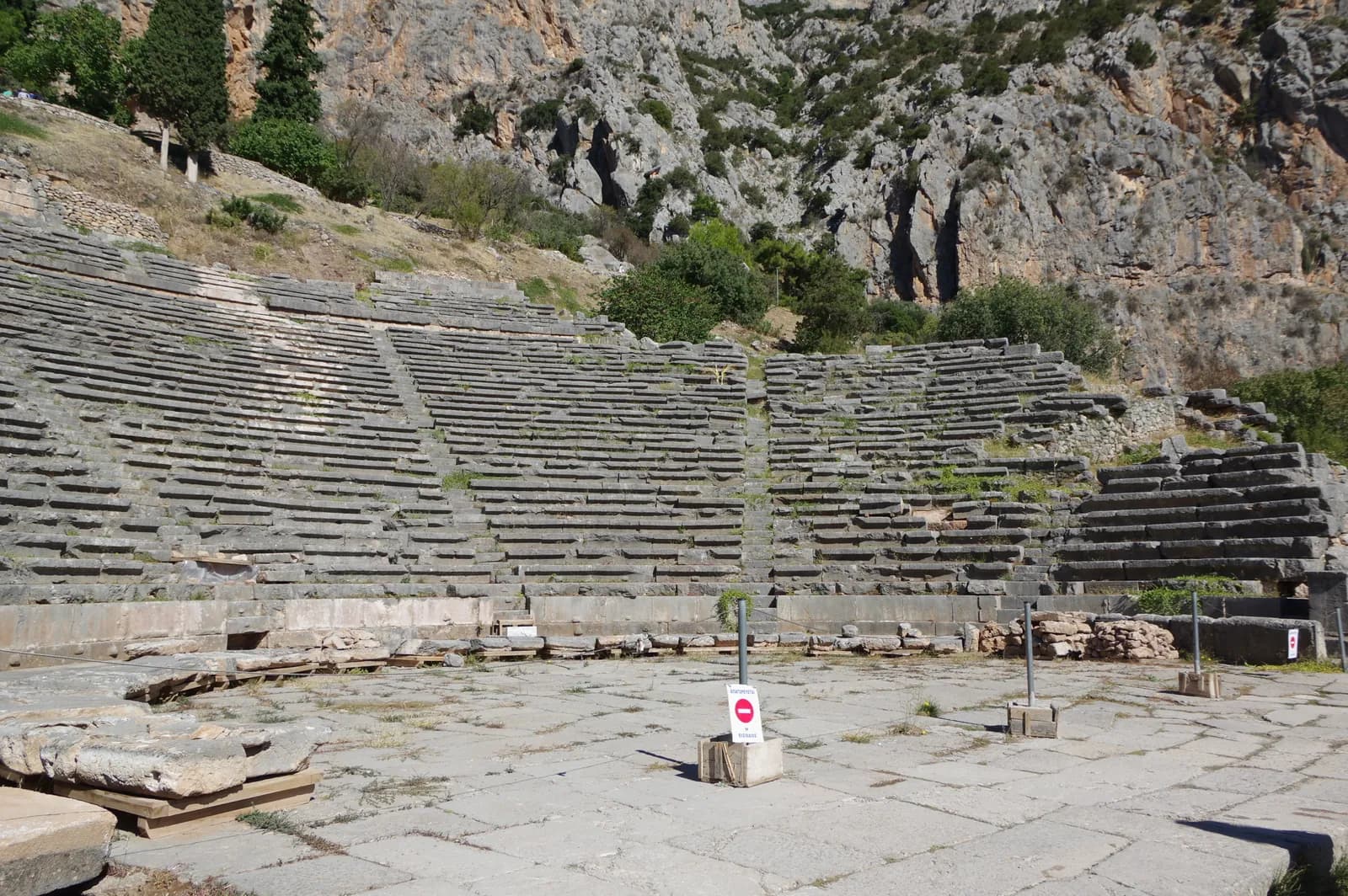
Above the temple stand the theatre and, higher still, the stadium where the Pythian Games were held.
Economy and supply
Delphi lived on the oracle. Consultation required a fee and a preliminary sacrifice, and states and individuals made dedications that accumulated into a treasury of extraordinary value — which is why the sanctuary was repeatedly plundered.
The Pythian Games, held every four years, brought further traffic. The sanctuary also functioned as a kind of bank and archive for the Greek world, holding deposits and records.
Cult and sanctuaries
The Pythia, a local woman, delivered the responses from within the temple. Ancient descriptions have her seated on a tripod; the mechanics of what she did and how her utterances were rendered into the hexameter responses that were recorded are not clearly attested.
Consultation was highly regulated: purification at Castalia, a preliminary sacrifice whose acceptance had to be signalled by the victim's reaction, a fixed number of consultation days, and an order of precedence that states negotiated over.
Apollo was believed to be absent in winter, when Dionysus held the sanctuary. The pairing of the two gods at the most orderly oracle in Greece is a genuine feature of the cult and not a modern literary idea.
The city at war
Delphi was not a military site, but it was a strategic asset. Control of the Amphictyonic council carried political weight across central Greece, and the Sacred Wars were fought over it.
Its wealth also made it a target: the sanctuary was plundered by the Phocians in the fourth century BCE to pay mercenaries, an act that shocked the Greek world and triggered the war that brought Philip south.
Population
Ancient population figures are quoted with a confidence the evidence never supported. Each estimate below carries what it rests on and what it is worth.
Resident population of the sanctuary settlement
Small; no figure survives
No ancient count
Delphi was a sanctuary with a service community attached, not a city with a citizen body of significant size. Its importance is entirely disproportionate to the number of people who lived there.
Monuments
- Evidence level: Documented
The visible remains are of the 4th century BCE, replacing a 6th-century temple
Temple of Apollo
The maxims 'know thyself' and 'nothing in excess' were reported by ancient authors to have been inscribed at the temple.
- Evidence level: Documented
Early 5th century BCE
The Athenian Treasury
Re-erected in the early twentieth century. Pausanias reports it was built from the spoils of Marathon; the dating is argued and some scholars place it slightly earlier.
- Evidence level: Documented
c. 525 BCE
The Siphnian Treasury
Its frieze, including a gigantomachy, is among the finest archaic sculpture surviving, and is in the site museum.
- Evidence level: Documented
4th century BCE and later
The theatre and the stadium
The stadium, high above the sanctuary, is among the best preserved in Greece.
Archaeology and excavation
The French School at Athens conducted the Grande Fouille from 1892, which required the relocation of the village of Kastri that stood on top of the sanctuary — an operation that would be handled very differently today, and which is part of the site's own modern history.
Delphi's inscriptions are among its most valuable products: manumission records, accounts, and the Amphictyonic decrees give a documentary record of the sanctuary's administration alongside the monuments.
Museum collections
Where the finds are now. Where a holding is contested, the entry says so.
Delphi Archaeological Museum · Delphi, Greece
The Charioteer of Delphi, a bronze of about 470 BCE surviving from a larger group; the Siphnian Treasury frieze; the Naxian Sphinx; the omphalos; and the Delphic hymns to Apollo, inscribed with musical notation.
Open questions
Were the Pythia's utterances induced by gases from the ground?
Ancient authors including Plutarch, himself a priest at Delphi, describe a pneuma or vapour. A geological study published in 2001 identified faults beneath the temple and proposed ethylene as an intoxicant. The proposal attracted wide publicity and substantial criticism, on the grounds of the concentrations required and the reliability of the sampling. It is not established.
How were the responses actually produced?
Whether the Pythia spoke intelligibly and priests versified her answers, or whether she delivered hexameters directly, is not settled by the sources, which differ and are mostly late. The recorded responses are also a heavily filtered sample: ambiguous ones were more memorable and more likely to be transmitted.
Primary sources
Pausanias, Description of Greece 10.5-32
The fullest ancient description of the sanctuary and its dedications, monument by monument.
Herodotus, Histories 1.46-55, 7.140-143
Croesus's test of the oracles, and the 'wooden wall' response to Athens before Salamis.
Plutarch, On the Obsolescence of Oracles
By a priest at Delphi, discussing the decline of the oracle and the nature of the pneuma.
How to read the evidence labels
- Evidence level: Documented
- Supported by a named primary text or by excavated material evidence.
- Evidence level: Probable
- Supported by strong inference that most specialists accept.
- Evidence level: Disputed
- Substantial specialist disagreement exists; competing readings are stated.
- Evidence level: Literary
- Belongs to poetic or mythological construction rather than to history.
- Evidence level: Mythological
- Belongs to shared religious or mythic tradition rather than to any single text.
- Evidence level: Unknown
- The available evidence is insufficient to decide.
These labels describe the status of the evidence, not our confidence in a conclusion. A claim marked Literary is not a claim we doubt; it is a claim about what kind of thing a poem is.