The site and its setting
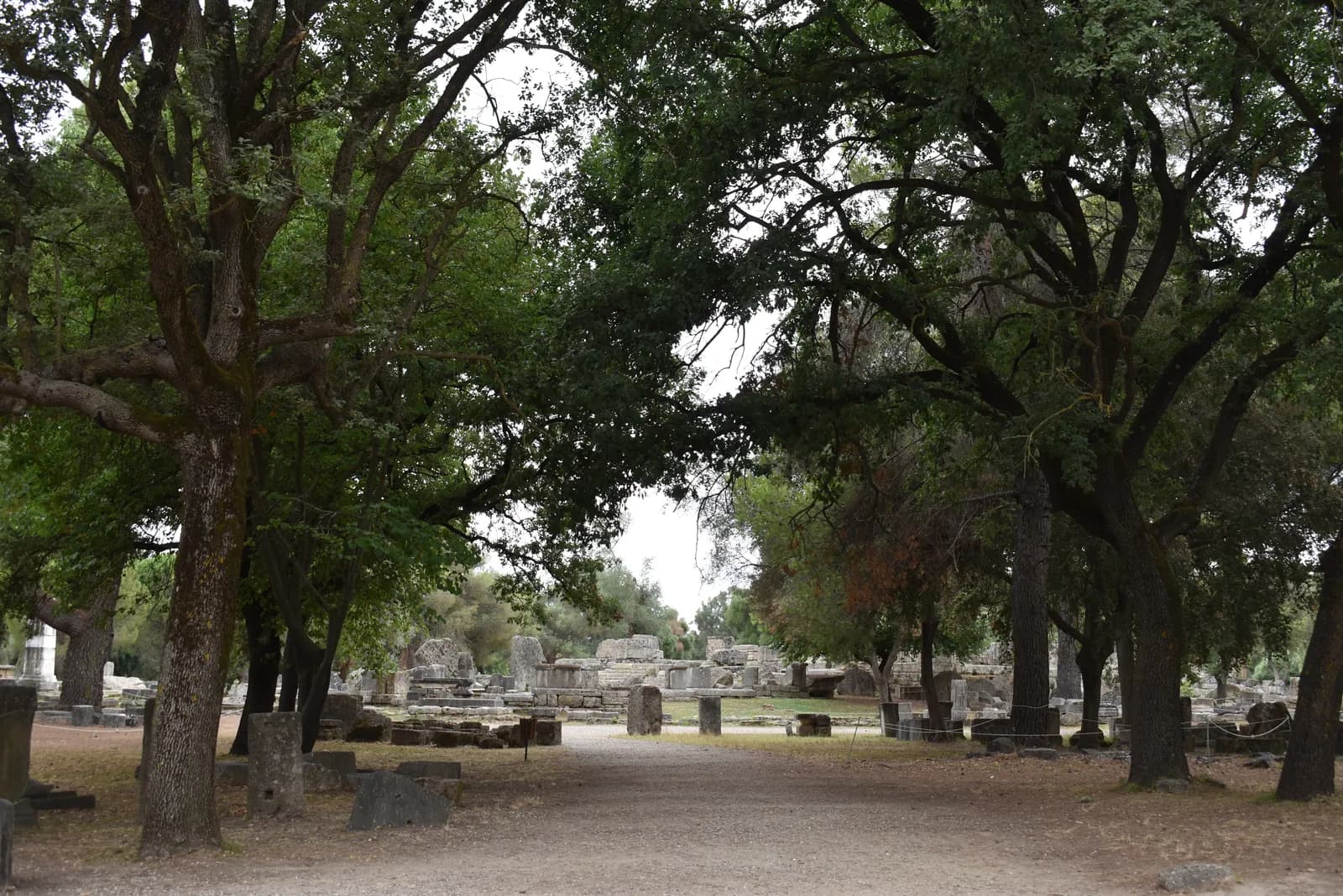
Olympia lies in a quiet valley at the confluence of the Alpheios and the Kladeos, in Elis, well away from any major city. That remoteness is part of its function: it was neutral ground.
The sacred precinct, the Altis, is a walled grove rather than an urban centre, with the administrative and athletic buildings arranged around it.
Foundation
The games were founded by Heracles, or by Pelops after his chariot victory over Oenomaus.
Competing foundation stories, both belonging to the tradition. The conventional date of 776 BCE for the first games is a later Greek calculation from victor lists, not a contemporary record, and should not be treated as a fixed point.
History of the settlement
Cult activity at the site begins around the end of the second millennium BCE, with very large numbers of bronze votive tripods and figurines from the Geometric period — the earliest evidence for the sanctuary's panhellenic reach.
The games structured Greek time. Dating by Olympiads, four-year cycles counted from the traditional first games, was the nearest thing the Greek world had to a common chronology, and a sacred truce protected travel to the festival.
The sanctuary was enriched continuously by states and individuals until the Roman period, plundered progressively in late antiquity, and closed with the other pagan sanctuaries at the end of the fourth century CE. Earthquake and the shifting rivers then buried it, which is why so much survived to be excavated.
Urban plan
The Altis contains the Temple of Zeus at its centre, the older Temple of Hera to the north, the Pelopion, treasuries built by individual states along a terrace, and the Philippeion, a round building begun by Philip II after Chaeronea.
Outside the sacred enclosure lie the practical buildings: the palaestra and gymnasium for training, the Leonidaion guest house, the bouleuterion where competitors swore their oath, and the workshop of Phidias, built to the internal dimensions of the temple cella so that the statue could be assembled and tested at full size.
The stadium lies east of the Altis, entered through a vaulted passage, with earth banks for spectators and no seating — some forty-five thousand people stood.
Economy and supply
Olympia had no economy of its own beyond the festival. Its wealth was dedications: bronzes, statues, arms taken as spoils and inscribed with the name of the defeated, and the treasuries in which states housed their gifts.
The inscribed spoils are historically valuable in a way the dedicators did not intend. Helmets and shields dedicated after victories carry the names of the states involved, and one Corinthian helmet from the site is inscribed as taken from the Argives.
Cult and sanctuaries
The great altar of Zeus was built up over centuries from the ash of sacrifices. Pausanias describes it and gives its dimensions.
The Temple of Zeus, built by Libon of Elis around 470–456 BCE, housed Phidias's chryselephantine seated Zeus, counted among the Seven Wonders. The statue is lost; nothing survives of it beyond descriptions and representations on coins.
The Heraion is the older temple, and its columns were replaced in stone piecemeal over centuries as the original wooden ones decayed — Pausanias records that one oak column still stood in his day, which excavation has borne out as a plausible description of the building's history.
The city at war
Olympia was neutral ground protected by a sacred truce, but it was thoroughly implicated in Greek warfare. The dedications are largely military spoils, and the sanctuary is the single richest source of Greek arms and armour.
Philip II's Philippeion, a round monument housing gold and ivory statues of his family, was built after Chaeronea and placed inside the Altis. Putting a dynastic monument in the panhellenic sanctuary was a political statement everyone understood.
Population
Ancient population figures are quoted with a confidence the evidence never supported. Each estimate below carries what it rests on and what it is worth.
Permanent residents
Very small; no figure survives
No ancient count
A sanctuary staff and service community. The festival crowd was many times the resident population and is itself estimated only from the capacity of the stadium banks.
Spectators at the games
Commonly given as about 45,000
Modern estimate from the dimensions of the stadium embankments
An engineering estimate from the standing area rather than an ancient statement. It gives an order of magnitude and no more.
Monuments
- Evidence level: Documented
c. 470–456 BCE, by Libon of Elis
Temple of Zeus
Its pedimental sculpture and the metopes of the labours of Heracles survive substantially and are in the site museum. The columns lie where earthquake dropped them.
- Evidence level: Documented
c. 600 BCE
The Heraion
One of the earliest monumental temples in Greece, and a record in stone of the gradual replacement of wooden columns.
- Evidence level: Documented
Mid-5th century BCE
The workshop of Phidias
Identified by excavation, with tools, ivory and moulds, and a black-glaze cup inscribed 'I belong to Phidias' — one of the most direct connections between a named ancient artist and a building that survives.
- Evidence level: Documented
Begun after 338 BCE
The Philippeion
A circular monument to Philip II's family, placed inside the sacred precinct.
- Evidence level: Documented
Successive phases; the surviving form is 5th–4th century BCE
The stadium
A running track with stone start and finish sills still in place, entered by a vaulted tunnel.
Archaeology and excavation
Excavated by the German Archaeological Institute from 1875 in one of the first excavations conducted under a formal agreement leaving the finds in the host country — a precedent in the history of the discipline. Work has continued in campaigns ever since.
The site's burial under river silt and earthquake debris preserved an unusual amount, including the temple sculpture and the workshop deposit. Olympia is the principal source of Greek bronze arms and armour, most of it dedicated as spoils and much of it inscribed.
Museum collections
Where the finds are now. Where a holding is contested, the entry says so.
Archaeological Museum of Olympia · Archaia Olympia, Greece
The pediments and metopes of the Temple of Zeus; the Hermes attributed to Praxiteles; the Nike of Paionios; the helmet inscribed as dedicated by Miltiades; and the cup of Phidias.
The attribution of the Hermes to Praxiteles rests on a passage in Pausanias and is argued; the statue may be a later copy.
Museum of the History of the Olympic Games in Antiquity · Archaia Olympia, Greece
Material relating to the games, victors and athletic practice.
Open questions
Is the date 776 BCE for the first games reliable?
It is a Hellenistic back-calculation from victor lists compiled long after the fact, not a contemporary record. Archaeological activity at the site begins earlier than that date and does not mark it. It should be treated as a traditional date, not an established one.
Is the Hermes of Olympia by Praxiteles?
Pausanias saw a Hermes by Praxiteles in the Heraion, and a Hermes was found there. Whether the surviving statue is the fourth-century original or a Hellenistic or Roman copy has been argued since its discovery on technical grounds. Unresolved.
Primary sources
Pausanias, Description of Greece 5-6
Two entire books on Olympia, the fullest ancient description of any Greek sanctuary, listing monuments and victors.
Herodotus, Histories
References to the games as a panhellenic institution and to the Olympiad dating system.
How to read the evidence labels
- Evidence level: Documented
- Supported by a named primary text or by excavated material evidence.
- Evidence level: Probable
- Supported by strong inference that most specialists accept.
- Evidence level: Disputed
- Substantial specialist disagreement exists; competing readings are stated.
- Evidence level: Literary
- Belongs to poetic or mythological construction rather than to history.
- Evidence level: Mythological
- Belongs to shared religious or mythic tradition rather than to any single text.
- Evidence level: Unknown
- The available evidence is insufficient to decide.
These labels describe the status of the evidence, not our confidence in a conclusion. A claim marked Literary is not a claim we doubt; it is a claim about what kind of thing a poem is.