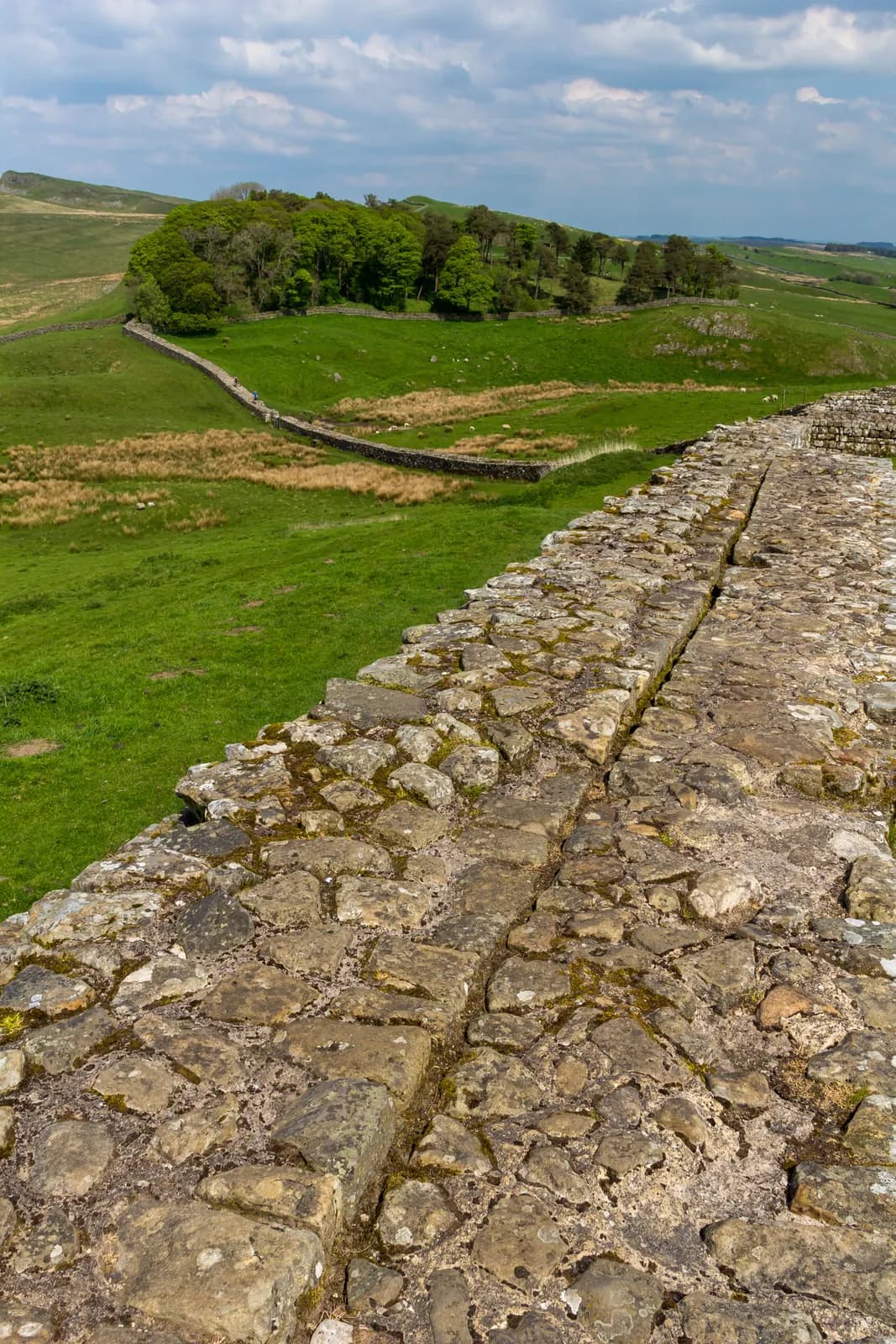
A Roman army on campaign built a fortified camp every night: a ditch, a rampart of the upcast earth topped with stakes, and a laid-out interior with fixed positions for each unit and for the commander. Polybius describes the plan in detail, and the point of the standardisation was that every soldier knew where everything was in an unfamiliar place in the dark.
The tactical consequence is large. An army that fortifies nightly cannot easily be attacked at rest, can refuse battle indefinitely, and can use its camp as a base for operations from a position of security. Much Roman campaigning consists of manoeuvring between fortified positions rather than seeking battle.
Marching camps were temporary and are visible archaeologically as cropmarks; permanent fortresses developed the same plan in stone and became the nuclei of cities. The continuity from the temporary plan to the permanent fortress to the town is a standard feature of Roman provincial urbanism.
What the evidence supports
The camp plan was standardised and is described in detail.
Polybius gives dimensions and unit positions; the later treatise on camp construction attributed to Hyginus gives another version.
Marching camps survive in large numbers.
Aerial survey has identified hundreds across Britain and elsewhere, recognisable by their characteristic gate defences.
How closely real camps followed the textbook plan is a question.
Polybius and Pseudo-Hyginus give idealised layouts, and excavated camps vary considerably in shape and internal arrangement with terrain and circumstance. The plan is a template, not a specification that was always met.
Permanent fortresses seeded cities.
The development from fortress to civil settlement is well attested at sites including York, Chester and Vienna.
Terms
- castra
- The camp. Castra aestiva are summer campaign camps; castra hiberna winter quarters.
- clavicula / titulum
- Gate defences that force an attacker to expose his unshielded side; the diagnostic feature for identifying camps from the air.
Archaeology
Aerial photography has transformed knowledge of temporary camps, particularly in Britain and Scotland, where the Roman advance can be traced by the camps left behind it.
Primary sources
Polybius, Histories 6.27-42
The classic description of the camp and its layout.
Pseudo-Hyginus, On the Fortification of a Camp
A later technical treatise on camp construction.
Josephus, The Jewish War 3.76-84
An outsider's admiring description of Roman camp discipline.
Battles
9 CE
The Teutoburg Forest
Three legions were destroyed in a running ambush over several days, and the Roman frontier settled on the Rhine rather than the Elbe.
52 BCE
Alesia
Caesar besieged Vercingetarix inside a hilltop stronghold while simultaneously defending his own siege lines against a relief army, and ended organised Gallic resistance.
How to read the evidence labels
- Evidence level: Documented
- Supported by a named primary text or by excavated material evidence.
- Evidence level: Probable
- Supported by strong inference that most specialists accept.
- Evidence level: Disputed
- Substantial specialist disagreement exists; competing readings are stated.
- Evidence level: Literary
- Belongs to poetic or mythological construction rather than to history.
- Evidence level: Mythological
- Belongs to shared religious or mythic tradition rather than to any single text.
- Evidence level: Unknown
- The available evidence is insufficient to decide.
These labels describe the status of the evidence, not our confidence in a conclusion. A claim marked Literary is not a claim we doubt; it is a claim about what kind of thing a poem is.