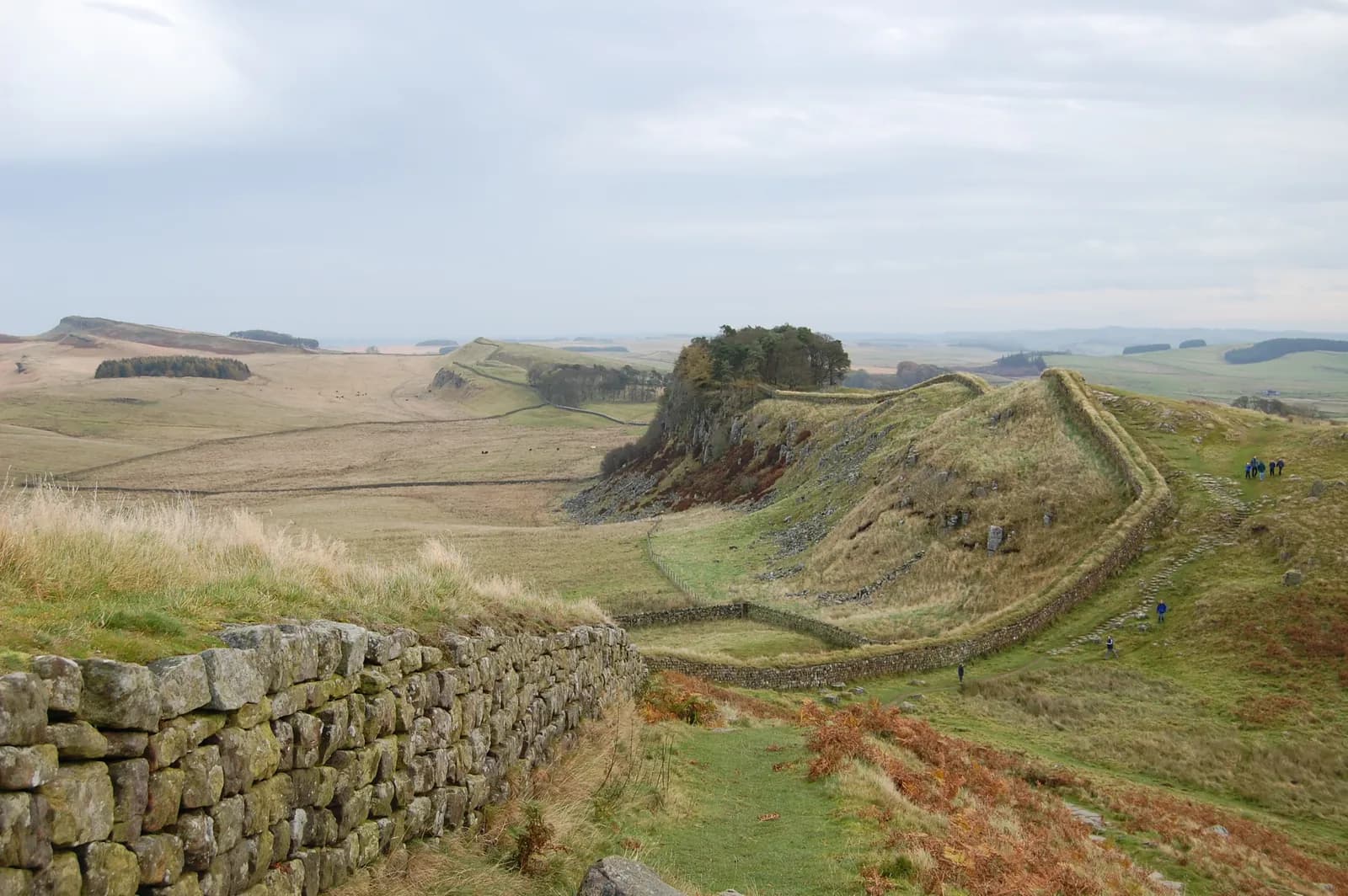
Fortification is the ancient world's largest category of construction by volume. The Mycenaean citadels used blocks so large that later Greeks attributed them to the Cyclopes. Classical Greek cities built circuits enclosing acropolis and town, and Athens built the Long Walls to tie the city to its port and make it unsiegeable by land.
The Hellenistic period changed the design problem. Once torsion artillery could break masonry, walls grew thicker, towers were built to mount defensive engines, and outworks pushed attackers further back — an arms race visible in the fortifications of the successor kingdoms.
Roman frontier works are a different category again: not defences against armies but controlled boundaries, regulating movement and taxing it. Hadrian's Wall with its milecastles and gates functions as a permeable barrier with customs points, and reading it as a defensive line against invasion misdescribes what it was for.
What the evidence supports
The Long Walls made Athens a maritime fortress.
Attested in Thucydides and traceable on the ground; the strategy of abandoning Attica and holding the city depended on them.
Hellenistic wall design responds to artillery.
Thicker curtains, projecting artillery towers and outworks appear as torsion engines become effective. The correlation is clear; the causal reading is an inference.
Roman frontier works controlled movement rather than repelling armies.
The density of gates on Hadrian's Wall is difficult to reconcile with a purely defensive purpose, and the current mainstream reading emphasises regulation and taxation.
Archaeology
Hadrian's Wall, the Antonine Wall, the German limes, the walls of Messene and the Egyptian Nubian fortresses are all extensively excavated and standing in part. Fortification is the best-preserved category of ancient military architecture.
Primary sources
Thucydides, History of the Peloponnesian War 1.89-93, 2.13
The building of the Athenian walls and the strategy that depended on them.
Aeneas Tacticus, On the Defence of Fortified Positions
A practical manual for defending a city.
Vitruvius, On Architecture 1.5
On the design of walls and towers.
Battles
52 BCE
Alesia
Caesar besieged Vercingetarix inside a hilltop stronghold while simultaneously defending his own siege lines against a relief army, and ended organised Gallic resistance.
480 BCE
Thermopylae
A Greek force held a coastal pass in central Greece for three days against the army of Xerxes, and was destroyed when the position was turned by a mountain path.
How to read the evidence labels
- Evidence level: Documented
- Supported by a named primary text or by excavated material evidence.
- Evidence level: Probable
- Supported by strong inference that most specialists accept.
- Evidence level: Disputed
- Substantial specialist disagreement exists; competing readings are stated.
- Evidence level: Literary
- Belongs to poetic or mythological construction rather than to history.
- Evidence level: Mythological
- Belongs to shared religious or mythic tradition rather than to any single text.
- Evidence level: Unknown
- The available evidence is insufficient to decide.
These labels describe the status of the evidence, not our confidence in a conclusion. A claim marked Literary is not a claim we doubt; it is a claim about what kind of thing a poem is.