Where the site is
The south coast of Thera, on what was then a single roughly circular island with a natural harbour. The eruption removed the centre of the island and left the crescent of cliffs standing today. Position on the sea route between Crete, the Cyclades and the Anatolian coast is the reason a town of this quality existed on a small island.
- Ancient region
- Thera, the Cyclades
- Modern country
- Greece
- Position
- 36.351° N, 25.404° E — The excavation shelter over the town
- Given to three decimal places, about a hundred metres. It locates the named feature, not the extent of the site.
What survives
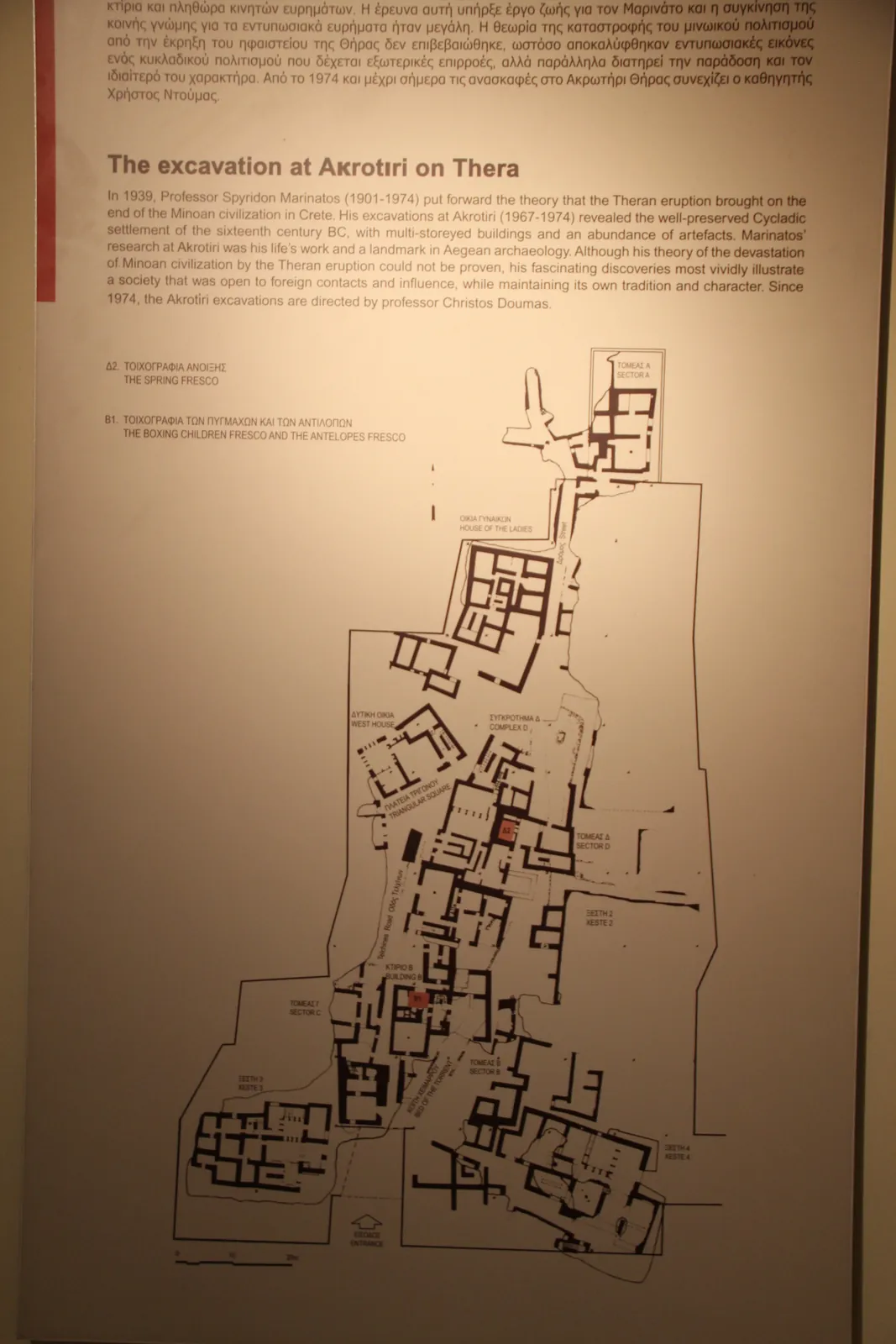
Streets, squares and houses standing to two and in places three storeys, under a modern roof. Because the burial medium was pumice and ash rather than the hot pyroclastic surges that hit Herculaneum, the walls were supported rather than sheared, and the town stands more or less as it was left.
Wooden elements did not survive as wood, but they left voids in the ash which have been filled with plaster to recover beds, tables, doors and window frames — the same technique Giuseppe Fiorelli developed for the bodies at Pompeii, used here on furniture.
What is conspicuously absent is people. No bodies have been found, and very little of value: no hoards, no jewellery caches, no abandoned tools of the kind a sudden catastrophe leaves. The town was emptied deliberately.
Occupation and chronology
Dates below are stored as signed years and rendered with the precision they actually carry. c. 4000 BCE is approximate; c. 1600 BCE is disputed.
c. 4000–2000 BCE
Early settlement
Late Neolithic and Early Bronze Age occupation under the town, known from soundings rather than from open excavation.
c. 1800–1600 BCE
The town
A substantial place with multi-storey houses, drainage, imported goods and wall painting of a quality found nowhere else in the Aegean at this scale.
shortly before the destruction
Earthquake, then eruption
The town was damaged by earthquake, cleared and partly repaired, and then abandoned before the eruption buried it. The sequence is legible in the deposits themselves.
History of excavation
Who recovered the evidence, when, and by what method. Where an excavation destroyed as much as it found, the entry says so.
- Evidence level: Documented
1867
Quarry workers and, briefly, Ferdinand Fouqué
Pumice quarried on Thera for the Suez Canal works exposed prehistoric walls. Fouqué, a geologist, recorded and published what was visible and understood that the buildings predated the eruption.
- Evidence level: Documented
1967–1974
Spyridon Marinatos, Greek Archaeological Service
The excavation that opened the town. Marinatos died at the site in 1974 and is buried there. He had argued since 1939 that the Theran eruption destroyed Minoan Crete — a hypothesis this excavation was designed to test, and which the chronology has not sustained.
- Evidence level: Documented
1974–present
Christos Doumas and the Archaeological Society at Athens
Continued excavation, conservation and publication, with a deliberate policy of leaving most of the town unexcavated. Only a small part of the estimated extent is open, and the estimate of the whole is itself derived from survey rather than from exposure.
Principal structures
The evidence level answers how we know what a structure looked like, not whether it existed.
- Evidence level: Documented
c. 1650 BCE
The West House
A well-preserved house of two or three storeys whose upper room carried the miniature frieze. Standing to its second floor.
- Evidence level: Documented
c. 1650 BCE
Xeste 3
A large ashlar-fronted building with a lustral basin and an extensive fresco programme, generally read as having a ceremonial function. The reading rests on the architecture and the paintings, not on any text.
- Evidence level: Documented
c. 1700–1600 BCE
The drainage system
Clay pipes running under the streets, serving upper-floor facilities in individual houses. Not exceptional in the Aegean Bronze Age, but rarely preserved this completely.
Finds and where they went
Almost nothing recovered from these sites is still on them. Where an object has a full provenance record on this platform, it is linked.
- Evidence level: Documented
The miniature frieze
A long narrow painting running around the top of a room in the West House, showing a fleet, a landscape, two towns and men in the water. It is the most detailed picture of Bronze Age Aegean ships and coastal settlement that exists. What it depicts — a festival, an expedition, a specific event — is not established.
- Evidence level: Documented
The Boxing Boys and the Antelopes
Two facing walls of a single room. The boys wear a single glove each; the identification as boxing is by posture, not by any label.
- Evidence level: Documented
The Spring Fresco
Lilies and swallows over a volcanic landscape, painted on three walls of a room and lifted intact. The only Aegean wall painting recovered complete on all the walls of its room and lifted in place.
- Evidence level: Documented
The olive branch from the eruption deposit
A branch buried alive by the tephra, whose rings were radiocarbon-dated in a sequence. It is the single most important object in the dating dispute below.
Sampled and published; not a display object
Ancient testimony
No ancient author describes this town. It was buried some eight hundred years before Greek prose existed and the name Akrotiri is that of the modern village. Plato's Atlantis is not testimony about it, and treating it as such would invert the relationship between evidence and story that this layer exists to keep straight.
How the site has been interpreted
Akrotiri is the best-preserved Bronze Age settlement in the Aegean, and it is preserved precisely because it was empty. The absence of bodies and valuables, combined with the earlier earthquake damage and evidence of repair, indicates an orderly departure after warning — probably weeks or months of precursor activity. Where the people went is unknown, and no destination population has ever been identified.
The material culture is closely related to Crete without being simply Cretan. Weights, script, pottery shapes and fresco conventions are shared; the architecture and some of the iconography are local. Whether Thera was a Cretan dependency, a partner or an independent participant in a shared Aegean system is argued, and the town is the main evidence either way.
Marinatos's original hypothesis — that this eruption destroyed the Cretan palaces — is not sustained. The Cretan destructions are stratigraphically later than the Theran ash on Crete, by enough that a direct causal link fails. The eruption remains an enormous regional event with real consequences for shipping, agriculture and Theran society specifically.
Unresolved
When did the eruption happen?
Radiocarbon determinations, including the olive branch and short-lived samples from the destruction level, cluster in the late seventeenth century BCE, around 1620–1600. Conventional Aegean chronology, built on synchronisms between pottery styles and dated Egyptian material, puts it around 1500. The gap is roughly a century and it will not close by splitting the difference: one of the two dating systems is wrong somewhere. Both camps are active and both have refined their positions; the question is open.
Is Akrotiri the origin of the Atlantis story?
The proposal is modern — it dates from the twentieth century, and Marinatos was among its promoters. Plato places Atlantis beyond the Pillars of Heracles, in the Atlantic, nine thousand years before Solon, and describes a great power defeated by Athens. Thera is in the Aegean, was destroyed around eleven hundred years before Plato wrote, and was a town on a small island. The association is an inference about how a memory might have travelled, not evidence, and the site does not need it.
How to read the evidence labels
- Evidence level: Documented
- Supported by a named primary text or by excavated material evidence.
- Evidence level: Probable
- Supported by strong inference that most specialists accept.
- Evidence level: Disputed
- Substantial specialist disagreement exists; competing readings are stated.
- Evidence level: Literary
- Belongs to poetic or mythological construction rather than to history.
- Evidence level: Mythological
- Belongs to shared religious or mythic tradition rather than to any single text.
- Evidence level: Unknown
- The available evidence is insufficient to decide.
These labels describe the status of the evidence, not our confidence in a conclusion. A claim marked Literary is not a claim we doubt; it is a claim about what kind of thing a poem is.