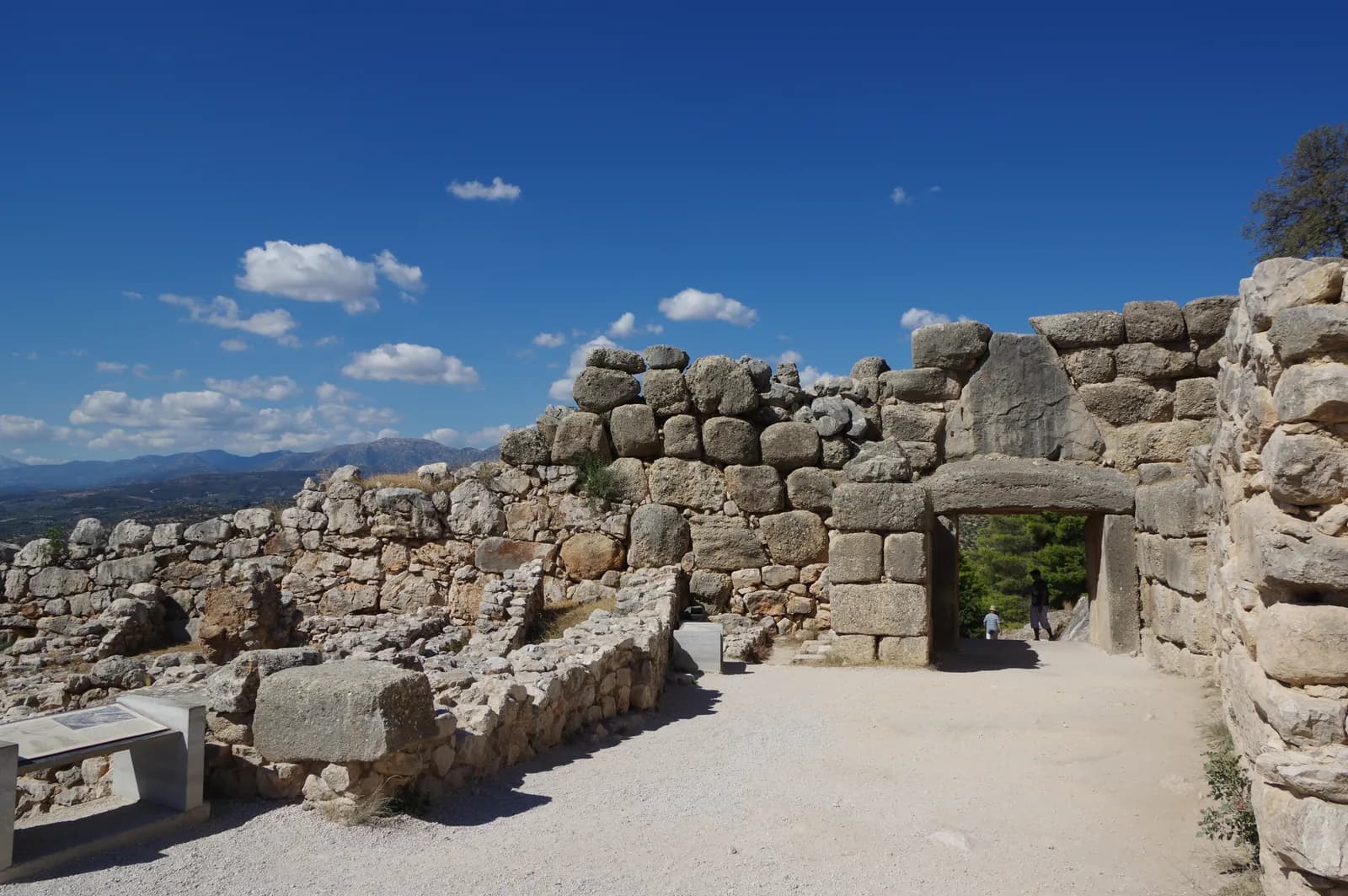
Where the site is
A low, steep-sided ridge wedged between the hills of Profitis Ilias and Sara, at the head of the Argive plain. The position is not defensive theatre: it commands the plain below and the pass north through the mountains towards Corinth and the isthmus, which is the land route between the Peloponnese and central Greece. Water came from a spring outside the walls, reached late in the citadel's life by an underground stair cut through the rock — a siege provision.
- Ancient region
- The Argolid
- Modern country
- Greece
- Position
- 37.731° N, 22.756° E — The Lion Gate
- Given to three decimal places, about a hundred metres. It locates the named feature, not the extent of the site.
What survives
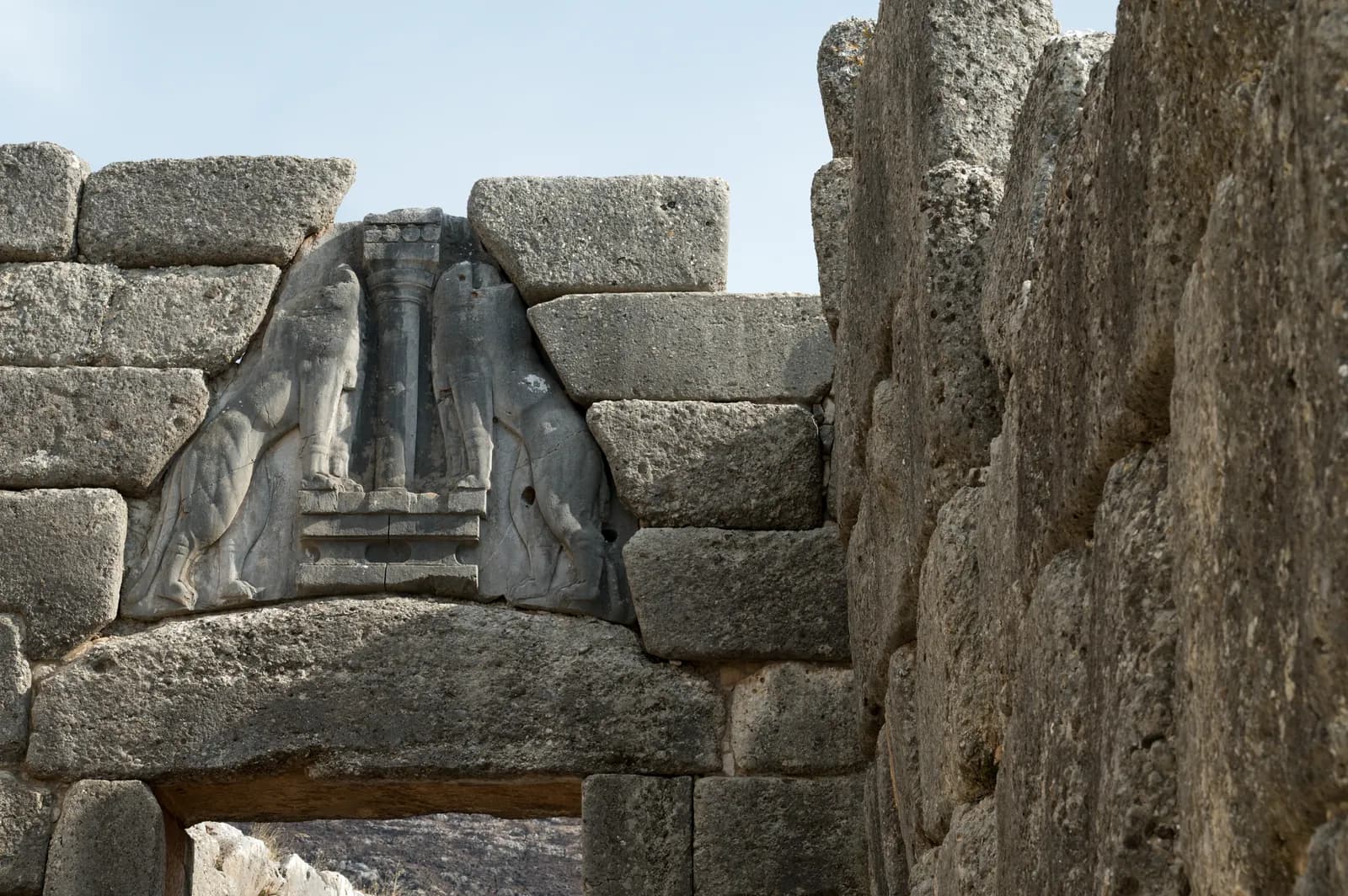
The circuit wall stands to a considerable height over much of its course, built of limestone blocks large enough that later Greeks assumed the Cyclopes had laid them. The Lion Gate is intact apart from the heads of the two animals above the lintel, which were made separately and are lost; what remains is the oldest monumental sculpture in Europe still standing where it was set.
Inside the gate, Grave Circle A survives as a double ring of upright slabs enclosing six shaft graves — the graves themselves emptied, the circle rebuilt in antiquity to bring it inside the extended walls. The palace on the summit survives as foundations and a fragment of the megaron floor; part of the hill has fallen away.
Outside the walls stand nine tholos tombs, of which the one traditionally called the Treasury of Atreus is complete: a corbelled dome some fourteen metres across, approached by a walled passage, its doorway spanned by a lintel block weighing something over a hundred tonnes.
Occupation and chronology
Dates below are stored as signed years and rendered with the precision they actually carry. c. 1600 BCE is approximate; 468 BCE is approximate.
c. 1600–1500 BCE
Shaft-grave period
The two grave circles. Extraordinary quantities of gold, weapons and imported material buried with a small number of people, at a moment when the settlement itself was not yet remarkable.
c. 1350–1200 BCE
Palatial Mycenae
The megaron, the cyclopean circuit, the Lion Gate and the great tholos tombs. This is the period the Linear B administration belongs to.
c. 1200–1100 BCE
Destruction and after
The palace burned. Occupation continued on a reduced scale for generations afterwards; the collapse was of an administrative system, not of the population.
5th century BCE
Classical Mycenae
A small independent town that sent men to Thermopylae and Plataea, and was destroyed by Argos in about 468 BCE. Later a Hellenistic settlement built a theatre across the mouth of one of the tholos tombs.
History of excavation
Who recovered the evidence, when, and by what method. Where an excavation destroyed as much as it found, the entry says so.
- Evidence level: Documented
1841
Kyriakos Pittakis, Greek Archaeological Society
The Lion Gate was cleared. The citadel had never been lost; Pausanias saw it in the second century CE and travellers drew it in the eighteenth.
- Evidence level: Documented
1876
Heinrich Schliemann, with Panagiotis Stamatakis for the Archaeological Service
Grave Circle A. Five shaft graves in a season, a sixth after Schliemann left. Stamatakis was posted to supervise him and the two men fought continuously over method; the record we have of the finds owes a great deal to Stamatakis's insistence.
- Evidence level: Documented
1886–1902
Christos Tsountas, Greek Archaeological Society
Cleared the palace on the summit and excavated a large number of chamber tombs in the surrounding slopes — the burials of the ordinary population rather than of the elite, which is what makes the site interpretable at all.
- Evidence level: Documented
1920–1955
Alan Wace, British School at Athens
Established by stratigraphy that the tholos tombs form a developmental series and that the citadel's history was independent of Crete's — directly against Arthur Evans, who held that mainland Greece was a Cretan province. Wace lost his permit to dig at Mycenae in the 1920s during the dispute and did not resume until after Evans's death; how far Evans's standing in the British School caused that is argued rather than documented.
- Evidence level: Documented
1951–1955
Ioannis Papadimitriou and George Mylonas
Grave Circle B, found during road works outside the walls: twenty-four graves, slightly earlier than Circle A and less spectacularly furnished, which is what allows Circle A to be read as the end of a process rather than a sudden apparition.
Principal structures
The evidence level answers how we know what a structure looked like, not whether it existed.
- Evidence level: Documented
c. 1250 BCE
The Lion Gate
A single monolithic lintel with a relieving triangle above it, filled by a slab carved with two animals flanking a column. Standing, and standing where it was placed.
- Evidence level: Documented
c. 1350, extended c. 1250 BCE
The cyclopean circuit
Two main building phases; the second brought Grave Circle A inside the walls, which is an argument in stone about whose ancestors these were.
- Evidence level: Probable
c. 1350–1200 BCE
The palace and megaron
Foundations, a stretch of the great court, and part of the megaron with its circular hearth. The south-east corner has collapsed down the slope, so the plan is incomplete rather than reconstructed.
- Evidence level: Documented
c. 1600–1500 BCE, re-enclosed c. 1250
Grave Circle A
Six shaft graves, nineteen burials. The circle of slabs standing today is the later monumentalisation, not the original arrangement.
- Evidence level: Documented
c. 1250 BCE
The Treasury of Atreus
The largest and best preserved of the tholos tombs, complete to the apex. The name is Pausanias's usage, not an identification: it was a tomb, it was robbed in antiquity, and nothing found in it names anybody.
- Evidence level: Documented
c. 1250 BCE
The underground cistern
A stepped passage cut through the rock beneath the north-east wall to reach a spring outside the circuit. It belongs to the same phase as the wall extension and implies an expectation of siege.
Finds and where they went
Almost nothing recovered from these sites is still on them. Where an object has a full provenance record on this platform, it is linked.
- Evidence level: Documented
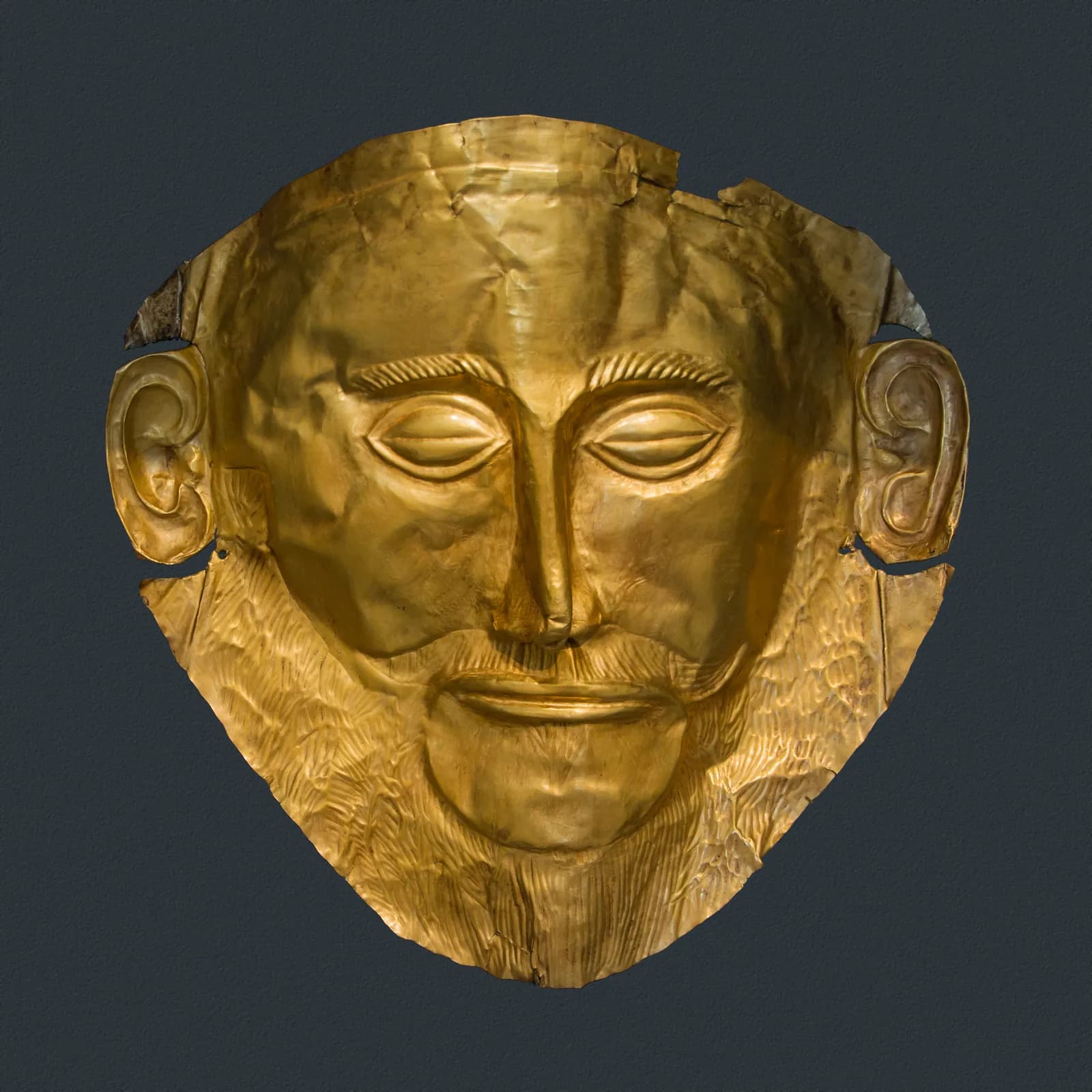
The gold mask from Shaft Grave V
Beaten gold funerary mask, one of five from Circle A. Schliemann associated it with Agamemnon; it dates to roughly 1550–1500 BCE, some three centuries before any traditional date for the Trojan War, and nothing on or around it names a person.
National Archaeological Museum, Athens · Full provenance record
- Evidence level: Documented
The Warrior Vase
A krater showing a file of armed men leaving, and a woman raising her hand. One of the very few Mycenaean images of contemporary infantry equipment.
- Evidence level: Documented
The Siege Rhyton
A fragmentary silver vessel with a scene of an attack on a walled town. Small, damaged, and the closest thing to a Mycenaean battle picture that exists.
- Evidence level: Documented
Inlaid daggers
Bronze blades inlaid in gold, silver and niello with hunting and lion scenes, from the shaft graves. The technique is Aegean; several of the motifs are Egyptian or Near Eastern.
- Evidence level: Documented
Linear B tablets
Recovered from houses outside the citadel wall, notably the group Wace excavated in the 1950s. Fewer than at Pylos or Knossos, and they record the same kind of thing: commodities, personnel, allocations.
Ancient testimony
What ancient authors say about the place, and how far it can be trusted.
Pausanias, Description of Greece 2.16.5–7
Pausanias saw the walls, the Lion Gate and the tholos tombs in the second century CE, describing the tombs as underground treasuries and attributing the walls to the Cyclopes. His account is why the tombs carry the names they do.
Thucydides, History of the Peloponnesian War 1.10
Thucydides' warning that the physical remains of a city are a poor guide to the power it once had, argued with Mycenae as the example. Written while the site was visible and unremarkable.
Homer, Iliad 7.180, 11.46
“Mycenae rich in gold.” The epithet is formulaic and belongs to poetic tradition; the shaft graves are gold, and the temptation to treat the second fact as confirmation of the first is exactly the move this platform tries not to make.
How the site has been interpreted
For a century after Schliemann the site was read through Homer, and the reading ran in one direction: the shaft graves were the graves of Homer's kings, the citadel was Agamemnon's, and the Iliad was a memory of the Bronze Age. The decipherment of Linear B in 1952 broke that. The tablets are administrative and they are in Greek — which vindicated the linguistic continuity — but they describe a palace bureaucracy of scribes, allocations and land registers that has nothing in common with the world of the poems.
What Mycenae is evidence for is a redistributive palace state with a reach across the Argolid, an appetite for imported gold, amber, ivory and lapis, and a fortification programme in its last century that looks defensive rather than ceremonial. What it is not evidence for is the political geography of the Iliad.
The wealth of the shaft graves is genuinely difficult. It arrives suddenly, at a settlement that was not previously exceptional, and it stops. Proposals range from mercenary service abroad to control of a metals route to a local dynasty's monopoly on prestige exchange, and none is established.
Thucydides saw the problem before anyone excavated. Mycenae in his day was a small place, and he warned that later ages would misjudge the power of cities from the size of their ruins. He was arguing that Mycenae had been greater than it looked. The warning cuts both ways, and it is the best single sentence written about this site.
Unresolved
Is the Mask of Agamemnon authentic?
A minority argument, principally by William Calder and David Traill, holds that Schliemann altered or introduced the mask, noting that it differs in style from the other four and that the moustache and the modelling look nineteenth-century. Most specialists reject this: the find was witnessed and recorded by Stamatakis, the technique matches other Aegean goldwork, and the argument rests heavily on aesthetic judgement. The mask's date, which is not in doubt, already removes it from Agamemnon.
What destroyed the palace?
The palace burned around 1200 BCE, as did most of the Mycenaean palaces within a few decades of each other. Earthquake, internal collapse, external attack, systemic failure of a fragile redistributive economy and combinations of all four have been argued. There is no destruction layer anywhere that names an enemy, and the coincidence in date across sites is the strongest single fact and the hardest to explain.
Whose ancestors were in Grave Circle A?
When the circuit wall was extended in the thirteenth century it was diverted to bring the four-hundred-year-old grave circle inside, and the graves were monumentalised. That is a deliberate act of ancestral claim by a later dynasty. Whether that dynasty was descended from the people in the graves is not recoverable.
How to read the evidence labels
- Evidence level: Documented
- Supported by a named primary text or by excavated material evidence.
- Evidence level: Probable
- Supported by strong inference that most specialists accept.
- Evidence level: Disputed
- Substantial specialist disagreement exists; competing readings are stated.
- Evidence level: Literary
- Belongs to poetic or mythological construction rather than to history.
- Evidence level: Mythological
- Belongs to shared religious or mythic tradition rather than to any single text.
- Evidence level: Unknown
- The available evidence is insufficient to decide.
These labels describe the status of the evidence, not our confidence in a conclusion. A claim marked Literary is not a claim we doubt; it is a claim about what kind of thing a poem is.