What it is
The Ara Pacis — the processional friezes and the disputed identifications, the 1930s excavation by freezing the water table, the Augustan bimillennium, and the relationship to the meridian of Augustus.
Built Voted 13 BCE, dedicated 9 BCE. The principal date, dedicated 30 January 9 BCE, is fixed.
4 July 13 BCE
The vote
The Senate voted an altar of Augustan Peace on Augustus's return from Spain and Gaul. The date is preserved in the calendars.
30 January 9 BCE
Dedication
Dedicated on Livia's birthday, in the Campus Martius on the line of the Via Flaminia.
late antiquity onwards
Burial
The Campus Martius silted and the altar was buried by rising ground and Tiber flooding.
1568, 1859, 1903, 1937–1938
Recovery
Found piecemeal beneath the Palazzo Peretti over nearly four centuries, and finally excavated whole in 1937–38 by freezing the groundwater.
1938
Reassembly and relocation
Reassembled on a new site beside the Mausoleum of Augustus and inaugurated on 23 September 1938, the two-thousandth anniversary of Augustus's birth.
Who ordered it built
Each attribution carries what supports it. Ancient buildings are routinely credited to people on the authority of writers centuries later, and that is not the same claim as an inscription on the building.
- Evidence level: Documented
Dedicated by
The Senate
Res Gestae 12, and the Roman calendars, which record both the vote and the dedication.
- Evidence level: Documented
Commissioned by
Augustus
Res Gestae 12, in which Augustus records that the Senate decreed the altar on his return and ordered magistrates, priests and Vestals to sacrifice at it annually.
What it was for
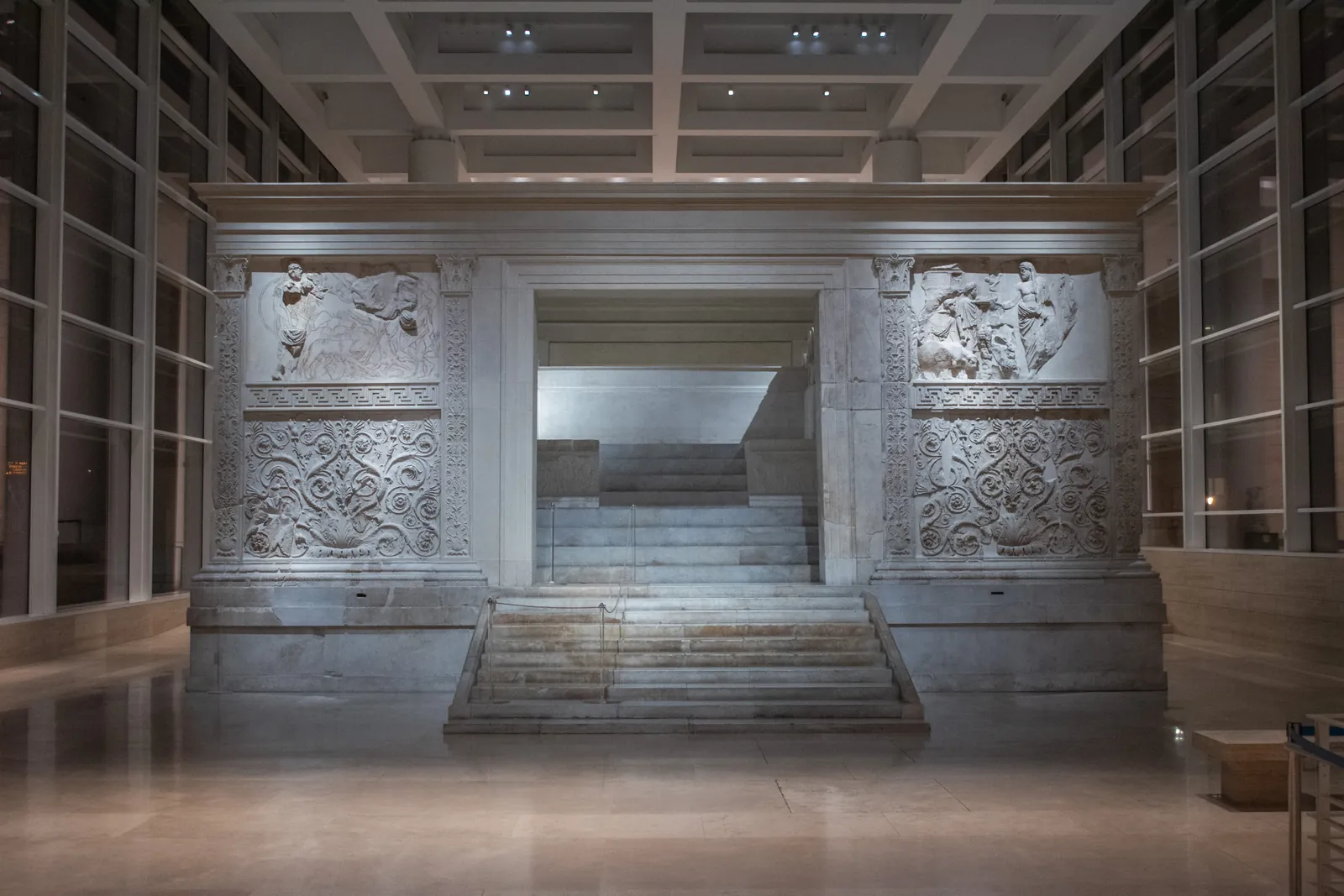
An open-air altar within a marble precinct, for an annual sacrifice by magistrates, priests and Vestal Virgins. It is a working altar, not a temple: the sacrificial table stands inside a walled enclosure open to the sky, reached by steps on the west.
The sculptural programme carries the meaning. Outside, a procession of the imperial family, priests and magistrates on the two long walls; mythological panels at the corners — Aeneas or Numa sacrificing, the she-wolf, Roma, and a seated female figure with children and animals whose identity has never been agreed. Below all of it, a deep band of acanthus scroll teeming with small creatures.
How it was built
A rectangular marble screen wall on a low podium, with openings east and west, enclosing a stepped altar. The whole thing is a frame for relief carving, and the carving is among the finest to survive from the ancient world.
The procession friezes are carved in two planes, with figures at the front in high relief and a crowd behind them in low relief, which gives depth to a slab less than a hand's breadth thick. Children appear in the procession, tugging at adults' clothing, which is generally said to be their first appearance on a Roman state relief.
Materials
- Evidence level: Documented
Luna marble
The precinct walls, the altar and all the sculpture
Measured
Every figure states what it rests on. A modern survey, an ancient text, a conversion from an ancient unit and a modern estimate are four different kinds of statement and are not interchangeable.
Precinct
about 11.6 × 10.6 m, walls about 6 m high
Modern survey of the reassembled monument, which reproduces the excavated dimensions.
What it meant
Peace here is a specific claim: peace secured by victory, granted by a returning commander, and celebrated by a Senate that had voted it. The Res Gestae puts the altar immediately after the closing of the doors of Janus, and the two are the same argument.
The procession is a dynastic photograph. Reading it is the central problem: the figures are not labelled, and identifications of Agrippa, Livia, Tiberius, Antonia, Drusus and the children have been proposed, revised and abandoned repeatedly. A monument that is universally described as showing the imperial family shows a group of people nobody can name with certainty.
Its modern history is as political as its ancient one. Excavated with novel engineering, reassembled on a new site by the Mausoleum, and unveiled for the Augustan bimillennium in 1938, the altar was made into a centrepiece of a regime that presented itself as the heir of Augustus. The current museum, opened in 2006, replaced the 1938 pavilion and was itself controversial.
The annual sacrifice by magistrates, priests and Vestals is specified in the senatorial decree, which makes the altar an instrument of the state calendar rather than a memorial.
The mythological panels tie the present regime to the foundation: Aeneas sacrificing, the twins and the wolf, Roma on her arms. Whether the sacrificing figure is Aeneas or Numa is argued, and the two readings point the programme in different directions — descent or lawgiving.
After antiquity
Buried under four metres of silt and later buildings. Nine sculpted slabs came to light in 1568 and were dispersed — to the Villa Medici, to Florence, to the Vatican, and eventually to the Louvre.
Further fragments were found in 1859. In 1903 an excavation under the Palazzo Peretti reached the monument but had to stop because the building was unsafe. In 1937 the ground was frozen with brine to hold back the water table, and the remainder was recovered.
Reassembled from the excavated blocks, the returned fragments and casts of those that could not be recovered, and inaugurated in 1938.
Condition today
Re-erected in modern times
Standing complete, several hundred metres from its ancient position, assembled from original blocks with casts filling the gaps. It is simultaneously one of the best-preserved Augustan monuments and one of the most reconstructed.
The 1938 reassembly combined excavated blocks, fragments recovered from Italian and foreign collections, and plaster casts of pieces that stayed abroad. Which is which is documented but is not marked on the monument, and photographs rarely distinguish them.
The 1937–38 excavation is a landmark of technique: the ground was frozen to stop the water table collapsing the trench, which allowed a complete recovery of a monument that had defeated three earlier attempts.
The relationship between the altar and the great sundial of Augustus — an Egyptian obelisk with a meridian line laid out on the Campus Martius — was proposed in the 1970s on the basis of excavation and the claim that the obelisk's shadow reached the altar on Augustus's birthday. The meridian exists and has been partly excavated; the specific alignment claim has been contested on the ground that the geometry does not work as described.
Scattered fragments
What has left the building, and where it is now. Where a holding is contested, the museum page says so.
- Evidence level: Documented
Relief slabs found in 1568 and dispersed to European collections; several were returned for the 1938 reassembly and some remain abroad
- Evidence level: Documented
Fragments in the Vatican and Florentine collections
Written about in antiquity
Augustus, Res Gestae Divi Augusti 12
Augustus records the Senate's decree of an altar of Augustan Peace on his return from Spain and Gaul, and the order that magistrates, priests and Vestals should sacrifice at it every year.
Ovid, Fasti 1.709–722
Ovid on the altar of Peace and on the closing of the temple of Janus, the two Augustan claims about peace made together.
Still argued
Who is the seated woman with the twins?
The best-known panel shows a seated female figure with two infants, flanked by personifications of air and water, with livestock and fruit around her. She has been identified as Tellus, Italia, Pax, Venus, Ceres and a composite. No inscription names her, no ancient source describes the panel, and the reading changes what the whole programme is about.
Did the meridian of Augustus point at the altar?
Edmund Buchner argued that the obelisk's shadow ran to the Ara Pacis on Augustus's birthday, making the altar the terminus of a solar instrument. Later work on the surviving meridian pavement and on the ancient ground level has found the geometry difficult to sustain in that form. The obelisk, the meridian and the altar were certainly part of one Campus Martius programme; the precise alignment claim is not established.
How to read the evidence labels
- Evidence level: Documented
- Supported by a named primary text or by excavated material evidence.
- Evidence level: Probable
- Supported by strong inference that most specialists accept.
- Evidence level: Disputed
- Substantial specialist disagreement exists; competing readings are stated.
- Evidence level: Literary
- Belongs to poetic or mythological construction rather than to history.
- Evidence level: Mythological
- Belongs to shared religious or mythic tradition rather than to any single text.
- Evidence level: Unknown
- The available evidence is insufficient to decide.
These labels describe the status of the evidence, not our confidence in a conclusion. A claim marked Literary is not a claim we doubt; it is a claim about what kind of thing a poem is.