What it is
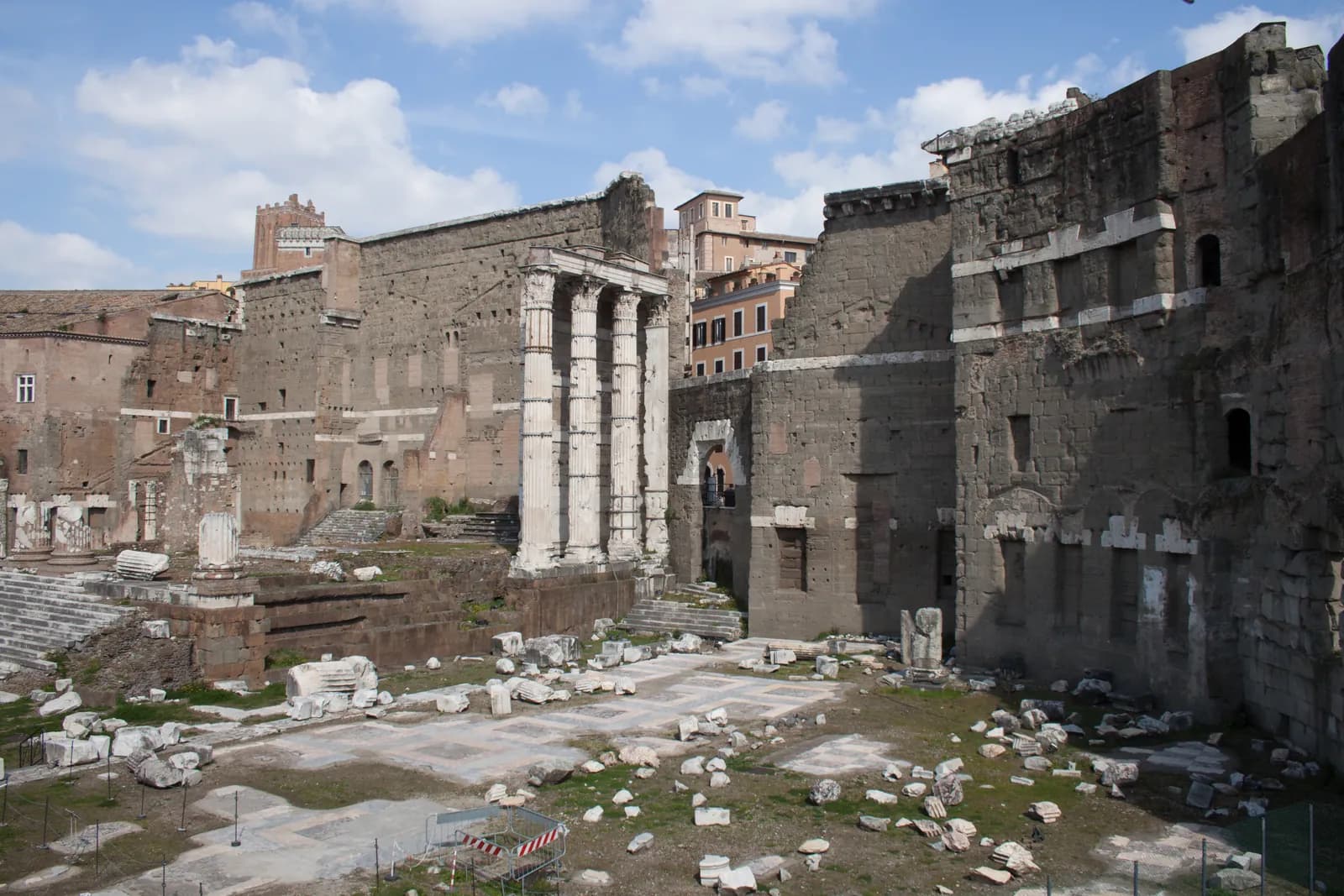
The Forum of Augustus — the Temple of Mars Ultor, the gallery of summi viri with their inscribed elogia, the fire wall against the Subura, and the land Augustus could not buy.
Built Vowed 42 BCE, dedicated 2 BCE. The principal date, dedicated 2 BCE, is fixed.
42 BCE
The vow at Philippi
Octavian vowed a temple to Mars the Avenger before the battle against Caesar's assassins. Forty years passed between the vow and its discharge.
20 BCE
The standards
The legionary standards lost at Carrhae were recovered from Parthia by negotiation. They were eventually housed in the temple, which gave Mars Ultor a second thing to avenge.
2 BCE
Dedication
Dedicated in the year Augustus received the title pater patriae. The forum was in use before the temple was finished.
1st century CE onwards
Fire, restoration and quarry
Repaired after fires; progressively stripped in the medieval period, when the site was occupied by a convent and later by houses.
Who ordered it built
Each attribution carries what supports it. Ancient buildings are routinely credited to people on the authority of writers centuries later, and that is not the same claim as an inscription on the building.
- Evidence level: Documented
Commissioned by
Augustus
Res Gestae 21: he built the forum on private ground and from the spoils of war. His own inventory of his works.
- Evidence level: Unknown
Architect
Unknown
No ancient source names an architect for the complex.
What it was for
A public square with a temple, built to relieve the congested Forum Romanum. Augustus states in his own account that legal business and the drawing of juries moved here, and it was also where the Senate met to deliberate on wars and triumphs, where generals departing for a province set out, and where victorious commanders dedicated their triumphal insignia.
It was also a gallery. The exedrae on either side carried statues of the summi viri — Rome's great men — each with an inscription giving name, offices and achievements. Aeneas with Anchises and the Julian line stood on one side; Romulus and the kings and Republican commanders on the other.
How it was built
The temple stands against the back wall rather than free in the square, so the composition is frontal: everything is arranged to be seen from the entrance looking at the temple.
The back wall is a piece of fire engineering as much as architecture. It is built of hard grey Gabine stone, is enormously thick and high, and separates the marble complex from the dense, flammable working district of the Subura behind it. It is still standing to most of its height, which is how we know what Augustan retaining construction could do.
The attic of the colonnades carried caryatids copied from the Erechtheion porch on the Athenian Acropolis, alternating with shields bearing the head of Jupiter Ammon — a direct architectural quotation of classical Athens, executed in Italian marble.
Materials
- Evidence level: Documented
Luna marble
The temple's columns and the paving of the square
- Evidence level: Documented
Coloured marbles
Pavonazzetto for the attic caryatids and the exedra floors, africano and giallo antico for the paving pattern
- Evidence level: Documented
Gabine stone (peperino)
The great fire wall along the back, over thirty metres high, separating the forum from the Subura
Measured
Every figure states what it rests on. A modern survey, an ancient text, a conversion from an ancient unit and a modern estimate are four different kinds of statement and are not interchangeable.
The fire wall
over 30 m high
Modern survey of the standing wall, which is the best-preserved element of the complex.
Temple podium
about 35 m wide
Modern survey of the surviving podium and the three standing columns.
What it meant
The gallery of summi viri is the most explicit statement of Augustan historical politics that survives. Placing the Julian line facing the Republican commanders, each with a formal inscription, made the new regime the culmination of Roman history rather than a break in it — and Suetonius says Augustus stated that he had set them up so that citizens should measure him and later principes against those men.
Mars Ultor avenges two things at once: Caesar's murder, which the vow at Philippi answered, and the standards lost at Carrhae, recovered from Parthia by diplomacy and presented as a conquest. Housing the standards in a temple of vengeance converted a negotiated settlement into a victory.
Suetonius also records that Augustus could not make the forum as large as he intended because he would not compel the neighbouring owners to sell. The square's irregular back corner is the physical trace of that restraint, and Roman writers treated it as a moral fact about him.
The vow-and-discharge pattern is the standard Roman transaction with a god, and here the interval is forty years, which is a reminder that these obligations were inherited and permanent rather than immediate.
The temple became the ceremonial centre for war: the Senate voted on triumphs there, governors departed from it, and the boys of the imperial family assumed the toga virilis in it.
After antiquity
Damaged by fire, restored, and then progressively dismantled. In the medieval period the site held the church and convent of the Knights of Rhodes, built into the ruins, which is why part of the complex survived at all.
Cleared in the 1920s and 1930s as part of the same programme that produced the Via dei Fori Imperiali, and the road runs across the front of it.
Condition today
Foundations and plan
The great fire wall stands to most of its height. Three columns of the temple and part of its podium survive, along with the paving of the square and one exedra. The statue gallery is gone; a number of the inscribed elogia survive in fragments.
Fragments of the elogia — the inscriptions under the statues — have been recovered here and, in a fuller series, in a copy of the gallery at Arezzo and elsewhere in Italy. The copies are how the programme can be reconstructed, and they show it was exported to other cities.
Excavation established the plan, the position of the exedrae and the caryatid attic; a section of the attic has been re-erected.
Scattered fragments
What has left the building, and where it is now. Where a holding is contested, the museum page says so.
- Evidence level: Documented
Caryatids and Jupiter Ammon shields from the colonnade attic
Museo dei Fori Imperiali, Rome
- Evidence level: Documented
Fragments of the elogia of the summi viri
Museo dei Fori Imperiali, Rome, and the epigraphic corpora
- Evidence level: Probable
Colossal statue fragments from the temple, including a hand and part of a foot
Museo dei Fori Imperiali, Rome
Whether they belong to a cult statue of Mars or to a colossus of Augustus in the forum is argued.
Written about in antiquity
Augustus, Res Gestae Divi Augusti 21
Augustus: he built the forum on ground he owned and from the spoils of war. Two sentences that establish the funding and the ownership.
Suetonius, The Twelve Caesars Augustus 29, 31, 56
Suetonius on the vow before Philippi, on the statues of the great men and Augustus's stated reason for them, and on his refusal to compel the neighbours to sell.
Ovid, Fasti 5.545–598
Ovid's account of the dedication of the temple of Mars Ultor and of the vow at Philippi, written within a few years of the event and as court poetry.
Still argued
What stood in the temple?
Reconstructions place Mars, Venus and the deified Caesar in the cella, on the evidence of a relief from Algeria usually taken to copy the group. Colossal fragments from the site have been assigned both to that cult group and to a statue of Augustus in the square. The identification is a reasonable inference from a copy and is not documented.
How to read the evidence labels
- Evidence level: Documented
- Supported by a named primary text or by excavated material evidence.
- Evidence level: Probable
- Supported by strong inference that most specialists accept.
- Evidence level: Disputed
- Substantial specialist disagreement exists; competing readings are stated.
- Evidence level: Literary
- Belongs to poetic or mythological construction rather than to history.
- Evidence level: Mythological
- Belongs to shared religious or mythic tradition rather than to any single text.
- Evidence level: Unknown
- The available evidence is insufficient to decide.
These labels describe the status of the evidence, not our confidence in a conclusion. A claim marked Literary is not a claim we doubt; it is a claim about what kind of thing a poem is.