What it is
The Mortuary Temple of Hatshepsut — the terraces and the colonnades, the Punt expedition and divine birth reliefs, Senenmut's hidden portraits, and the erasure of Hatshepsut's name.
Built Built during Hatshepsut's reign, c. 1479–1458 BCE. The principal date, c. 1479–1458 BCE, is range endpoint.
c. 1479–1458 BCE
Construction
Built over most of the reign, beside and above the much older terraced temple of Mentuhotep II, which it quotes and outdoes.
from c. 1440s BCE
The erasure
Hatshepsut's images and cartouches were cut out and in places replaced by those of Thutmose I, II and III. The campaign began decades into Thutmose III's sole reign, not at its start.
Ptolemaic – Christian
Later use
A sanctuary of Imhotep and Amenhotep son of Hapu was installed in the upper terrace, and later a Coptic monastery gave the site its modern name, the northern monastery.
1890s – present
Excavation and restoration
Cleared by Édouard Naville for the Egypt Exploration Fund and by Herbert Winlock for the Metropolitan Museum, and reconstructed over decades by the Polish–Egyptian mission working from the fallen blocks.
Who ordered it built
Each attribution carries what supports it. Ancient buildings are routinely credited to people on the authority of writers centuries later, and that is not the same claim as an inscription on the building.
- Evidence level: Documented
Commissioned by
Hatshepsut
Her cartouches and her building texts throughout, including where they were later cut out and the erasure itself records them.
- Evidence level: Probable
Architect
Senenmut
Steward of Amun and overseer of works under Hatshepsut, with over twenty statues and a tomb beneath the temple forecourt. Small images of him were cut into the temple behind doors where they would normally be hidden. His titles and his proximity make the attribution reasonable; no text says he designed it.
What it was for
A mortuary temple for the cult of the dead king, with chapels for Amun, Hathor, Anubis and the royal ancestors, aligned on Karnak across the river and connected to it by the annual Beautiful Festival of the Valley.
The king's tomb is elsewhere, in the Valley of the Kings on the other side of the cliff. Separating the tomb from the mortuary temple is the New Kingdom's solution to the pyramid's problem, which was that a monument marking a burial advertises it to robbers.
How it was built
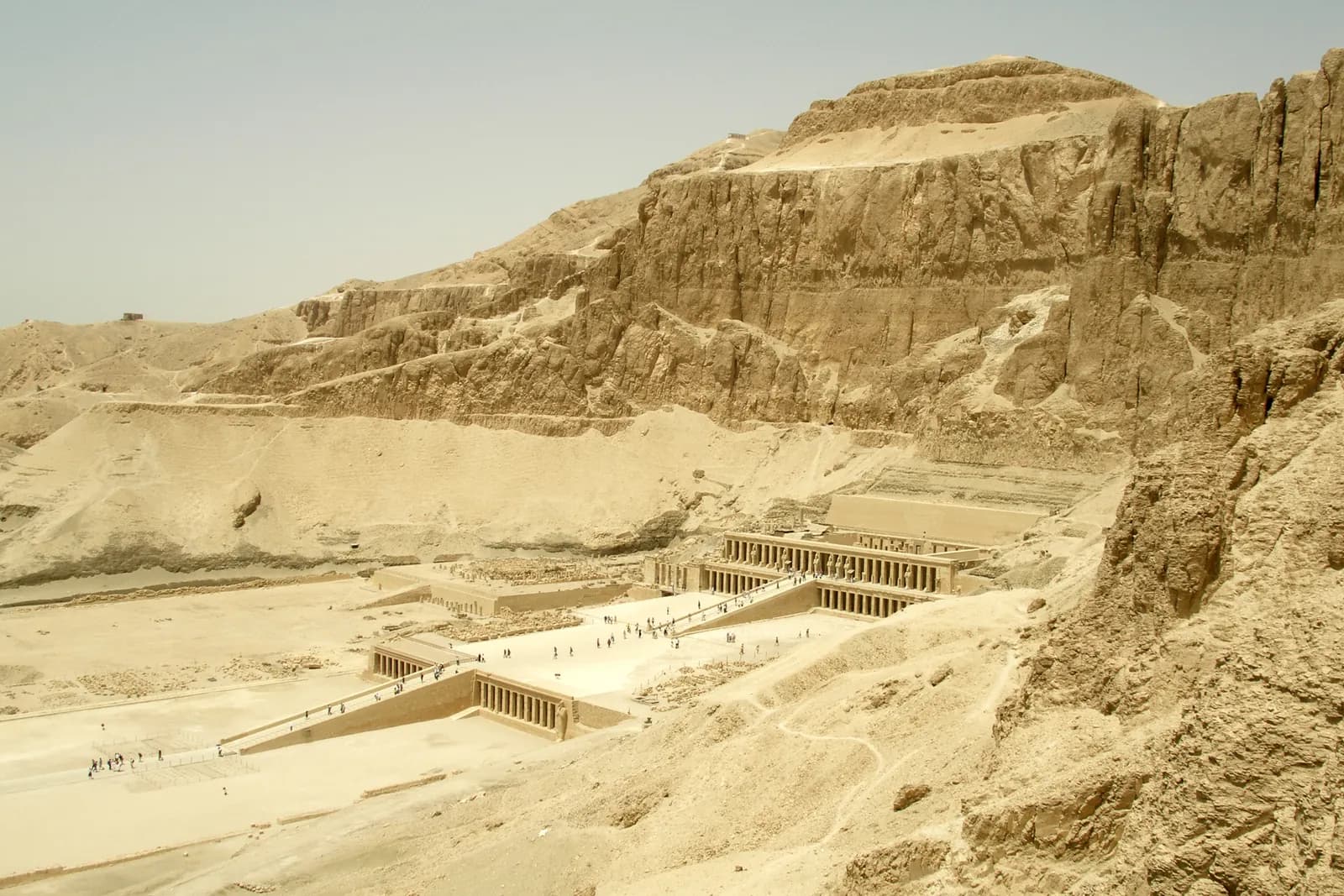
The building's idea is the cliff behind it. Three terraces of colonnades step up against a bay of vertical rock three hundred metres high, and the architecture is proportioned so that the building appears to be a continuation of the geology rather than an object placed in front of it.
The colonnades use square and polygonal piers rather than the plant-form columns of a temple like Karnak. The effect is closer to a Greek stoa than to anything else in Egypt, which is why nineteenth-century visitors reached for the word proto-Doric — an anachronism, since the building precedes any Doric column by nine centuries.
Ramps on the central axis link the terraces, so the whole is one processional route from the valley floor to the sanctuary cut into the rock.
Materials
- Evidence level: Documented
Limestone
The terraces, colonnades and reliefs
- Evidence level: Documented
Granite
Doorways and the sanctuary elements
- Evidence level: Documented
Paint
The reliefs throughout; substantial colour survives in the sheltered chapels
Measured
Every figure states what it rests on. A modern survey, an ancient text, a conversion from an ancient unit and a modern estimate are four different kinds of statement and are not interchangeable.
Terraces
three, rising to about 25 m above the valley floor
Modern survey.
Width of the terrace fronts
about 90 m
Modern survey of the colonnade fronts.
What it meant
Hatshepsut ruled as king, with the full titulary and, in most representations, the male royal costume and the false beard. The temple's reliefs are the fullest statement of how that was justified: the divine birth sequence shows Amun visiting her mother and fathering her, and another sequence shows her father Thutmose I presenting her as his successor.
Both are claims made after the fact by the reign that needed them. The divine birth motif recurs for later kings, and the coronation sequence describes an event no other source records.
The Punt expedition reliefs are a different register: an account of a trading voyage to a land somewhere on the Red Sea or the Horn of Africa, with the ships, the cargo of incense trees, ebony, ivory and animals, and portraits of the ruler of Punt and his wife. It is the best-documented long-distance expedition from the ancient world.
The temple is aligned on Karnak, and the Beautiful Festival of the Valley brought Amun's barque across the river to it each year — the west bank's answer to the Opet festival.
The upper terrace later held a healing sanctuary of the deified Imhotep and Amenhotep son of Hapu, with incubation practised there in the Ptolemaic and Roman periods. Two Egyptian officials became gods of medicine, and pilgrims slept in a fifteenth-century-BCE temple to consult them.
After antiquity
Hatshepsut's images were removed in a systematic campaign that also replaced her name with those of her father, husband and stepson. The chronology of the erasure — beginning around the twentieth year of Thutmose III's sole reign rather than immediately — is the strongest argument that it was dynastic tidying rather than personal vengeance.
Damaged by earthquake, quarried, occupied by a Coptic monastery, and buried in debris. Cleared from the 1890s and reconstructed from its own fallen blocks by the Polish–Egyptian mission from 1961 onwards.
Condition today
Re-erected in modern times
Standing in three terraces, with a very large proportion of the visible fabric re-erected from fallen original blocks over sixty years of anastylosis. The chapels retain their painted relief; the erased figures remain erased.
The Polish–Egyptian mission's reconstruction, running since 1961, is one of the longest anastylosis programmes anywhere. It uses original blocks recovered from the debris, with new stone where necessary and marked, and has restored the upper terrace and its sanctuary.
Senenmut's small figures, cut into the walls in positions covered when the doors stood open, were found during clearance. Whether they were an unauthorised intrusion, a permitted privilege, or normal practice for a chief official is argued.
Winlock's excavation for the Metropolitan Museum recovered the smashed statues of Hatshepsut from a quarry pit near the causeway, where they had been broken and dumped during the erasure. Many were reassembled in New York.
The Royal Cache of reburied royal mummies, found in 1881, lies in a shaft in the cliff immediately above the temple.
Scattered fragments
What has left the building, and where it is now. Where a holding is contested, the museum page says so.
- Evidence level: Documented
Statues of Hatshepsut recovered smashed and reassembled
The Metropolitan Museum of Art, New York, and the Egyptian Museum, Cairo
- Evidence level: Documented
Relief blocks removed in the nineteenth century
Written about in antiquity
The Punt reliefs middle terrace, south colonnade
The expedition to Punt: the ships, the village on stilts, the ruler and his wife, the incense trees carried aboard in baskets, and the inventory of the cargo. An Egyptian record of a voyage, carved as a temple relief.
The divine birth and coronation reliefs middle terrace, north colonnade
Amun visiting Ahmose in the form of Thutmose I, the birth and nursing of Hatshepsut, and her presentation as heir. A theological argument for a reign, carved by that reign.
Still argued
Why was Hatshepsut erased?
Personal hatred by Thutmose III was the traditional answer. The timing — beginning roughly twenty years into his sole reign — is difficult to reconcile with it, and the current majority reading is a dynastic correction, removing an anomalous female king from the record to secure the succession of Thutmose III's own heir. The erasure is documented; the motive is inference from its date.
Where was Punt?
Proposals place it on the Sudanese or Eritrean Red Sea coast, in the Ethiopian highlands, or in Arabia. The reliefs show a coastal settlement of stilt houses, incense trees, giraffes and rhinoceroses, and oxygen-isotope analysis of a mummified baboon from an Egyptian context has been used to argue for the Eritrea–Ethiopia region. It is not settled.
How to read the evidence labels
- Evidence level: Documented
- Supported by a named primary text or by excavated material evidence.
- Evidence level: Probable
- Supported by strong inference that most specialists accept.
- Evidence level: Disputed
- Substantial specialist disagreement exists; competing readings are stated.
- Evidence level: Literary
- Belongs to poetic or mythological construction rather than to history.
- Evidence level: Mythological
- Belongs to shared religious or mythic tradition rather than to any single text.
- Evidence level: Unknown
- The available evidence is insufficient to decide.
These labels describe the status of the evidence, not our confidence in a conclusion. A claim marked Literary is not a claim we doubt; it is a claim about what kind of thing a poem is.