Most Greek columns are built of drums stacked and centred on wooden dowels, not carved from single blocks. The drums were quarried roughly, brought to site, and finished in place — which is why unfinished buildings show fluting only at the top and bottom of a shaft, with the middle still plain.
That detail is one of the most informative in ancient construction: it proves the fluting was cut after erection, from scaffolding, and it shows the sequence of work. Lifting bosses left on blocks and the cuttings for lifting tongs survive on many buildings and record how the stones were handled.
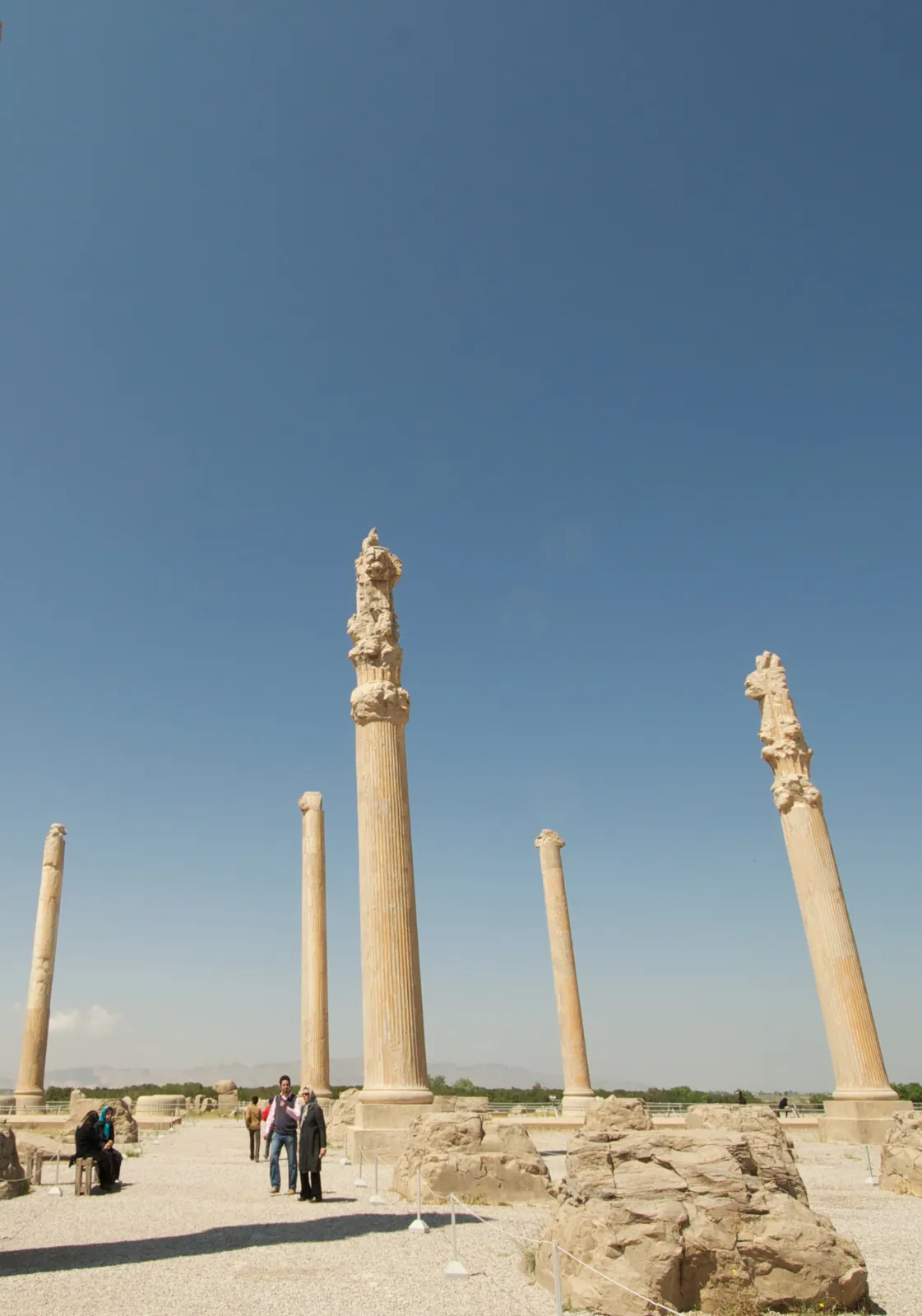
Other traditions solved it differently. Egyptian columns are often massive and closely spaced because the stone lintels they carry cannot span far, and their capitals take plant forms — papyrus, lotus, palm. Achaemenid columns are exceptionally slender and tall, with double-animal capitals, because they carried timber roofs rather than stone.
What the evidence supports
Fluting was cut after the column was erected.
Demonstrated by unfinished buildings where only the top and bottom drums are fluted, and by the continuity of flutes across drum joints.
Column spacing follows from roofing material.
Stone architraves span short distances, so Egyptian hypostyle halls are densely columned; Persian halls with timber roofs are open and slender. The correlation is clear and the reasoning is inference.
Lifting bosses and dowel holes record construction method.
Visible on many surviving members, and a direct trace of how blocks were moved and joined.
Examples
The evidence level on each answers how we know what the building looked like, not whether it existed.
- Evidence level: Documented
Persepolis · 5th century BCE
The columns of the Apadana
Exceptionally slender and widely spaced, with double-animal capitals; they carried a timber roof. Excavated, with column bases in place and fallen shafts recovered.
- Evidence level: Documented
Egypt · New Kingdom
The hypostyle hall at Karnak
Massive closely-spaced columns carrying stone architraves — the opposite structural solution. Standing, with the columns and architraves largely in place.
- Evidence level: Documented
Corinth · c. 560 BCE
The Temple of Apollo at Corinth
Monolithic shafts rather than drums, which is unusual and required moving single blocks of great weight. Standing, with the shafts in place.
Primary sources
Vitruvius, On Architecture 3–4, 10
Proportions, and the machines used for lifting.
Athenian building commissioners, Building accounts of the Erechtheion IG I³ 474-479
Inscribed accounts recording payments for specific tasks, including fluting — a direct record of the work sequence and its cost.
How to read the evidence labels
- Evidence level: Documented
- Supported by a named primary text or by excavated material evidence.
- Evidence level: Probable
- Supported by strong inference that most specialists accept.
- Evidence level: Disputed
- Substantial specialist disagreement exists; competing readings are stated.
- Evidence level: Literary
- Belongs to poetic or mythological construction rather than to history.
- Evidence level: Mythological
- Belongs to shared religious or mythic tradition rather than to any single text.
- Evidence level: Unknown
- The available evidence is insufficient to decide.
These labels describe the status of the evidence, not our confidence in a conclusion. A claim marked Literary is not a claim we doubt; it is a claim about what kind of thing a poem is.