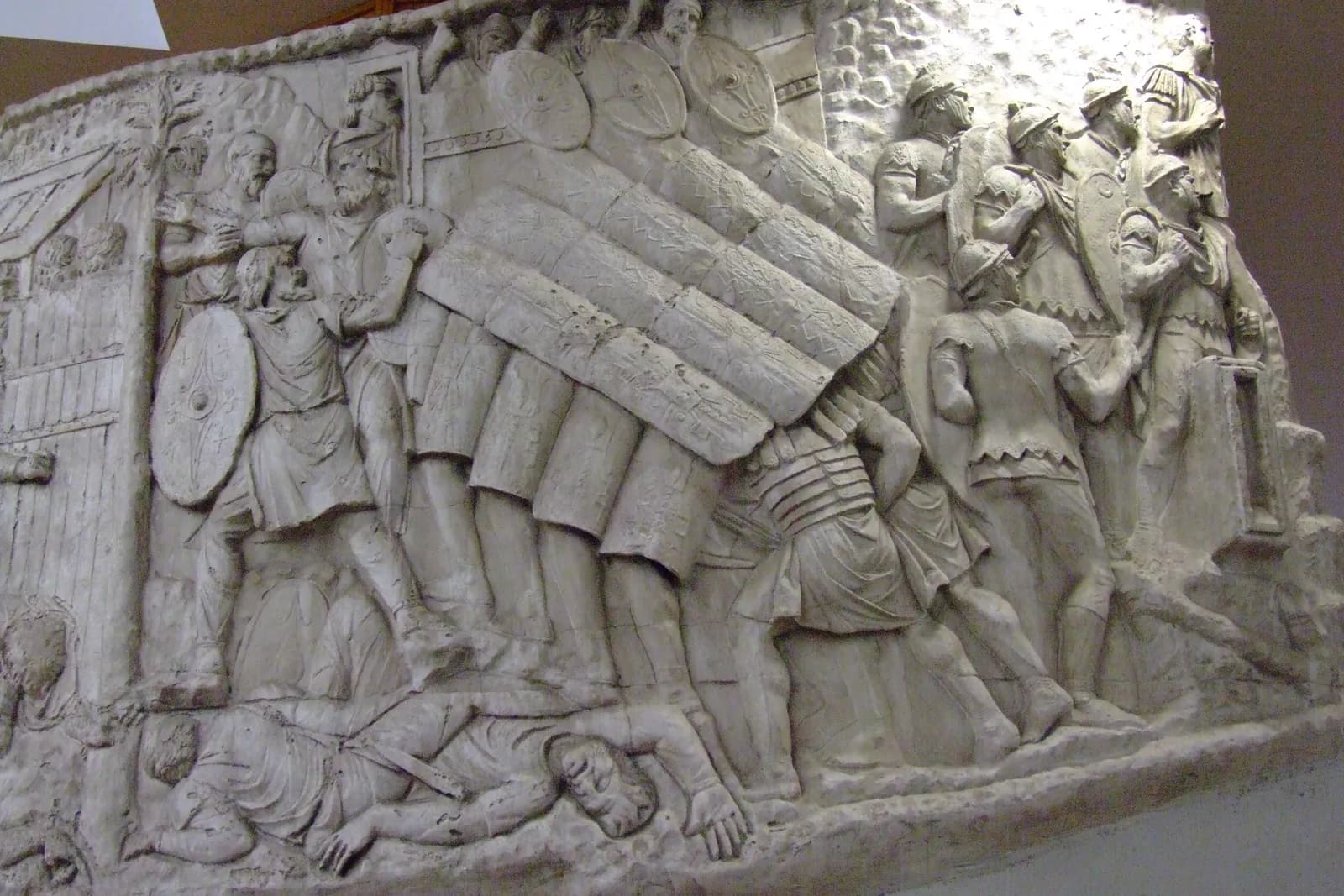
There is no single Roman army. The citizen levy that fought Hannibal, the professional force Caesar took into Gaul, the standing frontier army of the Principate and the field armies of the fourth century are different institutions with different recruitment, equipment, command and relation to the state. Statements about 'the Roman army' that do not specify a period are usually wrong about at least one of them.
What persists across the changes is a set of habits: fortify every night, standardise equipment and drill, subordinate the individual to the formation, and treat engineering as a branch of fighting. Rome lost battles at a rate that would have destroyed most ancient states and won wars because its manpower, its organisation and its willingness to continue outlasted the victors.
The army also became the decisive fact in Roman politics. Marius's reforms tied soldiers' futures to their commanders rather than to the state; from that point the legions were a constitutional problem as well as a military instrument.
What the evidence supports
Roman armies fortified a camp at the end of each day's march.
Described in detail by Polybius and confirmed by hundreds of excavated marching camps across the empire, visible as ditch-and-rampart enclosures with characteristic gate defences.
The legion changed from manipular to cohortal organisation.
Polybius describes the manipular system of the second century BCE; Caesar's narratives assume the cohort. The transition is generally associated with the late second century BCE and its exact mechanism is not documented.
How the manipular lines relieved each other in combat is not attested.
The standard reconstruction of hastati falling back through principes is an inference from the formation's described spacing. No ancient source explains the drill.
Primary sources
Polybius, Histories 6.19-42
The classic technical description of the mid-Republican army, its levy, camp and organisation.
Julius Caesar, The Gallic War
A commander's account of the late Republican army in the field.
Vegetius, Epitome of Military Science
A late compilation, valuable and unreliable: it mixes practices of widely separated periods.
Battles
216 BCE
Cannae
Hannibal destroyed the largest army Rome had ever put in the field by allowing his own centre to be pushed back, and produced the model double envelopment of European military history.
202 BCE
Zama
Scipio defeated Hannibal in North Africa and ended the Second Punic War, using the Roman manipular system against the tactic that had beaten it at Cannae.
52 BCE
Alesia
Caesar besieged Vercingetarix inside a hilltop stronghold while simultaneously defending his own siege lines against a relief army, and ended organised Gallic resistance.
48 BCE
Pharsalus
Caesar defeated a larger Pompeian army in Thessaly with a fourth line held back specifically to defeat the cavalry manoeuvre he had predicted, and effectively ended the Republic.
53 BCE
Carrhae
A Roman army was destroyed in open desert by Parthian horse archers and cataphracts, in the clearest ancient demonstration that heavy infantry has no answer to mobile missile cavalry.
9 CE
The Teutoburg Forest
Three legions were destroyed in a running ambush over several days, and the Roman frontier settled on the Rhine rather than the Elbe.
378 CE
Adrianople
An eastern Roman field army was destroyed and an emperor killed by a Gothic force outside Adrianople, in a defeat a contemporary historian called the heaviest since Cannae.
How to read the evidence labels
- Evidence level: Documented
- Supported by a named primary text or by excavated material evidence.
- Evidence level: Probable
- Supported by strong inference that most specialists accept.
- Evidence level: Disputed
- Substantial specialist disagreement exists; competing readings are stated.
- Evidence level: Literary
- Belongs to poetic or mythological construction rather than to history.
- Evidence level: Mythological
- Belongs to shared religious or mythic tradition rather than to any single text.
- Evidence level: Unknown
- The available evidence is insufficient to decide.
These labels describe the status of the evidence, not our confidence in a conclusion. A claim marked Literary is not a claim we doubt; it is a claim about what kind of thing a poem is.