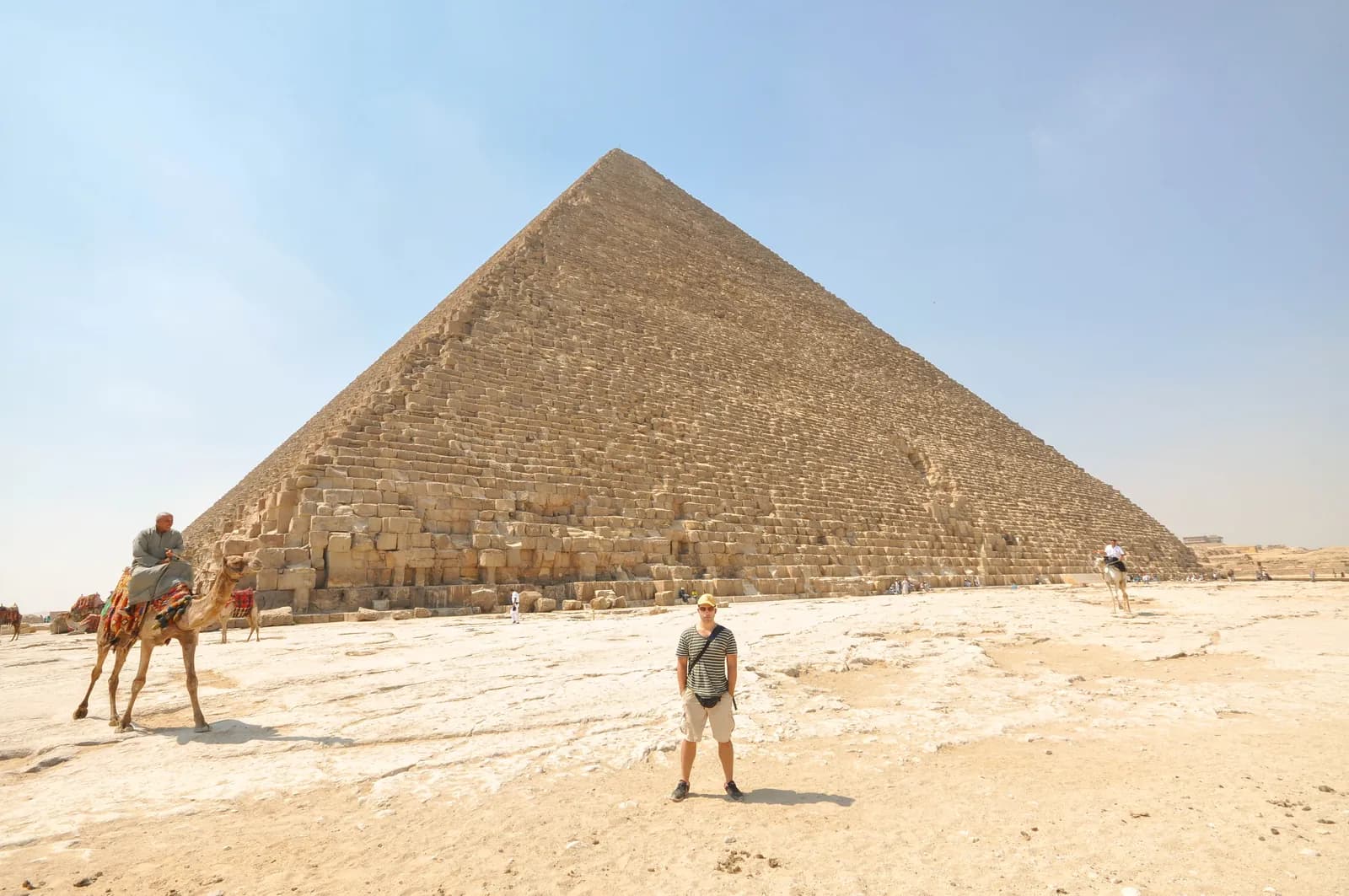
What it is
The Great Pyramid — Petrie's survey, the Grand Gallery and the relieving chambers, the gang marks that name Khufu, the Merer papyri, and what is still unknown about how it was built.
Built Built in the reign of Khufu, c. 2580–2560 BCE. The principal date, c. 2560 BCE, is approximate.
c. 2580–2560 BCE
Construction
Within Khufu's reign, whose length is given by later king lists as twenty-three years and by other sources as longer. The Merer papyri date to the year after the thirteenth cattle count, late in the reign, and record casing stone still arriving.
medieval
The casing stripped
The fine Tura limestone casing was taken for building in Cairo, principally after earthquake damage in the fourteenth century. A few casing blocks remain at the base on the north side.
9th century onwards
Entered and explored
The forced passage attributed to al-Ma'mun's expedition is the entrance visitors now use. The original entrance is higher and to the east of it.
Who ordered it built
Each attribution carries what supports it. Ancient buildings are routinely credited to people on the authority of writers centuries later, and that is not the same claim as an inscription on the building.
- Evidence level: Documented
Commissioned by
Khufu
Painted gang marks in the relieving chambers above the King's Chamber carry his cartouche. They are in spaces that were sealed at construction and were first entered in 1837, and the gang names match those in the contemporary Wadi al-Jarf papyri.
- Evidence level: Disputed
Architect
Hemiunu
A vizier and king's relative whose mastaba stands in the western cemetery and whose titles include overseer of all the king's works. The titles are documented; the inference that he designed this pyramid is modern.
What it was for
A royal tomb, and the centre of a complex: a valley temple by the canal, a causeway, a mortuary temple against the east face, three small queens' pyramids, boat pits, and a planned cemetery of mastabas for the court laid out on a grid.
No burial was found. The granite sarcophagus in the King's Chamber is in place, lidless and empty, and is wider than the ascending passage, which means it was installed as the building rose.
How it was built
The interior is unlike any other pyramid. A descending passage runs into the bedrock to an unfinished subterranean chamber; an ascending passage branches from it to the Queen's Chamber and to the corbelled Grand Gallery, which rises to the King's Chamber. Above that chamber are five hollow spaces separated by granite beams and roofed by a gable, which distribute the load of the masonry above.
The Grand Gallery's function is argued. Its corbelled walls, its slots and its ramps have been read as housing a counterweight system for hauling the granite portcullis blocks, and as an architectural solution to bridging a long ascending void. Both readings are reconstructions.
How the blocks were raised is unknown. Straight ramps require more material than the pyramid itself at the necessary length; spiral ramps obstruct the corners and the surveying; an internal ramp has been proposed from density anomalies and is unproven. No ramp has been excavated at Giza in a state that settles it, and no Egyptian source describes the method.
What is documented is the logistics. The Merer papyri record a boat crew making repeated trips with Tura limestone, working to a schedule, under an inspector, through a canal system reaching the foot of the plateau.
Materials
- Evidence level: Documented
Local limestone
The core blocks, quarried a few hundred metres away on the plateau
- Evidence level: Documented
Tura limestone
The fine white casing, quarried across the river and delivered by boat — the cargo the Merer papyri record
- Evidence level: Documented
Aswan granite
The King's Chamber, its roof beams, the portcullis blocks and the sarcophagus, brought some eight hundred kilometres downstream
- Evidence level: Documented
Copper and stone tools, wood, rope
Quarrying, dressing and transport; no iron and no wheeled vehicles are attested for the work
Measured
Every figure states what it rests on. A modern survey, an ancient text, a conversion from an ancient unit and a modern estimate are four different kinds of statement and are not interchangeable.
Original height
about 146.6 m; now about 138.5 m
Petrie's survey and later measurement, reconstructing the apex from the surviving slope. The original figure corresponds to 280 royal cubits.
Base
about 230.3 m a side
Petrie's survey of the socket corners. The figure corresponds to 440 royal cubits.
Levelling of the base
the corners differ in height by about 2 cm
Modern survey. This is the measurement that says most about the surveying, and it is a measurement rather than an estimate.
Number of blocks
roughly 2.3 million
A modern calculation from the pyramid's volume and an assumed average block size. It is an estimate and is quoted as a fact more often than any other figure about the building.
The Grand Gallery
about 46.7 m long and 8.6 m high
Modern survey of the interior.
What it meant
The pyramid is the largest single object the Old Kingdom state produced and the clearest measure of what it could organise. The workers' settlement excavated south-east of the plateau — bakeries, breweries, gallery accommodation, cattle brought from estates — describes a provisioned, rotating workforce rather than slaves, and the workers' cemetery contains people who broke bones and were treated and survived.
That is not a small correction. The slave story descends from Herodotus, two thousand years later, and from much later religious narrative, and it has no support in Egyptian evidence of any period.
Herodotus also reports that Khufu was remembered as an impious tyrant who closed the temples. That tradition is Late Period and tells us how Egyptians two millennia later thought about a king who had built the largest thing in their country.
The pyramid is a tomb within a cult complex, and the cult — offerings at the mortuary temple, a priesthood, endowed estates — was the point of the whole arrangement. Pyramid Texts do not appear until the end of the Fifth Dynasty, so the theology attached to this building is not written down anywhere.
The shafts running from the King's and Queen's Chambers towards the exterior have been read as ventilation and as routes for the king's ascent to the stars. Robotic exploration found blocking stones with copper fittings and further blockings beyond. Their purpose is undetermined.
After antiquity
Robbed at an unknown date; the sealed passages were breached and the sarcophagus emptied. Entered in the medieval period through a forced tunnel.
Stripped of its casing for Cairo's buildings. Measured by Napoleon's savants, then by Vyse and Perring with gunpowder, then by Petrie with instruments.
Since 2015 the ScanPyramids project has used muon tomography to image the interior without opening it, reporting a large void above the Grand Gallery and, later, a corridor behind the chevron blocks on the north face. Both have been independently confirmed as voids; what they are for is not established.
Condition today
Standing
Standing, stripped of its casing and its apex, with the interior accessible. It is the only one of the Seven Wonders that still exists.
Petrie's survey of 1880–82 established the dimensions and the accuracy of the construction, and demolished the numerological theories he had gone to test.
The workers' settlement and cemetery, excavated since the 1980s and 1990s, established who built it and how they were fed and housed.
The Merer papyri, found in 2013 at a Red Sea harbour four hundred kilometres away, are the only contemporary written account of the work.
Scattered fragments
What has left the building, and where it is now. Where a holding is contested, the museum page says so.
- Evidence level: Documented
Casing blocks and fragments removed over centuries
- Evidence level: Documented
The reassembled cedar boat from the pit on the south side
Grand Egyptian Museum, Giza
Written about in antiquity
Herodotus, Histories 2.124–126
Herodotus on the building: a hundred thousand men in three-month shifts, twenty years, machines of short timbers, and Cheops remembered as a tyrant. Written about two thousand years after the event.
The diary of Merer Papyrus Jarf A and B
The logbook of a boat crew ferrying Tura limestone to Akhet Khufu, with dates and named officials. The oldest inscribed papyri known and the only contemporary document of the construction.
Still argued
How were the blocks raised?
Straight, zigzag, spiral, internal and hybrid ramps have all been argued, along with lever-based lifting in stages. Every proposal has a serious objection, usually about the volume of ramp material or the geometry near the top. Nothing has been excavated that settles it, and the honest answer is that it is not known.
What are the voids found by muon imaging?
The large void above the Grand Gallery, announced in 2017, and the corridor behind the north-face chevrons, announced in 2023, are confirmed as spaces. Whether they are construction voids serving a structural purpose, unfinished passages, or chambers is not established, and no direct access has been made.
Are the gang marks genuine?
A claim that Vyse forged the cartouches in the relieving chambers in 1837 has circulated since the nineteenth century. It is not accepted: the marks are in spaces sealed since construction, they are painted in a workmen's hand consistent with other Old Kingdom quarry marks, and the gang names recur independently in the Wadi al-Jarf papyri found in 2013, which Vyse could not have known.
How to read the evidence labels
- Evidence level: Documented
- Supported by a named primary text or by excavated material evidence.
- Evidence level: Probable
- Supported by strong inference that most specialists accept.
- Evidence level: Disputed
- Substantial specialist disagreement exists; competing readings are stated.
- Evidence level: Literary
- Belongs to poetic or mythological construction rather than to history.
- Evidence level: Mythological
- Belongs to shared religious or mythic tradition rather than to any single text.
- Evidence level: Unknown
- The available evidence is insufficient to decide.
These labels describe the status of the evidence, not our confidence in a conclusion. A claim marked Literary is not a claim we doubt; it is a claim about what kind of thing a poem is.