Where the site is
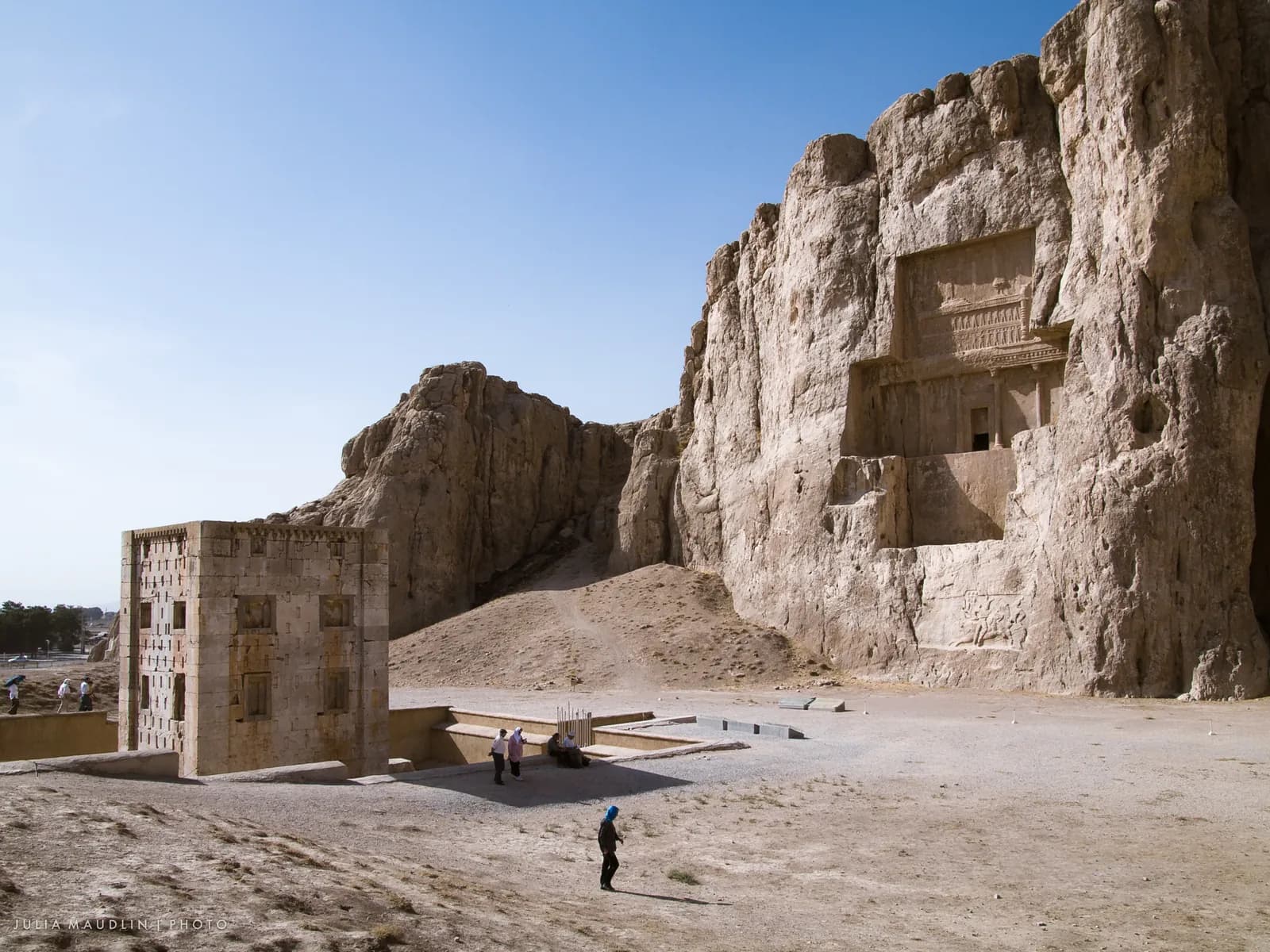
A cliff face on the north side of the plain, about six kilometres from Persepolis. The rock rises sheer from flat ground, which is what made it usable: the tombs are cut high in the face and are unreachable without scaffolding, and the reliefs below are at eye level to anyone approaching.
- Ancient region
- Persis
- Modern country
- Iran
- Position
- 29.989° N, 52.874° E — The tomb of Darius I
- Given to three decimal places, about a hundred metres. It locates the named feature, not the extent of the site.
What survives
Four tomb façades in the cliff, each about twenty-three metres high, cut as a cross: a blind columned porch below, a relief panel above showing the king before a fire altar on a platform carried by figures in the dress of the empire's peoples, and a small chamber behind with rock-cut sarcophagus troughs.
Below them, seven Sasanian reliefs in deep carving, the largest of them showing Shapur I mounted with a Roman emperor kneeling before him and another standing with his wrist held. Roman defeat, on a Persian cliff, at the scale of a building.
Opposite the cliff stands the Ka'ba-ye Zartosht: a square stone tower about twelve metres high with a single windowless upper chamber, blind windows in dark stone, and a stair. Its walls carry two of the most important inscriptions of the Sasanian period.
Occupation and chronology
Dates below are stored as signed years and rendered with the precision they actually carry. before 1000 BCE is approximate; c. 400 CE is approximate.
before 1000 BCE
The Elamite relief
The oldest carving on the cliff, largely cut away by a later Sasanian relief. What remains shows two figures in Elamite dress. It establishes that the place was already significant.
c. 486–400 BCE
The Achaemenid tombs
Four cruciform façades cut high in the rock, each with a columned portico and above it the king on a platform borne by the peoples of the empire, facing a fire altar.
3rd–4th centuries CE
The Sasanian reliefs
Seven large reliefs cut below and between the tombs: investitures, equestrian combats, and Shapur I's triumph over Rome. A new dynasty signing its name beneath the old one.
History of excavation
Who recovered the evidence, when, and by what method. Where an excavation destroyed as much as it found, the entry says so.
- Evidence level: Documented
1923 and 1936–1939
Ernst Herzfeld, then Erich Schmidt for the Oriental Institute, Chicago
Clearance around the Ka'ba, recording of the tombs and reliefs, and the first systematic photographic and epigraphic documentation. Schmidt's volume remains the standard publication.
- Evidence level: Documented
1936
The reading of the Shapur inscription
Excavation exposed the lower courses of the Ka'ba and with them the trilingual text of Shapur I in Middle Persian, Parthian and Greek — the fullest Sasanian royal document known, and the only one with a Greek version to check the readings against.
- Evidence level: Documented
1970s–present
Iranian antiquities authorities and joint missions
Conservation, survey of the surrounding plain, and continuing work on the Sasanian inscriptions, which are still producing readings.
Principal structures
The evidence level answers how we know what a structure looked like, not whether it existed.
- Evidence level: Documented
before 486 BCE
The tomb of Darius I
The only one identified from its own inscriptions. Darius's texts here, DNa and DNb, are on the façade beside the relief, which is why this tomb anchors the identification of the other three.
- Evidence level: Probable
5th century BCE
The three unnamed tombs
Attributed to Xerxes I, Artaxerxes I and Darius II on grounds of position, sequence and style. None carries a royal name. The attributions are conventional and reasonable, and they are attributions.
- Evidence level: Documented
5th century BCE
The Ka'ba-ye Zartosht
Standing almost intact. Fire temple, royal archive, coronation chamber, treasury and tomb have all been proposed. There is no interior fitting, no soot, no inscription of its own from the Achaemenid period, and no agreement.
- Evidence level: Documented
after 260 CE
The triumph of Shapur I
Shapur mounted, with Philip the Arab kneeling and Valerian held by the wrist. The Roman sources do not describe the capture in these terms, and the relief is the Persian account of the same events, carved at monumental scale.
Finds and where they went
Almost nothing recovered from these sites is still on them. Where an object has a full provenance record on this platform, it is linked.
- Evidence level: Documented
DNa and DNb
Darius's tomb inscriptions. DNa lists the lands he holds and names Ahuramazda as the giver of the kingship; DNb is a statement of the king's own qualities — self-control, judgement, the ability to distinguish a true accusation from a false one. It is the closest thing to an Achaemenid theory of rulership in the king's own words.
In position, Naqsh-e Rustam
- Evidence level: Documented
The Res Gestae of Shapur I
A trilingual inscription on the Ka'ba recording Shapur's campaigns against Rome, the capture of Valerian, the cities he took and the foundations he made. The Greek version is what allowed the Middle Persian and Parthian to be read with confidence.
In position, Naqsh-e Rustam
- Evidence level: Documented
The inscriptions of Kartir
The Zoroastrian priest Kartir's own account of his career under four kings, his promotion of the fires and the priesthood, and his measures against other religious communities. A rare case of a non-royal figure inscribing his own record on a royal monument.
In position, Naqsh-e Rustam
Ancient testimony
What ancient authors say about the place, and how far it can be trusted.
The tomb inscriptions of Darius I DNa, DNb
The king's list of lands and his account of his own conduct, carved on the façade. Achaemenid royal ideology in the first person, unmediated by Greek reporting.
Herodotus, Histories 3.88–97
Herodotus' account of Darius's satrapies and tribute. It should be read beside the DNa land list, which is a different kind of document making a different kind of claim about the same empire.
Diodorus Siculus, Library of History 17.71.7
Diodorus describes the tombs of the Persian kings cut high in a rock face, reachable only by machines, which is an accurate account of what a visitor to this cliff sees and the closest thing to an ancient description of it.
How the site has been interpreted
The tombs are an argument about empire, and the argument is in the relief rather than the text. The king stands on a platform held up by around thirty figures, each in the dress of a different people, each labelled in the parallel inscriptions. They are carrying him, not chained. Whatever the political reality of Achaemenid rule, the official self-image is of an empire held up by its constituent peoples rather than one holding them down — and it is worth comparing directly with how Greek writers described the same empire.
The Sasanian reliefs are a deliberate act of appropriation. Eight centuries after the Achaemenids fell, a new Persian dynasty carved its investitures and victories directly beneath their tombs, on the same cliff, in a place that had been continuously visible and continuously meaningful. Whether the Sasanians knew whose tombs these were is doubtful — their own traditions were vague about the Achaemenids — but they knew they were royal and ancient, and that was the point.
The Ka'ba is a standing reminder of how much is unknown. A complete Achaemenid building, in good condition, on the most important royal site in Persis, with no agreed function. Every proposal has an objection, and the honest position is that we do not know what it was for.
Reading this site for Zoroastrianism requires care. The tomb reliefs show a fire altar and name Ahuramazda; they do not show anything that securely identifies the religion of later Zoroastrian texts, and the burial of kings in rock chambers is difficult to reconcile with the exposure of the dead that those texts require. The Sasanian inscriptions, by contrast, are unambiguously Zoroastrian and eight centuries later.
Unresolved
Which king is in which tomb?
Darius I's is certain. For the rest, the sequence Xerxes I, Artaxerxes I, Darius II follows the order of the tombs along the cliff and the assumption that they were cut in reign order. Nothing rules out a different assignment, and the tombs were emptied long ago.
What was the Ka'ba-ye Zartosht for?
A fire temple is the traditional answer and is hard to sustain: the chamber is enclosed, unventilated and shows no burning. A repository for royal documents, a coronation chamber, a treasury and a tomb have all been argued. Its twin at Pasargadae, the Zendan, presents the same problem, which at least shows that whatever it was, it was a type.
How to read the evidence labels
- Evidence level: Documented
- Supported by a named primary text or by excavated material evidence.
- Evidence level: Probable
- Supported by strong inference that most specialists accept.
- Evidence level: Disputed
- Substantial specialist disagreement exists; competing readings are stated.
- Evidence level: Literary
- Belongs to poetic or mythological construction rather than to history.
- Evidence level: Mythological
- Belongs to shared religious or mythic tradition rather than to any single text.
- Evidence level: Unknown
- The available evidence is insufficient to decide.
These labels describe the status of the evidence, not our confidence in a conclusion. A claim marked Literary is not a claim we doubt; it is a claim about what kind of thing a poem is.