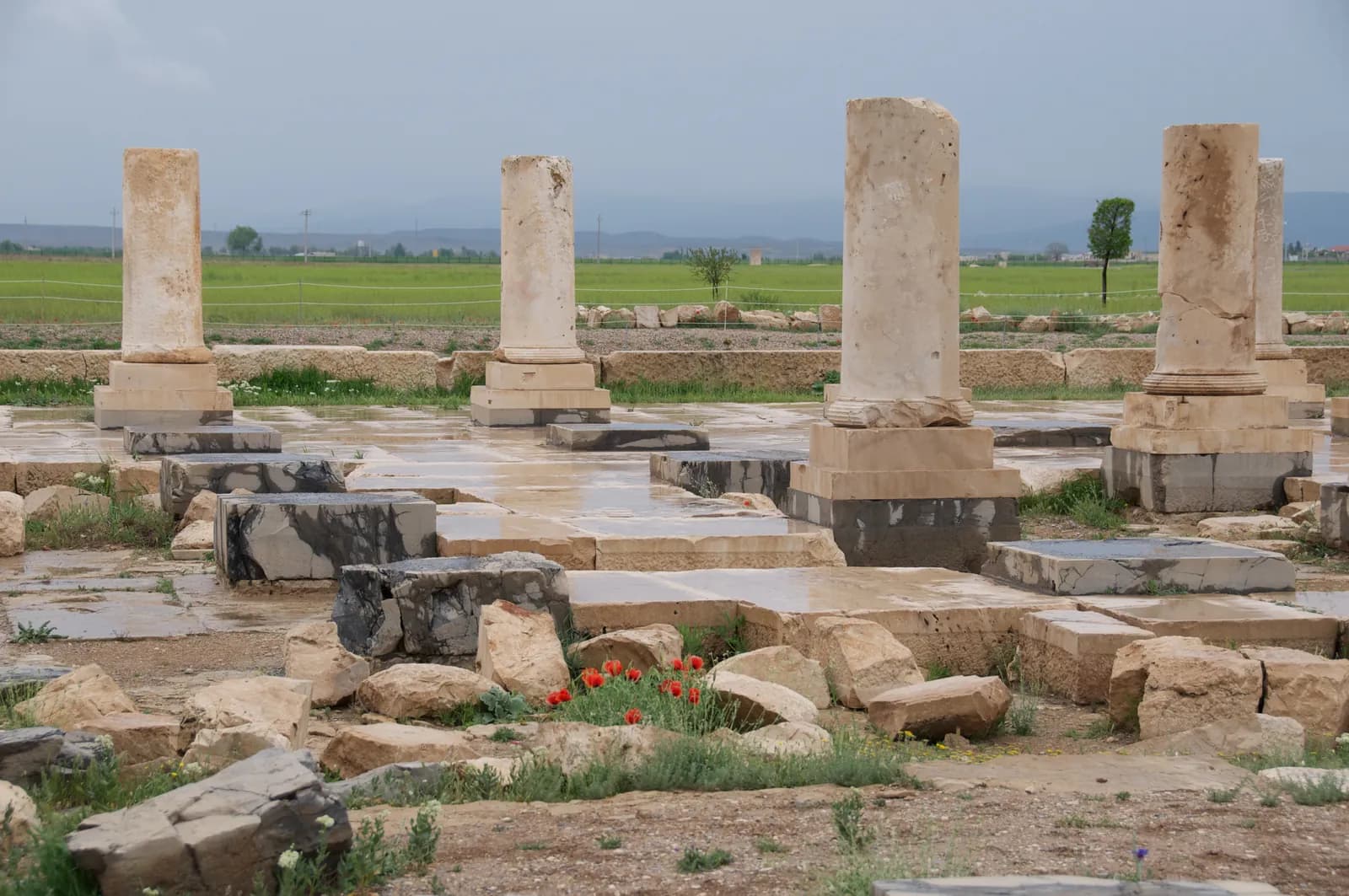
Where the site is
A high plain in Fars at about nineteen hundred metres, watered by the Pulvar river and open on all sides. Nothing about the position is defensive. The buildings are spread across a park rather than gathered behind a wall, which is itself a statement about how the first Persian king expected to be secure.
- Ancient region
- Persis
- Modern country
- Iran
- Position
- 30.194° N, 53.167° E — The tomb of Cyrus
- Given to three decimal places, about a hundred metres. It locates the named feature, not the extent of the site.
What survives
The tomb of Cyrus stands complete: a gabled stone chamber on a plinth of six receding steps, about eleven metres high, in the open. It is the oldest substantially intact free-standing stone monument in Iran and it looks like nothing else the Achaemenids built.
Elsewhere the site is low walls, column bases and single standing pieces spread over more than a kilometre — the audience palace, the residential palace, the gatehouse with its relief of a four-winged figure, and a tower called the Zendan whose purpose is not known.
Between them, excavation has recovered the stone channels and basins of a formal garden: straight watercourses dividing a planted area into quarters, with pavilions placed to look along them. It is the earliest known layout of this kind and it is the ancestor of a garden form that lasted two thousand years.
Occupation and chronology
Dates below are stored as signed years and rendered with the precision they actually carry. c. 546 BCE is approximate; c. 330 BCE is approximate.
c. 546–530 BCE
Cyrus's foundation
Palaces, gate, garden and tomb, begun after the defeat of Lydia and left incomplete when Cyrus died on campaign. Unfinished stonework is visible in several buildings.
530–330 BCE
Later Achaemenid use
Superseded as a working capital by Persepolis and Susa but retained as a ceremonial site, and reportedly the place of the royal investiture. The tomb had a body of priests attached to it.
330 and 324 BCE
Alexander
Alexander visited twice. On the second visit he found the tomb broken open and the body disturbed, and ordered it restored — an incident Arrian records from the eyewitness account of Aristobulus, who was given the job.
History of excavation
Who recovered the evidence, when, and by what method. Where an excavation destroyed as much as it found, the entry says so.
- Evidence level: Documented
1905 and 1928
Ernst Herzfeld
Survey and limited excavation, and the identification of the site with the Pasargadae of the Greek sources, which had been argued over since the eighteenth century.
- Evidence level: Documented
1949–1955
Ali Sami for the Iranian Archaeological Service
Clearance of the palaces and the gate, publishing the plans on which later work built.
- Evidence level: Documented
1961–1963
David Stronach, British Institute of Persian Studies
The excavation that produced the garden: the stone water channels, the pavilion positions and the planting pits. It changed the site from a group of buildings into a designed landscape.
- Evidence level: Documented
1999–present
Iranian and joint Iranian–French missions
Survey of the wider plain, work on the Tall-e Takht platform, and conservation of the tomb, which has suffered from stone decay and from the diversion of water in the surrounding agriculture.
Principal structures
The evidence level answers how we know what a structure looked like, not whether it existed.
- Evidence level: Documented
c. 530 BCE
The tomb of Cyrus
A gabled chamber on a stepped plinth, built in dressed limestone with metal cramps. Its form has been connected to Urartian, Lydian, Ionian and Elamite precedent and matches none of them exactly. It survived in part by being taken for the tomb of the mother of Solomon in the Islamic period.
- Evidence level: Documented
c. 540–530 BCE
Gate R and the four-winged figure
A gatehouse with a surviving relief of a standing figure with four wings, in an Elamite robe and an Egyptian hemhem crown. A genius, a protective spirit, and Cyrus himself have all been proposed; the figure has no attribute that decides it.
- Evidence level: Documented
c. 540–530 BCE
Palace P and Palace S
A residential palace and an audience hall, both columned, both with porticoes on more than one side — an openness the later palaces at Persepolis abandon.
- Evidence level: Documented
c. 540 BCE
The royal garden
Carved stone channels and basins defining a rectangular watered enclosure divided into quarters. The Greek word paradeisos comes from the Persian word for such an enclosure, and this is the earliest one excavated.
- Evidence level: Documented
c. 540–530 BCE
The Zendan-e Soleyman
A square stone tower, now standing to one corner, with a single upper chamber reached by a stair. Its twin at Naqsh-e Rustam is intact and equally unexplained.
Finds and where they went
Almost nothing recovered from these sites is still on them. Where an object has a full provenance record on this platform, it is linked.
- Evidence level: Disputed
The CMa inscription
A short trilingual text, once repeated on several buildings, reading “I, Cyrus the king, an Achaemenid”. Only fragments remain in place. Its date is the site's central problem: Old Persian cuneiform appears to have been devised under Darius, which would make these inscriptions a later addition claiming Cyrus for the Achaemenid line Darius belonged to.
In position, Pasargadae
- Evidence level: Documented
Achaemenid stone architecture in its first form
Column bases, door jambs with the feet of figures, and dressed masonry using techniques — anathyrosis, swallow-tail cramps — that come from Ionian and Lydian practice. The building tells the story of who Cyrus's masons were.
In position, Pasargadae
- Evidence level: Documented
The Pasargadae treasure
Gold and silver jewellery found in a jar in Palace P in the 1960s, of late Achaemenid date. One of the few precious-metal hoards from an Achaemenid palace context.
Ancient testimony
What ancient authors say about the place, and how far it can be trusted.
Arrian, Anabasis of Alexander 6.29
Arrian's account of Alexander at the tomb: the chamber, the golden coffin, the couch, the tapestries, the body disturbed by robbers, and Aristobulus given the task of restoring it. The fullest ancient description of a Persian royal burial, from a man who read the officers' memoirs.
Xenophon, Cyropaedia 8.7
Xenophon's death scene for Cyrus, in which the king instructs his sons about his burial and about the empire. Philosophical fiction rather than record, and it should be read against Arrian's account of what was actually in the tomb.
Herodotus, Histories 1.201–214
Herodotus on Cyrus's last campaign and death against the Massagetae, and on the dispute over what became of his body. A different tradition again, and a reminder that the Greeks had several.
How the site has been interpreted
Pasargadae is the moment before Achaemenid architecture became Achaemenid. The masonry is Lydian and Ionian in technique, the reliefs draw on Elamite and Egyptian conventions, the plan is dispersed across a garden, and there is no fortification wall. Twenty years later Darius built Persepolis on a walled terrace with a single processional route. The difference between the two sites is a change of political style set in stone.
The garden is the site's most consequential feature and the least visible. A quadripartite watered enclosure with pavilions on the axes is the direct ancestor of the Persian garden, of the Islamic chahar bagh, and through it of the formal European garden. That lineage begins in the stone channels Stronach excavated.
The tomb has been read as everything from a Zoroastrian compromise to a borrowing from Anatolia. What can be said is that Cyrus was interred in a built chamber, that a cult with an endowment was attached to it, and that the practice does not match the exposure of the dead that later Zoroastrian texts prescribe — which is one of several reasons for caution about calling the early Achaemenids Zoroastrian.
The epitaph everyone quotes is not on the building. Arrian and Strabo transmit a text they say stood on the tomb — asking the passer-by not to grudge the monument, since the man in it won the Persians an empire. No trace of any such inscription survives, and it comes to us through Greek authors reporting Alexander's officers.
Unresolved
Are the Cyrus inscriptions contemporary with Cyrus?
If Old Persian cuneiform was invented under Darius, as the majority position holds, then a monumental Old Persian inscription naming Cyrus as an Achaemenid cannot be from Cyrus's lifetime and is a retrospective claim — one that suits Darius, whose own descent from a common Achaemenid ancestor is exactly what the Behistun text asserts. A minority argues for an earlier development of the script. The stakes are high: the question is whether the Achaemenid dynasty as such existed before Darius said it did.
Who is the four-winged figure?
The identification with Cyrus rests largely on the proximity of the CMa inscription, which is itself in doubt. The crown is Egyptian, the dress Elamite, the wings Assyrian; a protective genius of a type common in Near Eastern gateways is the more economical reading. There is no attribute that names him.
How to read the evidence labels
- Evidence level: Documented
- Supported by a named primary text or by excavated material evidence.
- Evidence level: Probable
- Supported by strong inference that most specialists accept.
- Evidence level: Disputed
- Substantial specialist disagreement exists; competing readings are stated.
- Evidence level: Literary
- Belongs to poetic or mythological construction rather than to history.
- Evidence level: Mythological
- Belongs to shared religious or mythic tradition rather than to any single text.
- Evidence level: Unknown
- The available evidence is insufficient to decide.
These labels describe the status of the evidence, not our confidence in a conclusion. A claim marked Literary is not a claim we doubt; it is a claim about what kind of thing a poem is.