What it is
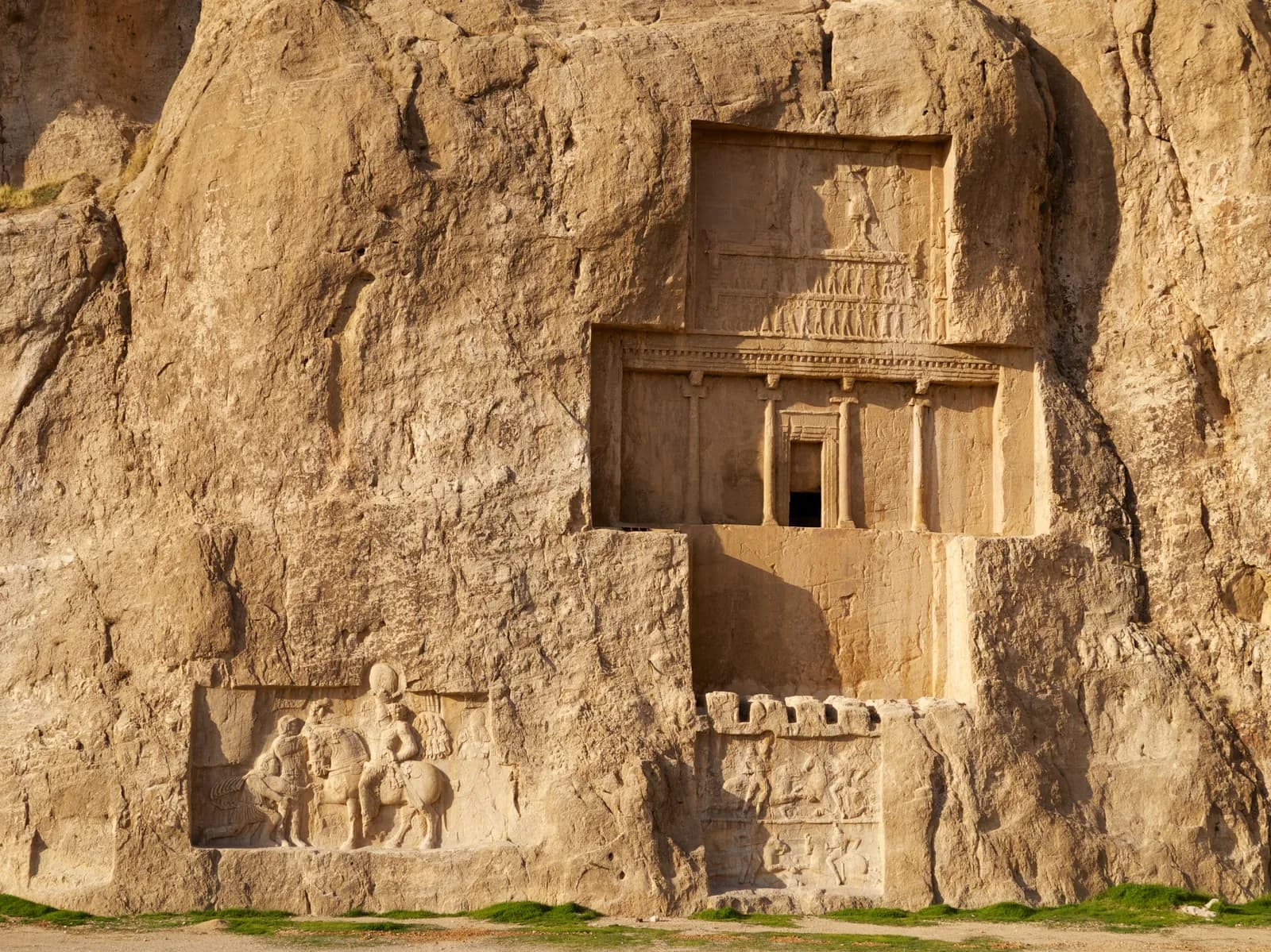
The tomb of Darius I at Naqsh-e Rustam — the cruciform façade, the throne carried by the peoples of the empire, and the DNa and DNb inscriptions.
Built Cut during Darius's reign and completed before his death in 486 BCE. The principal date, completed before 486 BCE, is range endpoint.
before 486 BCE
Cutting the tomb
The inscriptions are Darius's own and were cut while he lived; the tomb was prepared in advance, as Achaemenid royal tombs were.
antiquity
Robbery
The chambers were empty when first recorded. When they were emptied is not known; Alexander's period is one possibility among several.
3rd–4th centuries CE
Sasanian reliefs below
Cut beneath and between the Achaemenid tombs eight centuries later by a new Persian dynasty, without disturbing them.
Who ordered it built
Each attribution carries what supports it. Ancient buildings are routinely credited to people on the authority of writers centuries later, and that is not the same claim as an inscription on the building.
- Evidence level: Documented
Commissioned by
Darius I
The inscriptions DNa and DNb, cut on the façade in Old Persian, Elamite and Babylonian, are in his name and identify the tomb. No other Achaemenid rock tomb carries a royal name.
What it was for
A royal tomb: a cross-shaped façade cut into the cliff about fifteen metres above the ground, with a doorway at the centre of the cross leading to three chambers, each holding three rock-cut troughs for burials.
Nine burial places in one tomb indicates a family sepulchre rather than a single grave, though who else was interred there is not recorded.
How it was built
The cross form quotes a building: the lower arm is a blind columned porch with four engaged columns and bull capitals, so that the façade presents the front of a palace cut into a cliff.
Above it, a two-tier platform carried by thirty labelled figures in the dress of the empire's peoples, with the king standing on it before a fire altar under a winged figure and a disc.
The whole is carved, not built, and the technical achievement is a matter of scaffolding and of cutting to a plan on a vertical rock face fifteen metres up.
Materials
- Evidence level: Documented
Living rock
The entire monument, cut rather than built — there is no masonry
Measured
Every figure states what it rests on. A modern survey, an ancient text, a conversion from an ancient unit and a modern estimate are four different kinds of statement and are not interchangeable.
Façade
about 23 m high overall
Modern survey of the cliff face.
Height above ground
about 15 m to the doorway
Modern survey. The tomb is unreachable without scaffolding, which is presumably the point.
Throne-bearers
thirty figures, labelled
Count of the figures and of their inscribed trilingual labels on the relief.
What it meant
The throne-bearers are the empire's constitutional theory in an image. Thirty peoples, each named, each in their own dress, hold the king up; the arrangement is not of subjects beneath a conqueror but of a structure supported by its parts. Read beside Greek accounts of Persian despotism, it is a different account of the same state, offered by the state itself.
DNb is the closest thing to a Persian statement of what a king should be: that he holds himself in control, that he does not act on anger, that he judges by what he knows rather than by what is said, that he rewards and punishes by merit, and that he is trained to ride, to shoot and to spear. It is a document about self-command written by an autocrat, and it belongs beside the Greek philosophical material on rulership rather than in a footnote to it.
The king stands before a fire altar under a winged disc and the inscription names Ahuramazda as the giver of his kingship. That is Achaemenid royal ideology stated plainly; it is not, by itself, evidence for the doctrines of the Zoroastrian texts written centuries later.
The rock-cut chamber burial is again hard to square with the exposure of the dead that later Zoroastrian practice requires.
After antiquity
Emptied in antiquity. The cliff was reused by the Sasanians for their own reliefs, cut below the tombs, and one Elamite relief older than all of it was largely cut away in the process.
Recorded by European travellers from the seventeenth century and studied systematically by Herzfeld and by Erich Schmidt in the 1930s.
Condition today
Standing
The façade, reliefs and inscriptions are intact and legible. The chambers are empty. Weathering of the rock is the principal conservation concern.
Because the tomb is cut and not built, and because it was never buried, its evidence has always been the surface itself; the excavation at Naqsh-e Rustam concentrated on the Ka'ba-ye Zartosht and the ground below.
The identification of the three unnamed tombs on the same cliff as Xerxes I, Artaxerxes I and Darius II rests on their position and style relative to this one, which makes Darius's inscribed tomb the anchor for the whole group.
Written about in antiquity
Darius I, The tomb inscriptions DNa and DNb
Darius's list of the lands he holds, his attribution of the kingship to Ahuramazda, and his account of his own conduct as a ruler. Cut on the façade in three languages.
Herodotus, Histories 3.88–97
Herodotus on Darius's organisation of the empire into satrapies and their tribute — the same empire, listed by an outsider for a different purpose.
Diodorus Siculus, Library of History 17.71.7
Diodorus on the tombs of the Persian kings cut high in a rock face and reachable only by machines.
Still argued
Who else was buried in it?
Nine burial troughs in three chambers imply a family tomb. Ctesias reports a story that Darius's parents died trying to be hauled up to the tomb while it was being cut. Nothing identifies any occupant, and the chambers were empty when recorded.
How to read the evidence labels
- Evidence level: Documented
- Supported by a named primary text or by excavated material evidence.
- Evidence level: Probable
- Supported by strong inference that most specialists accept.
- Evidence level: Disputed
- Substantial specialist disagreement exists; competing readings are stated.
- Evidence level: Literary
- Belongs to poetic or mythological construction rather than to history.
- Evidence level: Mythological
- Belongs to shared religious or mythic tradition rather than to any single text.
- Evidence level: Unknown
- The available evidence is insufficient to decide.
These labels describe the status of the evidence, not our confidence in a conclusion. A claim marked Literary is not a claim we doubt; it is a claim about what kind of thing a poem is.