The site and its setting
Babylon stood on the Euphrates in central Mesopotamia, on the alluvial plain — no stone, no timber, and abundant clay, which determined that it would be built of mudbrick and that its monuments would be decorated rather than carved.
The river ran through the city, which was walled on both banks and connected by a bridge.
Foundation
An ancient foundation; the city rises to importance under Hammurabi in the 18th century BCE.
Attested in cuneiform records. The site's earlier levels are largely inaccessible because the water table has risen and the second-millennium city lies below it.
History of the settlement
Babylon became dominant in Mesopotamia under Hammurabi in the eighteenth century BCE, whose law code is the best-known document of the period.
After centuries of subjection to Assyria — and destruction by Sennacherib in 689 BCE — it rose again under the Neo-Babylonian kings. Nebuchadnezzar II rebuilt it on a monumental scale in the sixth century BCE, and it is his city that the excavations principally recovered.
It fell to Cyrus in 539 BCE and became an Achaemenid royal centre, was taken by Alexander, who died there in 323 BCE, and declined under the Seleucids as Seleucia on the Tigris drew away its population.
Urban plan
Nebuchadnezzar's city was laid out with a great processional way running from the Ishtar Gate south to the temple complex, past palaces on one side.
The inner city was walled, with an outer circuit beyond it. Herodotus describes walls of a size and a regularity that excavation has not confirmed, and his account of the city is one of the standard test cases for his reliability.
Etemenanki, the ziggurat of Marduk, stood in its own precinct beside Esagila, the god's temple. Only the foundations survive; the structure was dismantled in antiquity.
Economy and supply
Agriculture on irrigated alluvium, and long-distance trade along the rivers. Babylon was also a centre of scholarship: the astronomical diaries kept there over centuries are the longest continuous scientific record from the ancient world.
Those diaries are of direct historical use elsewhere on this platform: one of them records the lunar eclipse before Gaugamela and the outcome of the battle, independently of the Greek accounts.
Cult and sanctuaries
Marduk was the city god, and his temple Esagila and ziggurat Etemenanki were the religious centre. The New Year akitu festival, in which the king took the hand of the god, was the central ritual of legitimacy.
Etemenanki is generally taken to lie behind the Tower of Babel tradition in Genesis. The identification is widely accepted and is an inference rather than a stated equivalence.
The city at war
Babylon's walls were proverbial, and Herodotus counted them among the wonders of the world. The city nonetheless fell repeatedly — to Assyria, to Cyrus, to Alexander — and in 539 BCE the Persian entry appears to have met little resistance.
The Cyrus Cylinder, a Babylonian foundation document written for Cyrus after the conquest, presents him as restoring the cult of Marduk against an impious predecessor. It is a legitimating text produced by the conqueror, and it is regularly and wrongly described as a charter of human rights.
Population
Ancient population figures are quoted with a confidence the evidence never supported. Each estimate below carries what it rests on and what it is worth.
The Neo-Babylonian city
Often estimated at 100,000–200,000
Modern reconstruction from the walled area and assumed densities
No ancient count survives. The figures rest on the excavated circuit and on density assumptions borrowed from other Near Eastern cities. Babylon is commonly called the first city to exceed 200,000 people; that claim is an estimate presented as a record.
Monuments
- Evidence level: Documented
c. 575 BCE, Nebuchadnezzar II
The Ishtar Gate and Processional Way
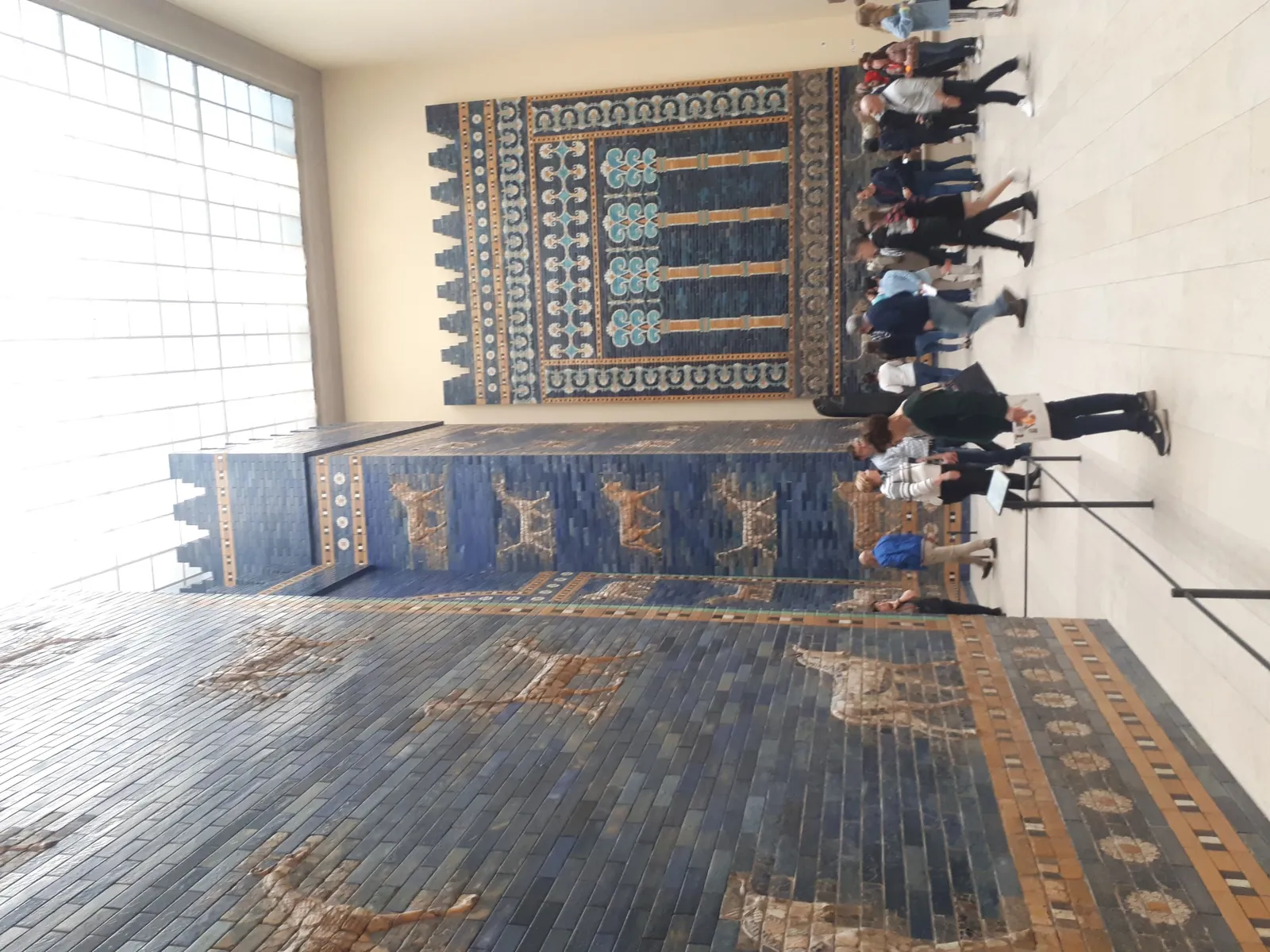
Glazed brick with moulded lions, bulls and dragons. A reconstruction using excavated bricks stands in the Pergamon Museum in Berlin; a smaller replica stands on the site.
- Evidence level: Documented
Rebuilt by Nabopolassar and Nebuchadnezzar II
Etemenanki
The ziggurat of Marduk. Only the foundation platform survives; the superstructure is known from cuneiform descriptions including the Esagila tablet.
- Evidence level: Documented
Rebuilt in the Neo-Babylonian period
Esagila
The temple of Marduk, only partly excavated because of the water table.
- Evidence level: Disputed
Attributed to Nebuchadnezzar II in later Greek sources
The Hanging Gardens
Not mentioned in any Babylonian source, not identified archaeologically at Babylon, and described only by Greek and Roman writers, none of whom claims to have seen them. See the dispute below.
Archaeology and excavation
Excavated by Robert Koldewey for the German Oriental Society from 1899 to 1917, in a campaign that recovered the Neo-Babylonian city and shipped enormous quantities of glazed brick to Berlin, where the Ishtar Gate was reconstructed. From the 1980s the Iraqi state rebuilt parts of the site on top of the ancient walls, with bricks stamped in the name of the head of state, damaging the archaeology. Further damage was done when the site was used as a military base after 2003. It was inscribed as a UNESCO World Heritage Site in 2019.
Two conditions limit what can be known. The water table has risen since antiquity, putting the second-millennium city of Hammurabi's period below reach; and the reconstruction and military use of the site have compromised parts of the record permanently.
Museum collections
Where the finds are now. Where a holding is contested, the entry says so.
Pergamon Museum · Berlin, Germany
The reconstructed Ishtar Gate and a section of the Processional Way, assembled from excavated glazed bricks, together with other material from Koldewey's excavations.
The reconstruction is built from original bricks with modern infill. The scale of the export reflects the terms under which the excavation was conducted and is part of the objects' modern history.
Iraq Museum · Baghdad, Iraq
Babylonian material, including objects recovered after the looting of 2003.
British Museum · London
The Cyrus Cylinder, Babylonian astronomical diaries and extensive cuneiform tablets.
Louvre · Paris, France
The Code of Hammurabi stele — taken from Babylon to Susa as booty in antiquity, and excavated there.
Open questions
Did the Hanging Gardens exist at Babylon?
No Babylonian text mentions them, including Nebuchadnezzar's own extensive building inscriptions, and no structure at Babylon has been identified with them. All the descriptions are Greek and Roman and are later. One influential proposal, argued by Stephanie Dalley, relocates them to Nineveh and attributes them to Sennacherib, on the basis of Assyrian texts and reliefs describing an elaborate irrigated garden and a screw-lifting technology. The proposal is taken seriously and is not established; the alternative is that the gardens are a literary construction.
How reliable is Herodotus on Babylon?
His measurements of the walls are far larger than the excavated circuits, and several of his descriptions of custom have no support. Some scholars hold that he never visited; others that he reports what he was told with the usual distortions of travellers' information. His account should not be used as a plan of the city.
Primary sources
Herodotus, Histories 1.178-200
The description of the city, its walls and its customs — famous, detailed and substantially unconfirmed by excavation.
Achaemenid administration at Babylon, The Cyrus Cylinder BM 90920
A Babylonian foundation text produced for Cyrus after the conquest of 539 BCE, presenting him as the restorer of Marduk's cult.
Babylonian astronomers, Babylonian astronomical diaries from the 7th century BCE onward
The longest continuous observational record from antiquity, including the entry covering the campaign of Gaugamela.
Hammurabi, The Code of Hammurabi stele, Louvre Sb 8
An 18th-century BCE law collection inscribed on a diorite stele, carried to Susa as booty and excavated there in 1901.
How to read the evidence labels
- Evidence level: Documented
- Supported by a named primary text or by excavated material evidence.
- Evidence level: Probable
- Supported by strong inference that most specialists accept.
- Evidence level: Disputed
- Substantial specialist disagreement exists; competing readings are stated.
- Evidence level: Literary
- Belongs to poetic or mythological construction rather than to history.
- Evidence level: Mythological
- Belongs to shared religious or mythic tradition rather than to any single text.
- Evidence level: Unknown
- The available evidence is insufficient to decide.
These labels describe the status of the evidence, not our confidence in a conclusion. A claim marked Literary is not a claim we doubt; it is a claim about what kind of thing a poem is.