What it is
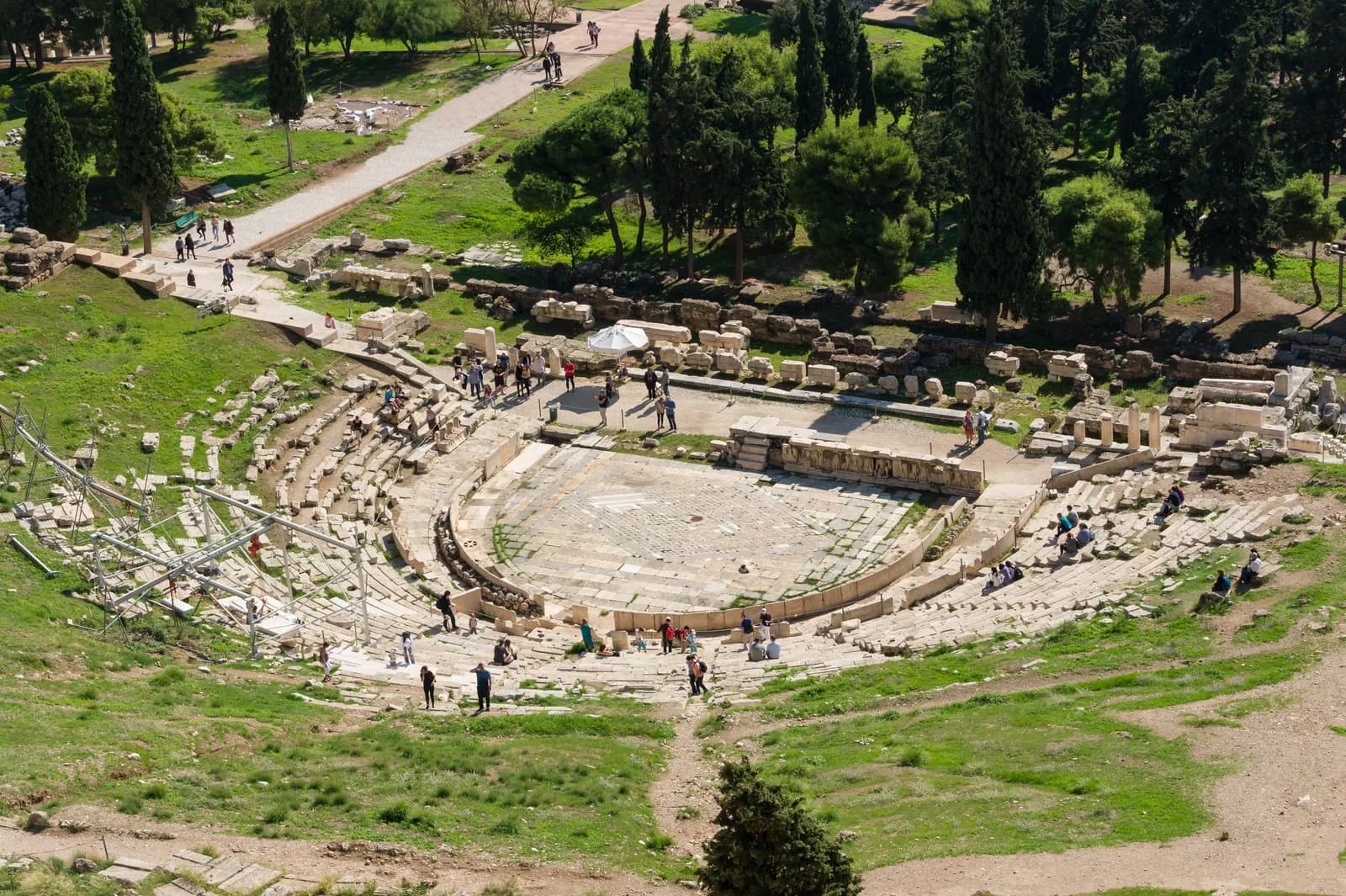
The Theatre of Dionysus — the wooden fifth-century theatre under the stone Lycurgan one, the sanctuary of Dionysus Eleuthereus, the priests' thrones, and the argument about the shape of the orchestra.
Built Performances from the 6th century BCE; the stone auditorium built c. 342–326 BCE. The principal date, the stone theatre c. 342–326 BCE, is approximate.
6th–5th centuries BCE
The early theatre
An orchestra in the sanctuary with wooden seating on the slope. This is the theatre of Aeschylus, Sophocles, Euripides and Aristophanes, and almost nothing of it survives.
c. 342–326 BCE
The Lycurgan rebuilding
The stone auditorium and stage building, associated with the financial administration of Lycurgus. The visible seating belongs to this phase, sixty years after the last of the great tragedians died.
2nd century BCE – 4th century CE
Hellenistic and Roman remodelling
The stage building rebuilt repeatedly; under Rome the orchestra was given a marble balustrade and paving, and a relief-decorated platform, the bema of Phaedrus, was inserted using recut Hellenistic panels.
Who ordered it built
Each attribution carries what supports it. Ancient buildings are routinely credited to people on the authority of writers centuries later, and that is not the same claim as an inscription on the building.
- Evidence level: Probable
Commissioned by
Lycurgus of Athens
The Lives of the Ten Orators credits Lycurgus with completing the theatre during his control of Athenian finances in the 330s. The association is ancient and the precise extent of his role is not documented.
What it was for
The theatre of the City Dionysia, the festival at which tragedies and comedies were produced in competition, within the sanctuary of Dionysus Eleuthereus whose temples stand below the auditorium.
It was also an assembly place. The Athenian assembly met here on occasion, and the theatre was used for civic ceremonies before the plays: the display of allied tribute, the announcement of honours, and the parade of the war orphans raised at public expense. Those ceremonies are part of what a tragedy was performed after.
How it was built
The auditorium is cut into the natural slope of the Acropolis rock and extended on built retaining walls, in the standard Greek arrangement that makes a theatre a piece of landscape engineering.
The front row carries sixty-seven marble thrones with inscribed names of the priesthoods and offices entitled to them, the central and grandest being that of the priest of Dionysus Eleuthereus. They are Hellenistic and Roman, and they are the clearest surviving evidence of how a Greek civic audience was ranked.
The Roman bema of Phaedrus at the front of the stage is built from reused Hellenistic relief panels showing the life of Dionysus, cut down to fit — spoliation of the same kind as the Arch of Constantine, three centuries earlier and on a smaller scale.
Materials
- Evidence level: Documented
Piraeus limestone
The Lycurgan seating and retaining walls
- Evidence level: Documented
Pentelic marble
The front row of thrones and the Roman-period orchestra pavement and balustrade
Measured
Every figure states what it rests on. A modern survey, an ancient text, a conversion from an ancient unit and a modern estimate are four different kinds of statement and are not interchangeable.
Capacity
commonly estimated at 14,000–17,000
Modern estimates from the surviving seating and the extent of the auditorium. Plato's Symposium mentions Agathon's audience as more than thirty thousand, which is rhetorical. No ancient count exists.
Orchestra
about 20 m across in the Roman phase
Modern survey of the surviving paving and balustrade.
What it meant
Tragedy was produced at a state festival, funded by wealthy citizens under a public obligation, judged by a panel selected by lot from the tribes, and performed in front of the assembled citizen body after a display of the empire's tribute. The institutional frame is not background to the plays; it is the occasion they were written for.
The theatre's use for assemblies and for honours shows how thin the line between civic and dramatic space was. The same benches held the same men in both capacities.
The theatre sits inside a sanctuary. The temple of Dionysus Eleuthereus stands below it, the god's image was brought into the theatre for the festival, and the performances were an act of cult.
That does not make the plays religious texts, and the platform does not treat them as such. It means the occasion was a festival of a god, and the plays were offered at it.
After antiquity
Remodelled under Rome for spectacles the Greek building was not designed for, including a waterproofed orchestra. Abandoned in late antiquity and built over.
Excavated from 1862 by the German Archaeological Institute and then by Wilhelm Dörpfeld, whose reconstruction of the early theatre has shaped the argument ever since.
Condition today
Standing ruin
The lower seating with its thrones, the orchestra with its Roman paving, and the foundations of the stage buildings and of the temples below. The upper auditorium is largely gone.
Excavation found remains of an earlier orchestra and of curved and straight retaining walls beneath the Lycurgan theatre. Dörpfeld read them as a circular orchestra of the fifth century; later work identified rectilinear elements that do not fit that reconstruction.
The consequence is direct: the shape of the space Aeschylus and Sophocles wrote for is not established, and every reconstruction of fifth-century staging rests on a contested plan.
Scattered fragments
What has left the building, and where it is now. Where a holding is contested, the museum page says so.
- Evidence level: Documented
The relief panels reused in the bema of Phaedrus
In position
Written about in antiquity
Aristotle, Poetics 1449a–1453a
Aristotle on the development of tragedy, the number of actors, the chorus and the structure of a play — written in Athens within a generation of the stone theatre being built.
Pausanias, Description of Greece 1.20–21
Pausanias on the sanctuary and the theatre, and on the statues of the tragedians set up there.
Lives of the Ten Orators 841d, 852c
The completion of the theatre attributed to Lycurgus, together with his decree that official copies of the tragedies be kept and that actors not depart from them.
Still argued
Was the fifth-century orchestra circular?
Dörpfeld's circular orchestra became the standard reconstruction and underlies most modern staging of Greek tragedy. Later excavation identified straight foundations that suggest a rectilinear or trapezoidal space, and the circular form may be an invention of the fourth-century rebuilding. The plays were written for a space whose shape is genuinely uncertain.
How many people did it hold?
Estimates range from around fourteen thousand to seventeen thousand and depend on how much of the lost upper auditorium is restored and on assumed seat width. Ancient figures are rhetorical. The number matters because arguments about whether the theatre audience was the citizen body turn on it.
How to read the evidence labels
- Evidence level: Documented
- Supported by a named primary text or by excavated material evidence.
- Evidence level: Probable
- Supported by strong inference that most specialists accept.
- Evidence level: Disputed
- Substantial specialist disagreement exists; competing readings are stated.
- Evidence level: Literary
- Belongs to poetic or mythological construction rather than to history.
- Evidence level: Mythological
- Belongs to shared religious or mythic tradition rather than to any single text.
- Evidence level: Unknown
- The available evidence is insufficient to decide.
These labels describe the status of the evidence, not our confidence in a conclusion. A claim marked Literary is not a claim we doubt; it is a claim about what kind of thing a poem is.