What it is
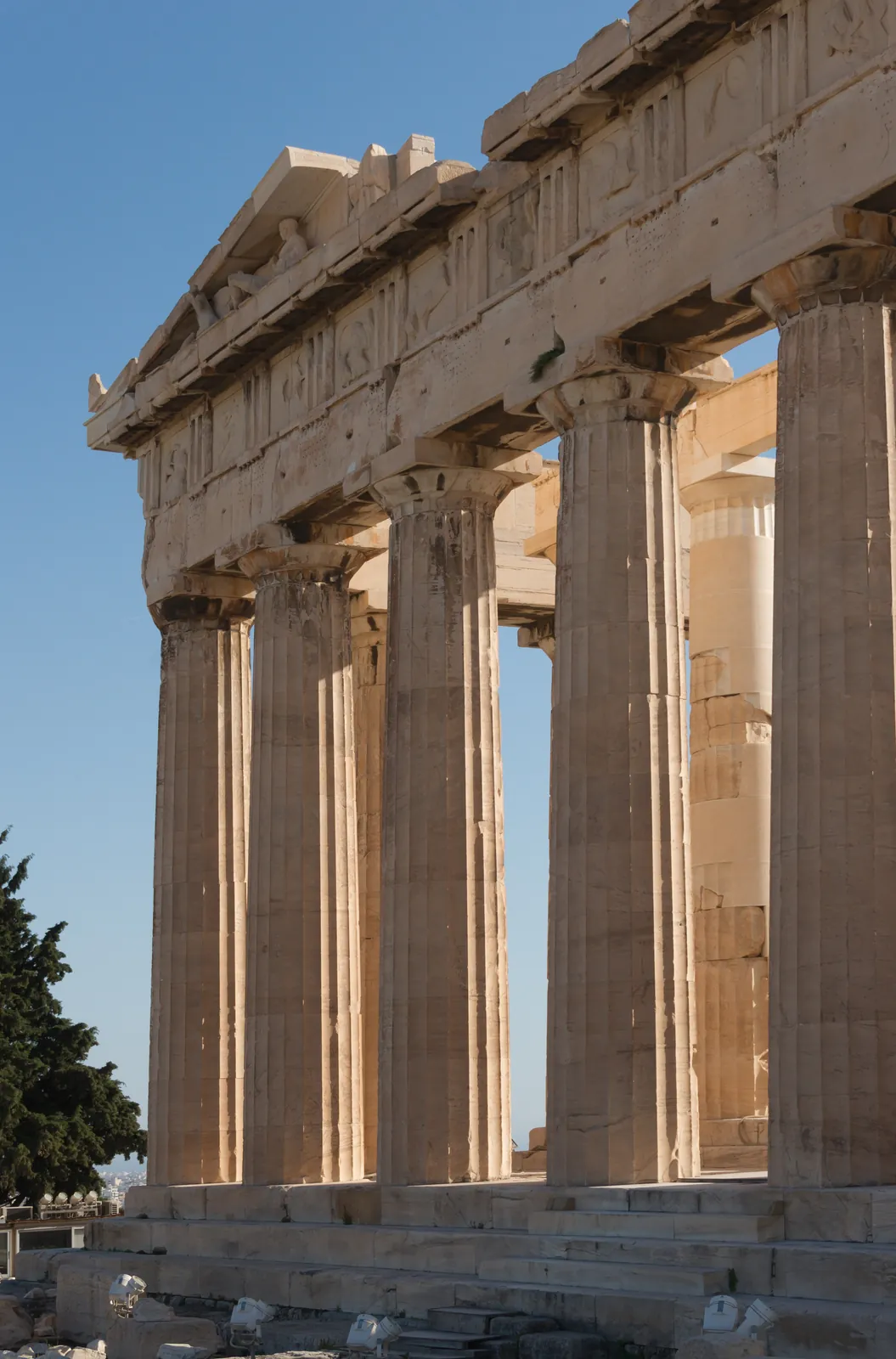
The Parthenon — Iktinos and Kallikrates, the optical refinements, the Athena Parthenos and its removable gold, the 1687 explosion, and the sculptures divided between Athens and London.
Built Built 447–432 BCE; sculpture completed 432. The principal date, 447–432 BCE, is fixed.
c. 490–480 BCE
The Older Parthenon
An earlier temple begun on the same platform after Marathon and destroyed unfinished by the Persians in 480. Its column drums were built into the Acropolis north wall in plain view.
447–438 BCE
The Periclean building
Dated precisely because the Athenians published the annual building accounts on stone and enough of them survive.
438–432 BCE
The sculpture
The pediments were finished after the building was dedicated. The accounts distinguish the two.
6th century CE – 1687
Church, then mosque
Converted to a church of the Virgin, then a Latin cathedral, then a mosque after 1458. Each conversion altered the interior and, in the Christian phase, destroyed the centre of the east pediment to make an apse.
26 September 1687
The explosion
The Ottoman garrison used the building as a powder magazine during the Venetian siege. A mortar shell reached it and blew out the centre of the building.
Who ordered it built
Each attribution carries what supports it. Ancient buildings are routinely credited to people on the authority of writers centuries later, and that is not the same claim as an inscription on the building.
- Evidence level: Probable
Architect
Iktinos
Named by Plutarch, Life of Pericles 13, and by Vitruvius 7.pref.12, who says he wrote a book about the temple with Karpion. Both are centuries later. No building account names an architect.
- Evidence level: Probable
Architect
Kallikrates
Named alongside Iktinos by Plutarch. Otherwise attested in inscriptions for other Athenian projects.
- Evidence level: Probable
Sculptor
Pheidias
Plutarch, Life of Pericles 13, makes him overseer of the whole programme and the maker of the cult statue. His responsibility for the architectural sculpture is an inference from that.
- Evidence level: Documented
Commissioned by
The Athenian demos
The building accounts, published annually on stone, record the assembly's appointment of commissioners and the sources of the money.
What it was for
A temple of Athena Parthenos, and a treasury. The rear chamber — the room actually called the parthenon in the accounts, before the name spread to the whole building — held the reserves of the goddess, and the inventories of what was in it were published on stone year by year.
It had no altar in front of it and did not replace the older temple of Athena Polias as the focus of the city's principal cult, which stayed with the ancient olive-wood statue housed in the Erechtheion. The Parthenon is a votive building on a colossal scale rather than the working centre of Athenian religion.
How it was built
The building is famous for having almost no straight lines. The stylobate curves upward at the centre, the columns lean inward and swell slightly in the middle, the corner columns are thicker and more closely spaced, and the entablature follows the curve. Every one of these is measurable and none is accidental.
Why they were done is a separate question. The traditional explanation, that they correct optical distortion, comes from Vitruvius; the alternative, that they animate the building and make it look alive rather than correct, is a modern reading. Both are interpretations of a fact that is beyond dispute.
Structurally it is ordinary Greek post-and-lintel work in marble, executed to a tolerance that is not ordinary at all. Blocks were finished in place after setting, joints are close enough to be invisible at arm's length, and the drums were joined by central wooden dowels that let each be ground against the next.
Its Ionic frieze inside a Doric peristyle is an unusual mixing of the orders, and its unusually wide cella carries a two-storey internal colonnade to hold the roof over the statue.
Materials
- Evidence level: Documented
Pentelic marble
The entire building, including the roof tiles, quarried sixteen kilometres away on Mount Pentelikon
- Evidence level: Documented
Gold and ivory
The cult statue: ivory for flesh, gold for the drapery, over a wooden core
- Evidence level: Documented
Iron and lead
Clamps and dowels joining the blocks, set in lead — the corrosion of replacements for these is what the modern restoration exists to reverse
- Evidence level: Documented
Paint
The sculpture and architectural mouldings were painted; traces survive and have been detected by non-contact imaging
Measured
Every figure states what it rests on. A modern survey, an ancient text, a conversion from an ancient unit and a modern estimate are four different kinds of statement and are not interchangeable.
Stylobate
about 69.5 × 30.9 m
Modern survey of the platform.
Column height
about 10.4 m, with 8 columns on the front and 17 on the flanks
Modern survey.
Curvature of the stylobate
rising about 11 cm at the centre of the long sides
Modern survey. The platform is not flat and the correction is deliberate.
Gold on the cult statue
forty talents, perhaps about a tonne
Thucydides 2.13, reporting Pericles' account of Athenian reserves, gives forty talents of removable gold. The conversion to modern weight depends on which talent standard is used and is approximate.
Ionic frieze
about 160 m long
Modern measurement of the surviving blocks and the reconstructed sequence.
What it meant
The programme was funded in substantial part from the tribute of the Delian League, moved to Athens from Delos in 454, and the decision was contested in Athens at the time. Plutarch preserves the charge — that the city was gilding herself like a vain woman with her allies' money — and Pericles' answer, that Athens owed the allies protection and not an account.
The gold on the statue was deliberately removable and was counted as part of the state's war reserve. A temple that doubles as a strategic asset says something about the relationship between Athenian religion and Athenian finance that no amount of writing about ideal beauty conveys.
The building went up on the ruins of the temple the Persians burned, within a generation, using the same platform. That is a statement about survival and it was legible to anyone who had seen the rock in 479.
Athena Parthenos, the virgin Athena, in a temple with no altar, alongside a working cult that continued elsewhere on the rock. The Parthenon is where the polis expressed itself to the goddess at maximum expense; it is not where the daily business of her cult happened.
The frieze is the single greatest interpretative problem in Greek art. The traditional identification with the Panathenaic procession runs into the difficulty that no Greek temple otherwise shows contemporary Athenians on a sacred building.
After antiquity
Church, cathedral and mosque in turn. The Christian conversion cut an apse through the east end and destroyed the centre of that pediment; the Ottoman phase added a minaret inside the ruined cella after 1687.
The explosion of 1687 blew out the long walls and much of the colonnades and threw sculpture to the ground. Morosini then tried to lower the horses of Athena from the west pediment as a trophy, dropped them, and destroyed them.
Between 1801 and 1812 agents of Lord Elgin removed roughly half of the surviving frieze, fifteen metopes and pedimental figures. They were sold to the British Museum in 1816. Greece has sought their return since the 1980s.
Condition today
Standing ruin
The colonnades stand around a roofless shell. The centre of the building is missing. All sculpture on the building is cast; the originals are in the Acropolis Museum and the British Museum.
Nikolaos Balanos re-erected columns between 1898 and the 1930s using iron clamps set without insulation. The iron rusted, expanded and split the marble from inside, and blocks were reassembled in wrong sequence.
The Acropolis Restoration Service has been undoing that work since 1975: dismantling, removing the iron, replacing it with titanium, returning blocks to their correct positions where these can be established, and documenting everything so the process is reversible. It is one of the very few large heritage projects that treats its own methods as provisional.
The building accounts, published annually on stone and surviving in fragments, fix the construction dates and record the money's sources. Almost no other ancient building can be dated this way.
Study during the modern restoration has recovered the working methods in detail — tool marks, setting lines, the sequence of finishing — and has established that many blocks Balanos reassembled were in the wrong place.
Scattered fragments
What has left the building, and where it is now. Where a holding is contested, the museum page says so.
- Evidence level: Documented
Frieze, metopes and pedimental sculpture remaining in Athens
- Evidence level: Documented
Roughly half the surviving frieze, fifteen metopes and pedimental figures removed 1801–1812
- Evidence level: Documented
Scattered blocks in the Louvre, Copenhagen, Vienna, Munich and Würzburg
Written about in antiquity
Plutarch, Life of Pericles 12–13
Plutarch on the building programme: the political attack on the use of allied money, Pericles' reply, the speed of the work, and the names of Iktinos, Kallikrates and Pheidias. Five centuries after the event, from earlier sources.
Thucydides, History of the Peloponnesian War 2.13
Thucydides has Pericles list Athenian reserves, including the forty talents of removable gold on the statue of Athena. The temple as a war chest, stated by a contemporary.
Pausanias, Description of Greece 1.24
Pausanias walks into the building in the second century CE and describes the pediments and the statue. The only surviving ancient description of what the sculpture showed.
Still argued
What does the frieze represent?
The traditional identification is the Panathenaic procession. Alternatives include the sacrifice of the daughters of Erechtheus, the heroised dead of Marathon, and an idealised citizen body outside any single occasion. No ancient text describes the frieze, and Pausanias, who describes the pediments, does not mention it.
Where should the sculptures be?
Greece argues that the removal took place under an occupying power without valid title and that a single programme should be reunited within sight of the building. The British Museum has argued that the acquisition was lawful by the standards of the time, that its trustees are constrained by statute, and that the collection provides comparative context. The original Ottoman authorisation has never been produced; what survives is an Italian translation of contested standing.
How to read the evidence labels
- Evidence level: Documented
- Supported by a named primary text or by excavated material evidence.
- Evidence level: Probable
- Supported by strong inference that most specialists accept.
- Evidence level: Disputed
- Substantial specialist disagreement exists; competing readings are stated.
- Evidence level: Literary
- Belongs to poetic or mythological construction rather than to history.
- Evidence level: Mythological
- Belongs to shared religious or mythic tradition rather than to any single text.
- Evidence level: Unknown
- The available evidence is insufficient to decide.
These labels describe the status of the evidence, not our confidence in a conclusion. A claim marked Literary is not a claim we doubt; it is a claim about what kind of thing a poem is.