What it is
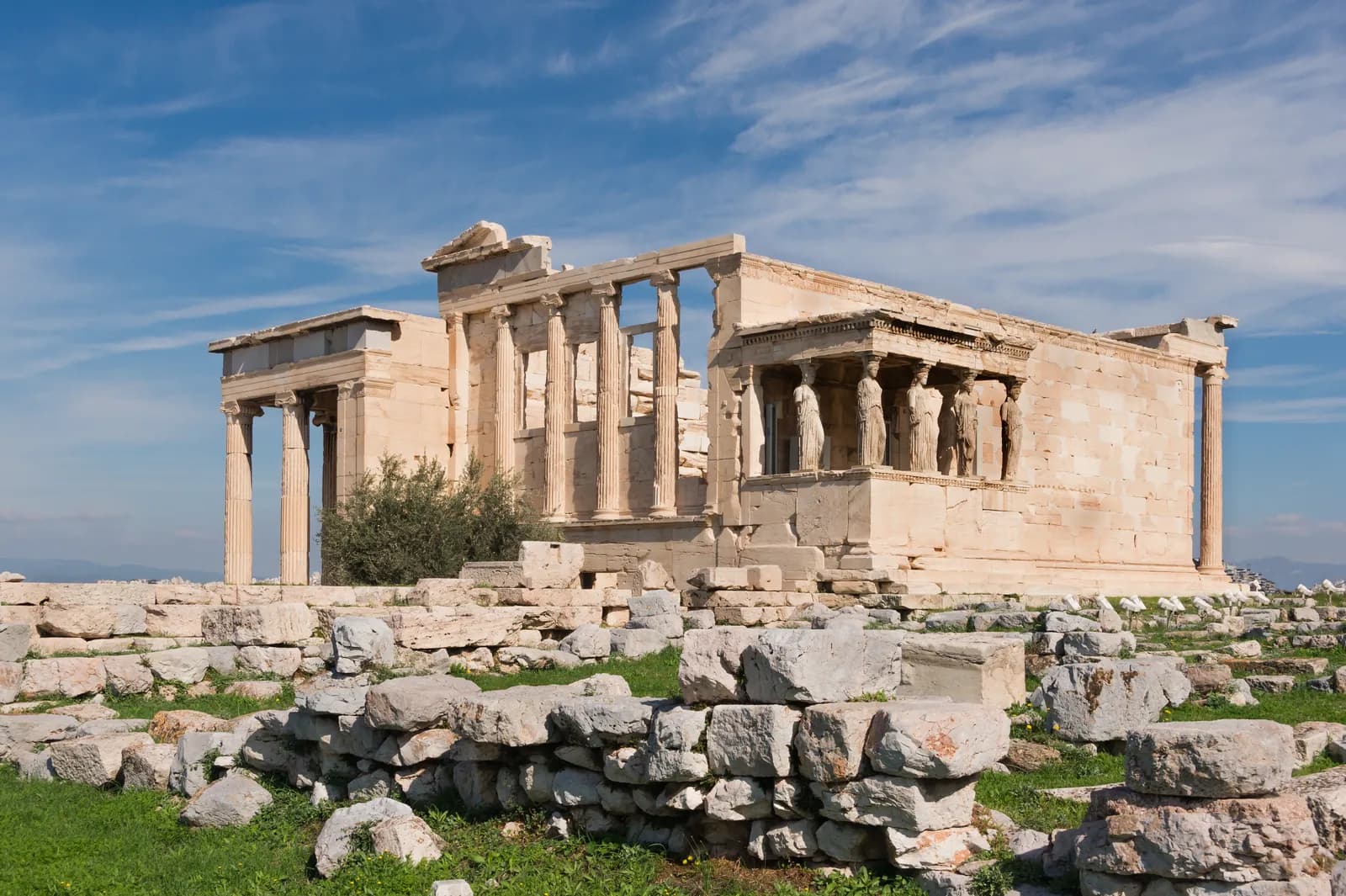
The Erechtheion — the cults it housed, the caryatid porch and the one in London, the inspection inscription of 409/8 BCE, and why the plan is irregular.
Built Built c. 421–406 BCE, with work interrupted by the war. The principal date, c. 421–406 BCE, is approximate.
6th century BCE
The old temple of Athena Polias
The archaic temple whose foundations lie between the Erechtheion and the Parthenon, burned by the Persians in 480 and never fully rebuilt.
c. 421–415 BCE
Construction
Begun during the Peace of Nikias and halted, probably when the Sicilian expedition consumed the city's resources.
409–406 BCE
Completion
Resumed and finished. The inspection inscription of 409/8 lists every piece of unfinished work on the building, block by block, and is the single best document of Greek building practice.
Who ordered it built
Each attribution carries what supports it. Ancient buildings are routinely credited to people on the authority of writers centuries later, and that is not the same claim as an inscription on the building.
- Evidence level: Documented
Architect
Philokles
Named as architect in the inspection inscription of 409/8 BCE, a contemporary Athenian public document — a level of evidence almost no other Greek building has.
- Evidence level: Disputed
Architect
Mnesikles
Sometimes proposed on stylistic grounds and on his known work on the Propylaia. No ancient source attaches him to this building.
What it was for
A single building holding several cults that could not be moved: the ancient olive-wood statue of Athena Polias, which was the city's real cult image; the olive tree Athena was said to have produced in the contest with Poseidon; the salt spring and the trident marks of Poseidon; the tomb of Kekrops; and altars of Hephaistos and Boutes.
The Panathenaic robe was presented to the olive-wood statue here, not in the Parthenon. Athens's principal religious act happened in this building.
The priestess of Athena Polias, one of the most important public offices held by a woman in the Greek world, served here, and it was a hereditary position in a single family.
How it was built
The plan is irregular because the cults are fixed in place. There is an east porch at one level, a large north porch at a level about three metres lower, and the small south porch of the caryatids between them; the interior is divided into rooms serving different deities, and the whole thing works as several buildings sharing walls.
The carving is among the finest surviving Ionic work anywhere: the north door frame, the capitals with their double volutes and inlaid palmettes, and the wall crown moulding are the reference examples of the order, and were copied directly in the Roman period and again in the eighteenth century.
The caryatid porch stands over the supposed tomb of Kekrops. Its six figures carry the entablature on their heads, with the weight taken through the straight supporting leg — an engineering solution disguised as drapery.
Materials
- Evidence level: Documented
Pentelic marble
The building throughout
- Evidence level: Documented
Eleusinian grey limestone
The frieze background, against which white marble figures were attached separately — a technique used almost nowhere else
Measured
Every figure states what it rests on. A modern survey, an ancient text, a conversion from an ancient unit and a modern estimate are four different kinds of statement and are not interchangeable.
Main block
about 22.8 × 11.6 m
Modern survey.
Level difference across the building
about 3 m between the east and the north-west
Modern survey. The site's rock falls away, and the plan follows it rather than levelling it.
Caryatids
six, about 2.3 m tall
Modern measurement of the figures.
What it meant
The building's construction record is a document about a city under strain. Work stops, resumes and is inspected in detail while Athens is losing a war, and the inscription of 409/8 was published precisely because public money needed accounting for at a moment when there was very little of it.
That the ancient olive-wood statue mattered more than the gold and ivory Athena next door is worth stating plainly. Athenian religion was conservative about objects: the older, cruder, more obviously ancient image held the cult, and the masterpiece was a dedication.
The contest of Athena and Poseidon for Attica is the founding story of the city, and the building encloses its physical evidence: a tree, a spring, and marks in the rock. Pausanias reports that the sea water in the well made a sound of waves when the south wind blew, and that the olive burned by the Persians grew back a cubit in a day.
Those are cult claims reported by a visitor, and the platform records them as such. The tree, the well and the marks were shown; what they were taken to prove is a different order of statement.
After antiquity
Converted to a church, and under the Ottomans used as the residence of the garrison commander's family. Damaged in the Venetian bombardment of 1687 and again in the Greek war of independence.
One caryatid was removed by Lord Elgin's agents around 1801 and is in the British Museum; a brick pier was put in its place until a cast was substituted.
The remaining five were taken indoors in 1979 because of atmospheric pollution and replaced on the building by casts. They are now displayed together in the Acropolis Museum with a gap where the sixth would stand.
Condition today
Standing ruin
Standing to roof level with its porches, extensively restored. All six caryatids on the building are casts.
Rebuilt in part by Balanos in 1902–1909, with the usual iron, and comprehensively dismantled and reassembled by the Acropolis Restoration Service between 1979 and 1987 — the first of the modern Acropolis interventions, and the one that established the method used since.
The inspection inscription of 409/8 BCE records the state of every unfinished element: which blocks were fluted, which were still rough, which needed lifting, and what remained to be paid. It is a snapshot of a Greek building site.
Excavation established the relationship to the burned archaic temple beside it and the position of the older cult installations the building was designed around.
Scattered fragments
What has left the building, and where it is now. Where a holding is contested, the museum page says so.
- Evidence level: Documented
The fifth caryatid, removed c. 1801
- Evidence level: Documented
The five caryatids remaining in Athens, withdrawn from the building in 1979
- Evidence level: Documented
A column from the north porch, removed with the caryatid
Written about in antiquity
Pausanias, Description of Greece 1.26–27
Pausanias on the building: the olive, the salt well that sounds like the sea in a south wind, the trident marks, the old wooden statue said to have fallen from heaven, and the ritual of the Arrephoroi.
The inspection inscription IG I³ 474
The Athenian commissioners' record of 409/8 BCE listing the unfinished work on the building block by block, and naming the architect Philokles. Contemporary, public and technical.
Herodotus, Histories 8.55
Herodotus on the olive of Athena burned by the Persians and found to have put out a new shoot the following day. Reported as what the Athenians said.
Still argued
What did the interior arrangement look like?
The building's internal divisions are known only from the wall foundations, and reconstructions differ on the number of rooms, on where the olive-wood statue stood, and on how the levels connected. The cults are documented; the floor plan that held them is argued.
Why caryatids?
Vitruvius explains figure-supports as a punishment motif, representing the enslaved women of Caryae. The story is late and almost certainly invented to explain a form already in use; korai as architectural supports appear at Delphi a century earlier. What the six figures represented to Athenians is not recorded.
How to read the evidence labels
- Evidence level: Documented
- Supported by a named primary text or by excavated material evidence.
- Evidence level: Probable
- Supported by strong inference that most specialists accept.
- Evidence level: Disputed
- Substantial specialist disagreement exists; competing readings are stated.
- Evidence level: Literary
- Belongs to poetic or mythological construction rather than to history.
- Evidence level: Mythological
- Belongs to shared religious or mythic tradition rather than to any single text.
- Evidence level: Unknown
- The available evidence is insufficient to decide.
These labels describe the status of the evidence, not our confidence in a conclusion. A claim marked Literary is not a claim we doubt; it is a claim about what kind of thing a poem is.