What it is
The Treasury of Atreus — the largest tholos tomb, the engineering of its dome and lintel, the green half-columns now in London, and why both its names are wrong.
Built c. 1250 BCE. The principal date, c. 1250 BCE, is approximate.
c. 1250 BCE
Construction
Dated by its masonry technique and by its position in the developmental sequence of the nine Mycenaean tholoi, which Alan Wace established by stratigraphy. There is no dating evidence from the contents, because there are none.
antiquity
Robbery
Emptied long before the modern period. Pausanias in the second century CE describes the tholoi as treasuries, which is how they were understood once nobody remembered they were graves.
1810 and after
Clearance
Cleared under Veli Pasha; the decorated half-columns from the façade were removed at this time and eventually reached the British Museum.
Who ordered it built
Each attribution carries what supports it. Ancient buildings are routinely credited to people on the authority of writers centuries later, and that is not the same claim as an inscription on the building.
- Evidence level: Unknown
Architect
Unknown
No name survives from Mycenaean Greece for any builder.
- Evidence level: Literary
Commissioned by
Atreus, or Agamemnon
Both names are modern conventions derived from Pausanias, who reports local identifications of tombs at Mycenae with figures of the Atreid legend. Nothing found in or on the tomb names anybody, and its date does not fit any traditional chronology for those figures.
What it was for
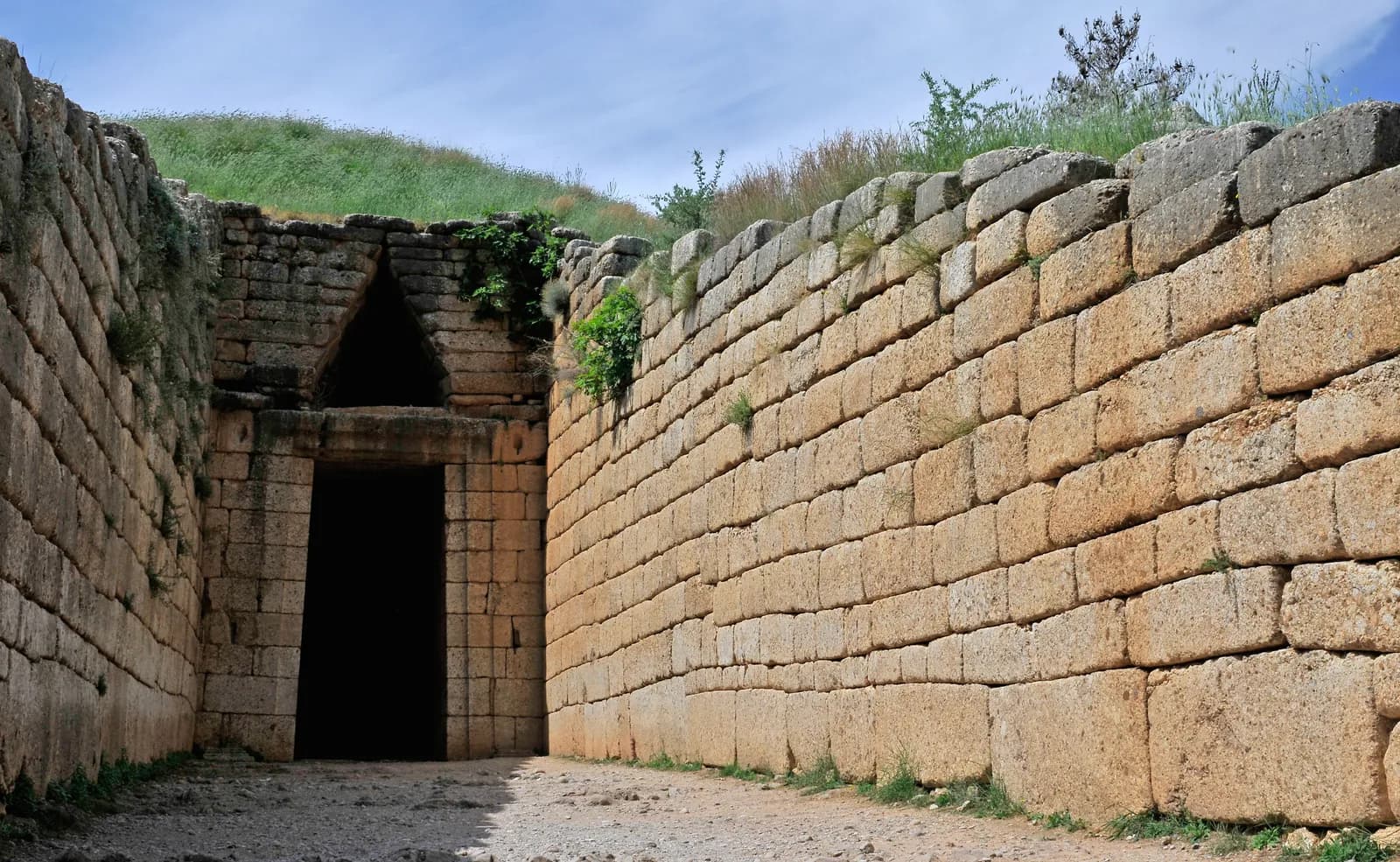
A tomb. A tholos of this kind held successive burials in a stone chamber approached along a walled passage, with the doorway blocked and the passage refilled between interments and the whole covered by a mound.
A side chamber cut into the rock off the main dome probably held the burials themselves; the great chamber may have been for ceremony. Since the tomb was emptied in antiquity, this is inference from better-preserved tholoi elsewhere.
How it was built
The dome is corbelled, not vaulted: thirty-three courses of blocks each projecting slightly further inward than the one below, cut back to a curve after setting, and closed by a single capstone. There is no keystone and no arch, and the structure works because the mass of the surrounding mound holds the rings in compression.
The relieving triangle above the door does the same job as at the Lion Gate — taking the wall's load off the lintel — and here it was faced with coloured stone rather than sculpture.
The interior was studded with bronze rosettes; the nail holes survive in rows across the dome, and their pattern is one of the few pieces of evidence for how Mycenaean interiors were finished.
How the lintel was raised is not known. It sits about five metres above the floor of the dromos and there is no evidence for a ramp or a mechanism.
Materials
- Evidence level: Documented
Conglomerate
The dressed blocks of the façade, the dromos walls and the doorway, sawn and finished to a precision unusual in Mycenaean building
- Evidence level: Documented
Green limestone
The engaged half-columns flanking the door, carved with zigzag and spiral bands
- Evidence level: Documented
Red and green stone
The decorative facing of the relieving triangle above the lintel, now lost except in fragments
Measured
Every figure states what it rests on. A modern survey, an ancient text, a conversion from an ancient unit and a modern estimate are four different kinds of statement and are not interchangeable.
Chamber
about 14.5 m in diameter and 13.4 m high
Modern survey of the standing dome.
The lintel
about 8.3 m long, weighing perhaps 120 tonnes
Modern measurement of the inner lintel block; the weight is calculated from its dimensions and the density of conglomerate. It is generally described as the heaviest single block used in any structure before the Roman period, which is a claim about a class rather than a measurement.
The dromos
about 36 m long and 6 m wide
Modern survey.
What it meant
The tholoi are the burials of whoever ran Mycenae in its palatial period, and their scale is the clearest surviving measure of that power. The labour of quarrying, moving and setting a hundred-and-twenty-tonne block for a tomb describes a command over people that no text records.
Their names are a caution about how ruins acquire stories. Pausanias found local guides attaching Homeric names to visible monuments a thousand years after they were built; Schliemann found the same practice still going in the nineteenth century, and both names on this building come from it.
After antiquity
Robbed in antiquity and open thereafter. Cleared in 1810 under the local Ottoman governor Veli Pasha, when the façade's decorated stonework was removed; the two green half-columns and other fragments passed through European collections and reached the British Museum in 1904.
Excavated and studied by Wace in the 1920s, who used the tholoi to establish a chronological sequence that broke the assumption of Cretan control over the mainland.
Condition today
Standing
The dome is intact and entered as it was built, with the dromos cleared. The façade has lost its coloured stonework and its half-columns.
Nothing was recovered from the chamber, which had been emptied. The tomb's date and significance rest entirely on its architecture and its place in a typological sequence.
Wace's stratigraphic work on the nine Mycenaean tholoi established a developmental series from simpler rubble-built chambers to this one, and dated them against the settlement — the argument that put mainland Greece on its own chronological footing.
Scattered fragments
What has left the building, and where it is now. Where a holding is contested, the museum page says so.
- Evidence level: Documented
The two engaged half-columns of green limestone from the façade, with fragments of the relieving-triangle facing
- Evidence level: Documented
Further façade fragments
Written about in antiquity
Pausanias, Description of Greece 2.16.6–7
Pausanias reports underground buildings at Mycenae, calling them the treasuries of Atreus and his sons, and locates the graves of Agamemnon and his companions. The source of both modern names, and a second-century account of what local people said about ruins already a thousand years old.
Still argued
Whose tomb was it?
Unknown, and unknowable from present evidence. The tomb was empty when first recorded, nothing on it names anyone, and the Atreid names come from Pausanias reporting local tradition. Its date, around 1250 BCE, is two generations or more before any traditional date for the Trojan War, which does not make an Atreid burial impossible but removes the only reason for supposing it.
How was the lintel placed?
Earth ramps, timber cradles and levering from above have all been proposed. No trace of a ramp has been found, and the calculations for a sledge on a ramp require a workforce and an organisation that are plausible but unattested. The question is open in the same way that the Egyptian pyramid ramps are.
How to read the evidence labels
- Evidence level: Documented
- Supported by a named primary text or by excavated material evidence.
- Evidence level: Probable
- Supported by strong inference that most specialists accept.
- Evidence level: Disputed
- Substantial specialist disagreement exists; competing readings are stated.
- Evidence level: Literary
- Belongs to poetic or mythological construction rather than to history.
- Evidence level: Mythological
- Belongs to shared religious or mythic tradition rather than to any single text.
- Evidence level: Unknown
- The available evidence is insufficient to decide.
These labels describe the status of the evidence, not our confidence in a conclusion. A claim marked Literary is not a claim we doubt; it is a claim about what kind of thing a poem is.