What it is
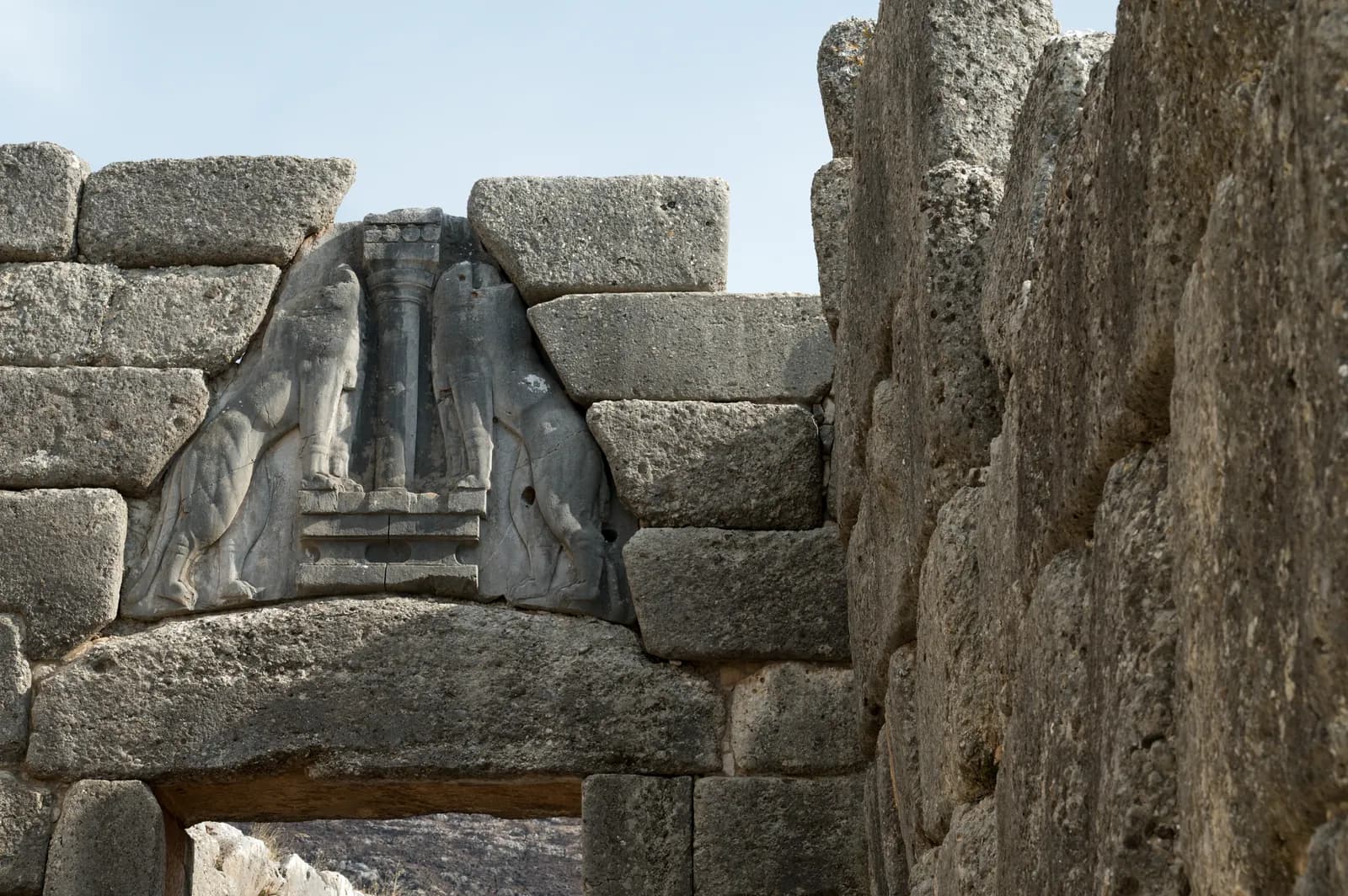
The Lion Gate at Mycenae — the relieving triangle and its relief, the missing heads, whether the animals are lions or lionesses, and what the column between them stands for.
Built c. 1250 BCE, with the extension of the citadel wall. The principal date, c. 1250 BCE, is approximate.
c. 1250 BCE
The wall extension
The gate belongs to the second phase of the cyclopean circuit, the one that brought Grave Circle A inside the walls. Gate and wall are a single act of building.
since antiquity
Continuous visibility
The gate was never lost. Pausanias saw it, early modern travellers drew it, and Kyriakos Pittakis cleared it in 1841.
Who ordered it built
Each attribution carries what supports it. Ancient buildings are routinely credited to people on the authority of writers centuries later, and that is not the same claim as an inscription on the building.
- Evidence level: Unknown
Architect
Unknown
Mycenaean Greece has left no architects' names. The Linear B tablets record scribes, officials, smiths and shepherds, and no builders.
What it was for
The principal entrance to the citadel: a gate about three metres square in a bastioned approach, with a courtyard inside and a guard chamber, arranged so that anyone entering had their unshielded right side exposed to the wall above.
It is also a display. The relief above the lintel is the only monumental sculpture the Mycenaean world produced at this scale, and it was placed where every arrival would pass under it.
How it was built
The gate is spanned by a single monolithic lintel, and above it the masonry is corbelled inward to form a triangular void — the relieving triangle — which takes the weight of the wall off the lintel and directs it into the jambs. The void is then filled by a thin sculpted slab that carries nothing.
That is the whole engineering idea and it is a good one: the structural solution creates a triangular panel, and the panel is then used for the only monumental relief the culture made.
Getting the lintel into place is unexplained. There is no evidence for the method, and the block is heavier than anything the surviving Mycenaean toolkit obviously accounts for.
Materials
- Evidence level: Documented
Limestone
The threshold, jambs and lintel, in conglomerate and limestone blocks
- Evidence level: Documented
Limestone relief slab
The triangular panel above the lintel
- Evidence level: Unknown
Lost material
The two heads, made separately and attached by dowels — the sockets survive. What they were made of is not known; steatite, ivory and metal have all been proposed
Measured
Every figure states what it rests on. A modern survey, an ancient text, a conversion from an ancient unit and a modern estimate are four different kinds of statement and are not interchangeable.
Gate opening
about 3.1 m wide and 3 m high
Modern survey.
Lintel block
about 4.5 × 2 × 0.8 m, weighing perhaps 20 tonnes
Modern measurement of the block; the weight is calculated from its volume and the density of the stone, not weighed.
The relief panel
about 3 m wide and 3 m high
Modern survey of the slab in position.
What it meant
The wall extension that this gate belongs to also brought the four-hundred-year-old shaft graves of Grave Circle A inside the fortifications and monumentalised them. Building a display gate and enclosing the ancestors in the same campaign is a claim of descent made in stone by a dynasty that may or may not have been descended from them.
The composition — two animals flanking a column on a stepped base — appears repeatedly on Aegean seals and is generally read as a heraldic or protective device. What it meant to the people who built the gate is not recorded.
The central column stands on what looks like an altar base and is often read as a religious symbol, and there is a long-running argument about whether it represents a deity, a palace, or the citadel itself. Nothing decides it.
After antiquity
Buried to the lintel by hillwash over centuries but never invisible; the relief was drawn by travellers before excavation. Cleared to its threshold in 1841.
Consolidated repeatedly since; the bastion beside it has been restored.
Condition today
Standing
Standing complete in its wall, with the relief in place. Only the two heads are missing.
The pivot holes and bar sockets in the jambs and threshold show a double door barred from inside, and the cutting for the bar runs deep into the masonry.
Excavation of the approach established the bastion and the guardroom, and the relationship of the gate to the extended circuit and to the re-enclosed grave circle.
Written about in antiquity
Pausanias, Description of Greece 2.16.5
Pausanias, in the second century CE, describes the ruined circuit with a gate over which lions stand, and reports that the Cyclopes built the wall. The only ancient notice of the gate, and it is accurate.
Still argued
Are they lions?
The animals have no manes, which has led to their identification as lionesses, and their heads — which would settle the question — are missing. Griffins have also been proposed on the basis of the dowel arrangement in the neck sockets, which some read as accommodating a beak or crest. The gate is universally called the Lion Gate and the identification is not secure.
What does the column mean?
Readings include a cult symbol, an aniconic deity, the palace, the dynasty and the citadel itself. The motif recurs in Aegean glyptic with variations, which supports its being a formula rather than a portrait of a specific thing, and no text explains it.
How to read the evidence labels
- Evidence level: Documented
- Supported by a named primary text or by excavated material evidence.
- Evidence level: Probable
- Supported by strong inference that most specialists accept.
- Evidence level: Disputed
- Substantial specialist disagreement exists; competing readings are stated.
- Evidence level: Literary
- Belongs to poetic or mythological construction rather than to history.
- Evidence level: Mythological
- Belongs to shared religious or mythic tradition rather than to any single text.
- Evidence level: Unknown
- The available evidence is insufficient to decide.
These labels describe the status of the evidence, not our confidence in a conclusion. A claim marked Literary is not a claim we doubt; it is a claim about what kind of thing a poem is.