Where the site is
A ridge inland from the Bay of Navarino, with a view over the bay and the coastal plain. The tablets show the state it governed reaching across south-western Messenia in two provinces, so the position is administrative rather than defensive; the palace was unwalled.
- Ancient region
- Messenia
- Modern country
- Greece
- Position
- 37.027° N, 21.695° E — The palace megaron on the Ano Englianos ridge
- Given to three decimal places, about a hundred metres. It locates the named feature, not the extent of the site.
What survives
Foundations and low walls over the whole palace plan, protected by a modern roof: an entrance court, the megaron with its circular hearth and the emplacement for a throne, corridors of storerooms, pantries and workshops, and a bathroom with its terracotta tub still in place.
The frescoes survive as fallen fragments, recovered and reassembled: a lyre player and a bird, processions, hunting scenes, a griffin beside the throne position. The floors of the megaron kept their painted grid.
What is not here is a wall. Pylos was unfortified, in contrast with Mycenae and Tiryns, and it burned anyway.
Occupation and chronology
Dates below are stored as signed years and rendered with the precision they actually carry. c. 1600 BCE is approximate; c. 1180 BCE is approximate.
c. 1600–1400 BCE
Before the palace
Occupation and rich burial on and around the ridge, including the tholos tombs and the shaft grave of 2015. The elite here was wealthy long before the palace was built.
c. 1300–1200 BCE
The palace
The building as excavated: megaron, archive rooms, storerooms, workshops. Its life was short.
c. 1200–1180 BCE
Destruction
Fire, comprehensive enough to bake unfired clay tablets into permanence. The site was not substantially reoccupied.
History of excavation
Who recovered the evidence, when, and by what method. Where an excavation destroyed as much as it found, the entry says so.
- Evidence level: Documented
1939
Carl Blegen, University of Cincinnati, with Konstantinos Kourouniotis
Linear B tablets turned up in the first days of the first season, in the room beside the entrance that turned out to be the archive. Blegen closed the trench, published a preliminary note, and the Second World War stopped everything for thirteen years.
- Evidence level: Documented
1952–1966
Carl Blegen and Marion Rawson
The full excavation of the palace, running in parallel with Ventris's decipherment — so for the first time an Aegean building was being excavated and its own records read at the same time.
- Evidence level: Documented
2015–2018
Sharon Stocker and Jack Davis, University of Cincinnati
The shaft grave now called the Griffin Warrior, found intact and unrobbed beside the palace, followed by two further tholos tombs. The first undisturbed elite Aegean burial excavated with modern recovery methods.
Principal structures
The evidence level answers how we know what a structure looked like, not whether it existed.
- Evidence level: Documented
c. 1300 BCE
The megaron
Porch, vestibule and hall around a circular painted hearth four metres across, with four columns and a throne emplacement against the right-hand wall. The standard Mycenaean plan, better preserved here than anywhere.
- Evidence level: Documented
c. 1300 BCE
The Archives Room
Two small rooms immediately inside the entrance, where the tablets were kept on shelves and in baskets. Their position — the first thing past the door — is itself an argument about what the building was for.
- Evidence level: Documented
c. 1300 BCE
The storerooms and pantry
Thousands of plain kylikes stacked in one room, oil jars in others. The tablets and the pots describe the same operation from two directions.
- Evidence level: Documented
c. 1500–1450 BCE
Tholos IV and the Griffin Warrior grave
Earlier than the palace by two centuries and immediately beside it. The shaft grave was cut into rock, covered, and never found by robbers.
Finds and where they went
Almost nothing recovered from these sites is still on them. Where an object has a full provenance record on this platform, it is linked.
- Evidence level: Documented
The Linear B archive
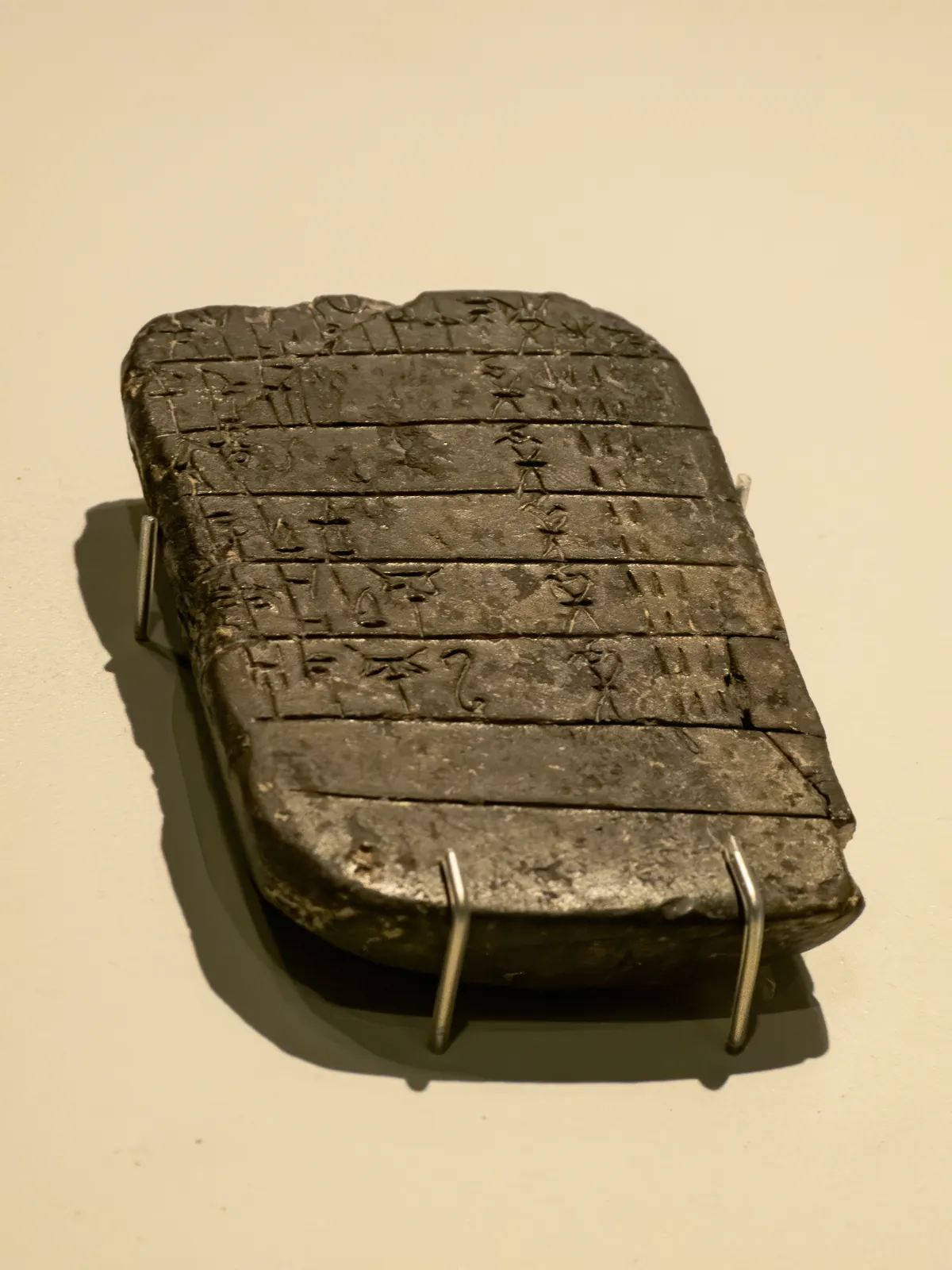
Around eleven hundred tablets and fragments. They record land tenure, personnel, bronze allocation, textile production, offerings to named deities, rowers assigned to ships and a coastguard deployment. They are a single administrative year, or less, frozen by the fire that ended it.
- Evidence level: Documented
The Pylos Combat Agate
A sealstone thirty-six millimetres across from the Griffin Warrior grave, carved with a combat scene whose detail is at the limit of what the unaided eye can see. It has forced a reconsideration of what Aegean engravers could do around 1450 BCE.
Archaeological Museum of Chora, Messenia
- Evidence level: Documented
The Griffin Warrior assemblage
Some three thousand objects with a single burial: gold rings with Cretan iconography, a bronze sword with a gold hilt, silver cups, hundreds of beads, ivory, and a boar's-tusk helmet. The Cretan character of the finest objects is the interesting part.
Archaeological Museum of Chora, Messenia
- Evidence level: Documented
The lyre-player fresco
A seated figure playing a five-stringed instrument, with a large bird in flight, from the wall beside the throne. Frequently reproduced as the earliest picture of a Greek bard; what the painting shows is a musician in a palace hall.
Ancient testimony
What ancient authors say about the place, and how far it can be trusted.
Homer, Odyssey 3.1–485
Telemachus at Pylos: the sacrifice of bulls to Poseidon on the shore, Nestor's hospitality and his account of the returns from Troy. Poseidon's prominence in the poem and in the tablets is a genuine convergence, and it is one of very few.
Strabo, Geography 8.3.7
Strabo records the ancient argument over which of three places called Pylos was Nestor's, and comes down for the Triphylian claim — against the site now excavated.
How the site has been interpreted
Pylos is the best-documented Mycenaean state because its archive burned in the right way, and the picture the archive gives is of a bureaucracy: two provinces, sixteen districts, named officials, land held in specified tenures, rations issued to named groups of women and children, bronze weighed out to named smiths. It is a world of accounting, and the accounting stops abruptly.
That is the sharpest available contrast with the Homeric picture of Nestor. The poems know a Pylos, a Nestor and a sandy shore, and they know nothing whatever about scribes, land registers or a palace economy. Whatever the epic tradition preserved of the Bronze Age, it did not preserve the thing the Bronze Age spent most of its writing on.
The tablets also record religion in an administrative register: offerings of oil and animals to deities including Poseidon, who dominates at Pylos, and names that recur later in Greek cult. This is the earliest documentation of Greek religious practice, and it comes in the form of a delivery schedule.
The Griffin Warrior grave, two centuries earlier than the palace, shows a Messenian elite already burying its dead with Cretan luxury goods before any palace stood on the ridge. It complicates a simple story of Mycenaean conquest of Crete by showing how deep the exchange ran, and how early.
Unresolved
Is this Homer's Pylos?
The identification of the Ano Englianos ridge with the Pylos of the epics is probable and widely accepted, and it is not certain. Which Pylos Homer meant was already argued in antiquity — Strabo reports a Triphylian and a Messenian claim — and the ridge has produced no inscription naming the place in a way that settles it. The Linear B tablets do name a place, pu-ro, which is read as Pylos.
What does tablet Tn 316 record?
A tablet written in haste at the end lists offerings to a series of deities, including entries that some scholars read as human beings offered rather than objects. The reading turns on a handful of signs and on whether the accompanying terms denote persons or vessels. It is the single most contested tablet in the corpus and no consensus exists.
How to read the evidence labels
- Evidence level: Documented
- Supported by a named primary text or by excavated material evidence.
- Evidence level: Probable
- Supported by strong inference that most specialists accept.
- Evidence level: Disputed
- Substantial specialist disagreement exists; competing readings are stated.
- Evidence level: Literary
- Belongs to poetic or mythological construction rather than to history.
- Evidence level: Mythological
- Belongs to shared religious or mythic tradition rather than to any single text.
- Evidence level: Unknown
- The available evidence is insufficient to decide.
These labels describe the status of the evidence, not our confidence in a conclusion. A claim marked Literary is not a claim we doubt; it is a claim about what kind of thing a poem is.