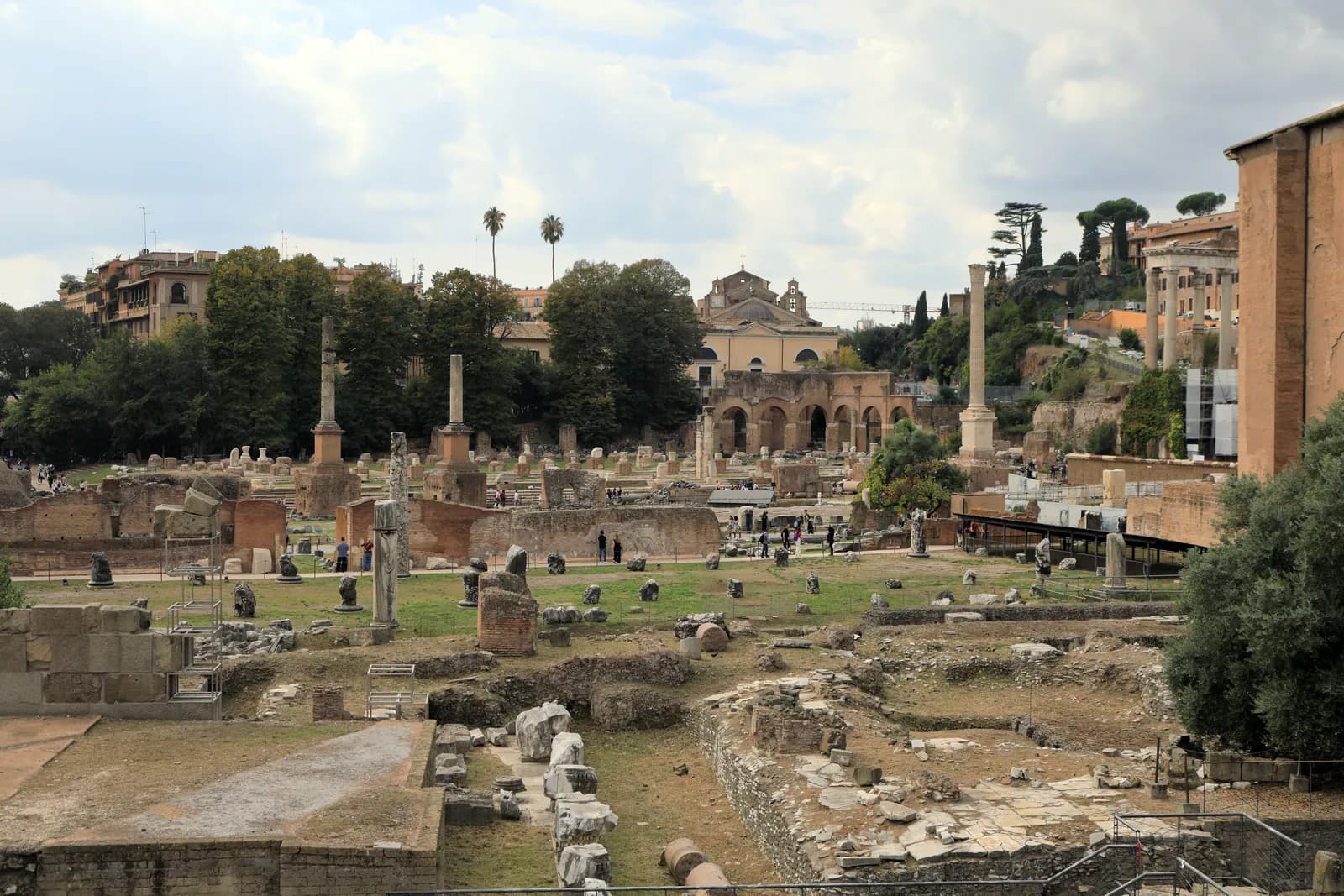
What it is
The Basilica Julia — Caesar's foundation, the centumviral court, Pliny's account of speaking before all four panels, and why almost nothing of it survives.
Built Begun 54 BCE, dedicated 46 BCE, completed under Augustus; restored 305 CE. The principal date, dedicated incomplete, 46 BCE, is fixed.
170 BCE
The Basilica Sempronia
The earlier hall on the site, built by Tiberius Sempronius Gracchus the elder over the house of Scipio Africanus, which he bought and demolished.
54–46 BCE
Caesar's building
Funded from the Gallic spoils and dedicated before it was finished, which Caesar did with several of his buildings.
12 BCE – 12 CE
Augustan completion and rebuilding
Burned before completion; Augustus rebuilt it and rededicated it in the names of his grandsons Gaius and Lucius, though the Res Gestae records that he kept Caesar's name on it.
283 and 305 CE
Late restorations
Burned in the fire of 283 and restored under Diocletian; an inscription records a further restoration by the prefect Gabinius Vettius Probianus in about 416.
Who ordered it built
Each attribution carries what supports it. Ancient buildings are routinely credited to people on the authority of writers centuries later, and that is not the same claim as an inscription on the building.
- Evidence level: Documented
Commissioned by
Julius Caesar
Named for him from the outset; Augustus's Res Gestae 20 records that he rebuilt the basilica between the temples of Castor and Saturn, a work begun by his father.
- Evidence level: Documented
Completed by
Augustus
Res Gestae 20, in his own words.
What it was for
A covered hall for business and, above all, for law. The centumviral court — which handled inheritance and property disputes, the cases that most concerned wealthy Romans — sat here in four panels, divided by screens and curtains, and could be combined into a single tribunal for an important case.
Pliny the Younger describes arguing before all four panels sitting together: a hundred and eighty judges, both galleries packed, the litigants' supporters brought in to applaud, and the speech running for nearly five hours by the water clock. It is the best surviving account of what a Roman basilica sounded like.
How it was built
A central nave two storeys high surrounded by a double aisle on all four sides, with the outer arcades opening onto the Forum. The arcades carried engaged Doric half-columns on the ground floor and Ionic above, in the standard Roman treatment of a Greek order as surface decoration on an arched structure.
The Augustan rebuilding raised it in brick-faced concrete with marble facing. What survives of the elevation is the stumps of the piers and one restored arch, re-erected in the twentieth century from fallen material.
Materials
- Evidence level: Documented
Marble
Paving, revetment and the piers, almost all removed and much of it burned for lime
- Evidence level: Documented
Brick-faced concrete and travertine
The core of the piers and the vaulting of the aisles
Measured
Every figure states what it rests on. A modern survey, an ancient text, a conversion from an ancient unit and a modern estimate are four different kinds of statement and are not interchangeable.
Overall dimensions
about 101 × 49 m
Modern survey of the surviving pavement and pier foundations.
The combined court
180 judges
Pliny the Younger, Letters 6.33, describing the four panels of the centumviral court sitting together for the case of Attia Viriola. An ancient figure for a specific occasion, not a standing establishment.
What it meant
Caesar's building programme in the Forum replaced Republican monuments associated with other families with buildings carrying his own name, and the Basilica Julia is the largest instance: it went up over the Basilica Sempronia, which itself stood over the house of Scipio Africanus. Three generations of Roman self-monumentalisation are stacked on one plot.
Augustus's decision to keep Caesar's name on a building he had substantially rebuilt, and to record that decision in the Res Gestae, is the same manoeuvre as Hadrian's with the Pantheon inscription and is stated by Augustus as a virtue.
After antiquity
Damaged in successive fires, restored into the fifth century, and then systematically quarried. Its marble was among the most accessible in the Forum and it went into lime kilns and later buildings over centuries, which is why a hall of this size is now a floor.
Nineteenth-century excavation exposed the pavement and the pier bases; one arch was reconstructed in the twentieth century to give the scale.
Condition today
Foundations and plan
The pavement, the steps onto the Forum, the stumps of the piers and one modern re-erected arch. Nothing of the elevation is ancient above a few courses.
The most-cited find here is not architectural. Boards for gaming were scratched into the marble of the steps and the pavement, in numbers, along with tallies and idle graffiti — the residue of people waiting for a court to reach their case.
Excavation established the double-aisle plan and the relationship to the earlier Basilica Sempronia beneath it, and recovered the inscription of the late restoration by Probianus, together with statue bases he moved into the hall.
Scattered fragments
What has left the building, and where it is now. Where a holding is contested, the museum page says so.
- Evidence level: Documented
Statue bases inscribed by the fifth-century prefect Probianus, recording statues he brought into the basilica
In position and in the Forum antiquarium
Written about in antiquity
Augustus, Res Gestae Divi Augusti 20
Augustus on rebuilding the basilica between the temples of Castor and Saturn, a work begun by his father, and on his intention that it should be completed under Caesar's name by his heirs if he did not live to finish it.
Pliny the Younger, Letters 6.33
Pliny the Younger on speaking before the united centumviral court: the four panels combined, a hundred and eighty judges, packed galleries, and a speech of nearly five hours.
Still argued
Where exactly did the four panels sit?
Pliny's account requires four separate tribunals within one hall, divisible by screens and combinable. Reconstructions place them in the nave, in the aisles, or on temporary platforms, and none can be tested against the surviving pavement, which carries no fixed emplacements. The procedure is documented; the furniture is not.
How to read the evidence labels
- Evidence level: Documented
- Supported by a named primary text or by excavated material evidence.
- Evidence level: Probable
- Supported by strong inference that most specialists accept.
- Evidence level: Disputed
- Substantial specialist disagreement exists; competing readings are stated.
- Evidence level: Literary
- Belongs to poetic or mythological construction rather than to history.
- Evidence level: Mythological
- Belongs to shared religious or mythic tradition rather than to any single text.
- Evidence level: Unknown
- The available evidence is insufficient to decide.
These labels describe the status of the evidence, not our confidence in a conclusion. A claim marked Literary is not a claim we doubt; it is a claim about what kind of thing a poem is.