What it is
The Temple of Castor and Pollux — the vow at Lake Regillus, the podium as a rostra and a bank, Cicero on the restoration contract, and the Tiberian rebuilding whose columns still stand.
Built Traditionally vowed 499 or 496 BCE and dedicated 484; the standing columns Tiberian, dedicated 6 CE. The principal date, traditionally dedicated 484 BCE, is traditional.
traditionally 499/496–484 BCE
The vow and the first temple
Vowed by the dictator Aulus Postumius at Lake Regillus, where the Dioscuri were said to have fought for Rome, and dedicated by his son. The battle's date and historicity are both argued; the temple's early existence is not.
117 BCE
The rebuilding of Metellus
Rebuilt by Lucius Caecilius Metellus Dalmaticus from triumphal spoils, on an enlarged podium.
dedicated 6 CE
The Tiberian temple
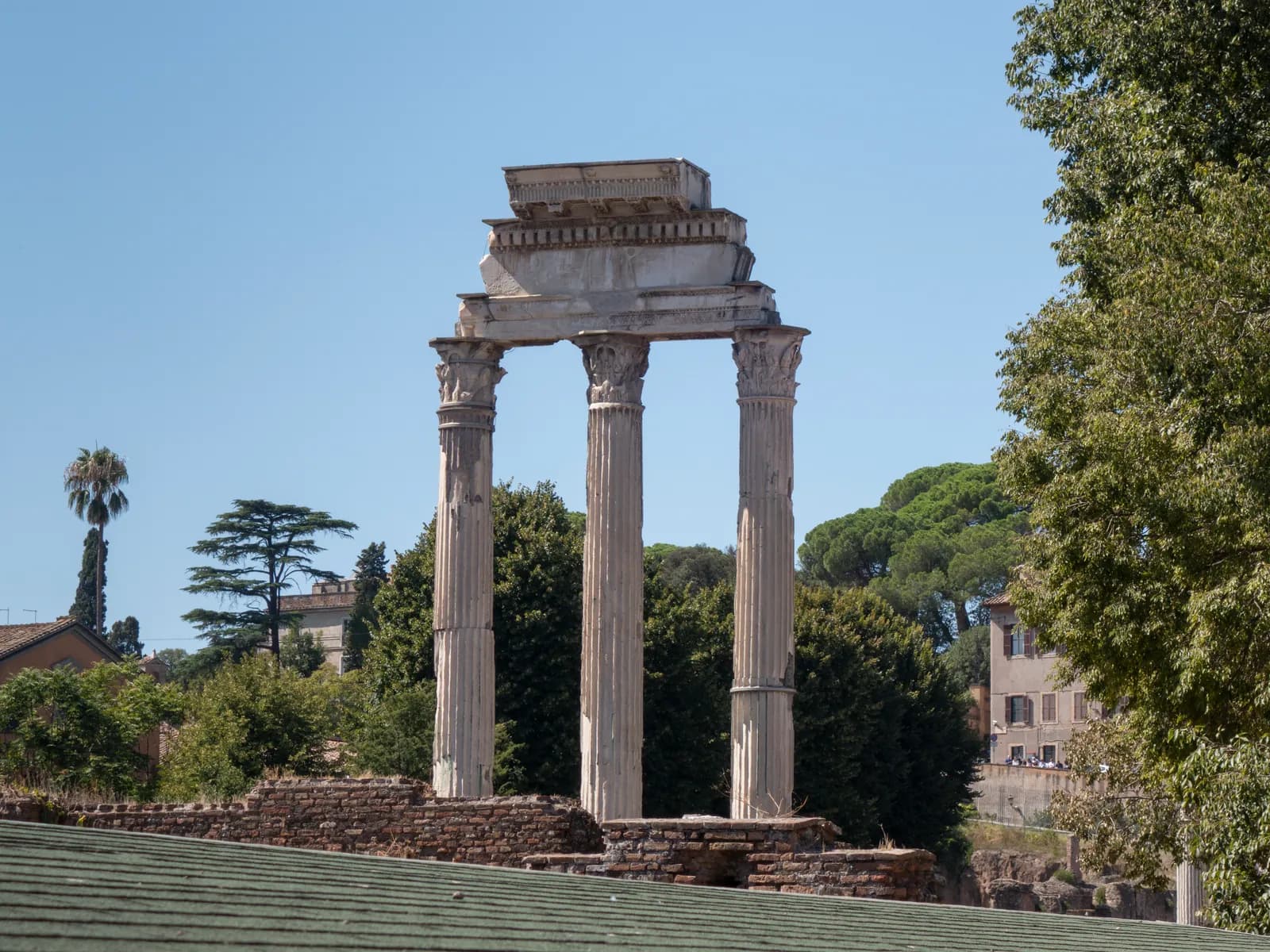
Rebuilt by Tiberius in his own name and that of his dead brother Drusus. The three standing columns belong to this building.
Who ordered it built
Each attribution carries what supports it. Ancient buildings are routinely credited to people on the authority of writers centuries later, and that is not the same claim as an inscription on the building.
- Evidence level: Literary
Dedicated by
Aulus Postumius Albinus
Livy 2.20 and 2.42 and Dionysius of Halicarnassus 6.13: the dictator vows the temple in battle and his son dedicates it as duumvir. A tradition recorded four centuries later.
- Evidence level: Documented
Commissioned by
Tiberius
Cassius Dio 55.27 and Suetonius, Tiberius 20, on the rebuilding dedicated in 6 CE in his own name and his brother's.
What it was for
A temple of Castor and Pollux, and one of the most heavily used pieces of public infrastructure in Rome. The high podium's front served as a speaker's platform for meetings of the assembly, so that a magistrate addressing the people stood on a temple.
The podium chambers housed the office of weights and measures, where standards were kept and traders' equipment checked, and bankers operated from tabernae in and around it. Deposits were made there under the protection of the god, in the same logic that put the treasury in the podium of Saturn.
The Senate met in it from time to time, as it could in any inaugurated temple.
How it was built
A high Italic podium carrying a Corinthian peripteral temple, with the stair at the front broken by a projecting platform — the arrangement that let the podium front work as a speaker's platform without interrupting access to the cella.
The Tiberian carving is exceptionally fine and is the reason the three columns became the standard image of the Forum: the capitals and the entablature survive in a condition that almost nothing else on the square does.
Materials
- Evidence level: Documented
Marble
The Tiberian columns, capitals and entablature — Corinthian, and among the finest carved work surviving on the Forum
- Evidence level: Documented
Concrete faced with tufa and travertine
The podium of the 117 BCE rebuilding, which the Tiberian temple reused
Measured
Every figure states what it rests on. A modern survey, an ancient text, a conversion from an ancient unit and a modern estimate are four different kinds of statement and are not interchangeable.
Podium
about 50 × 30 m, standing about 7 m high
Modern survey of the surviving podium.
Standing columns
three, about 12.5 m tall with their entablature
Modern survey.
What it meant
A temple that doubles as a rostra puts the assembly's business inside a sacred frame, which had real procedural consequences: unfavourable auspices could stop a meeting. Roman politics did not have a secular venue and did not want one.
Cicero's prosecution of Verres includes a sustained attack on the contract for the temple's upkeep, which Verres was accused of manipulating — inspecting the building, declaring the columns out of plumb, and reletting the maintenance at a corrupt price. It is one of the most detailed accounts of Roman public contracting that survives, and it is a hostile one.
Tiberius rebuilding it in his own name and his brother's turns a Republican victory monument into a dynastic one, using the divine twins as the obvious model for a pair of imperial brothers.
The Dioscuri were said to have appeared at Lake Regillus fighting for Rome, and then to have watered their horses at the spring of Juturna beside the temple site and announced the victory in the Forum. The spring is there and has been excavated; the appearance is a foundation story for the cult.
The temple's vow follows the standard Roman pattern in which a commander contracts with a god during a battle and the state discharges the obligation afterwards, sometimes decades later.
After antiquity
Standing into late antiquity and then quarried; the three columns survived because they remained standing with their entablature locked together, and were a landmark through the medieval period when the Forum floor around them rose by several metres.
Excavated in the nineteenth century and consolidated since.
Condition today
Standing ruin
The podium core, part of the front stair, and three Corinthian columns with their entablature. The cella is gone.
Excavation established three superimposed podia — the archaic temple, the Metellan rebuilding and the Tiberian one — with the earliest going back to the fifth century BCE, which is the archaeological support for a temple here at approximately the traditional date.
The spring of Juturna and its basin beside the temple have been excavated, together with dedications, and confirm a cult focus on the spot the legend attaches to.
Scattered fragments
What has left the building, and where it is now. Where a holding is contested, the museum page says so.
- Evidence level: Documented
Architectural fragments and sculpture from the successive temples
Written about in antiquity
Livy, From the Founding of the City 2.20, 2.42
Livy on the vow at Lake Regillus and on the dedication of the temple fifteen years later by the vower's son.
Cicero, Against Verres 2.1.129–154
Cicero's account of the maintenance contract for the temple and of how Verres was alleged to have exploited it. Forensic rhetoric, and the fullest description of the building's upkeep that exists.
Cassius Dio, Roman History 55.27
Cassius Dio on the rebuilding dedicated by Tiberius in 6 CE in his own name and that of Drusus.
Still argued
Did the battle of Lake Regillus happen?
The battle is dated by tradition to 499 or 496 BCE and is described in detail only by writers four centuries later. Its scale, its date and its outcome are all argued, and the epiphany of the Dioscuri is plainly a cult legend. The temple's archaic podium shows that a temple stood here in the fifth century, which supports an early cult without confirming the story that explains it.
How to read the evidence labels
- Evidence level: Documented
- Supported by a named primary text or by excavated material evidence.
- Evidence level: Probable
- Supported by strong inference that most specialists accept.
- Evidence level: Disputed
- Substantial specialist disagreement exists; competing readings are stated.
- Evidence level: Literary
- Belongs to poetic or mythological construction rather than to history.
- Evidence level: Mythological
- Belongs to shared religious or mythic tradition rather than to any single text.
- Evidence level: Unknown
- The available evidence is insufficient to decide.
These labels describe the status of the evidence, not our confidence in a conclusion. A claim marked Literary is not a claim we doubt; it is a claim about what kind of thing a poem is.