What it is
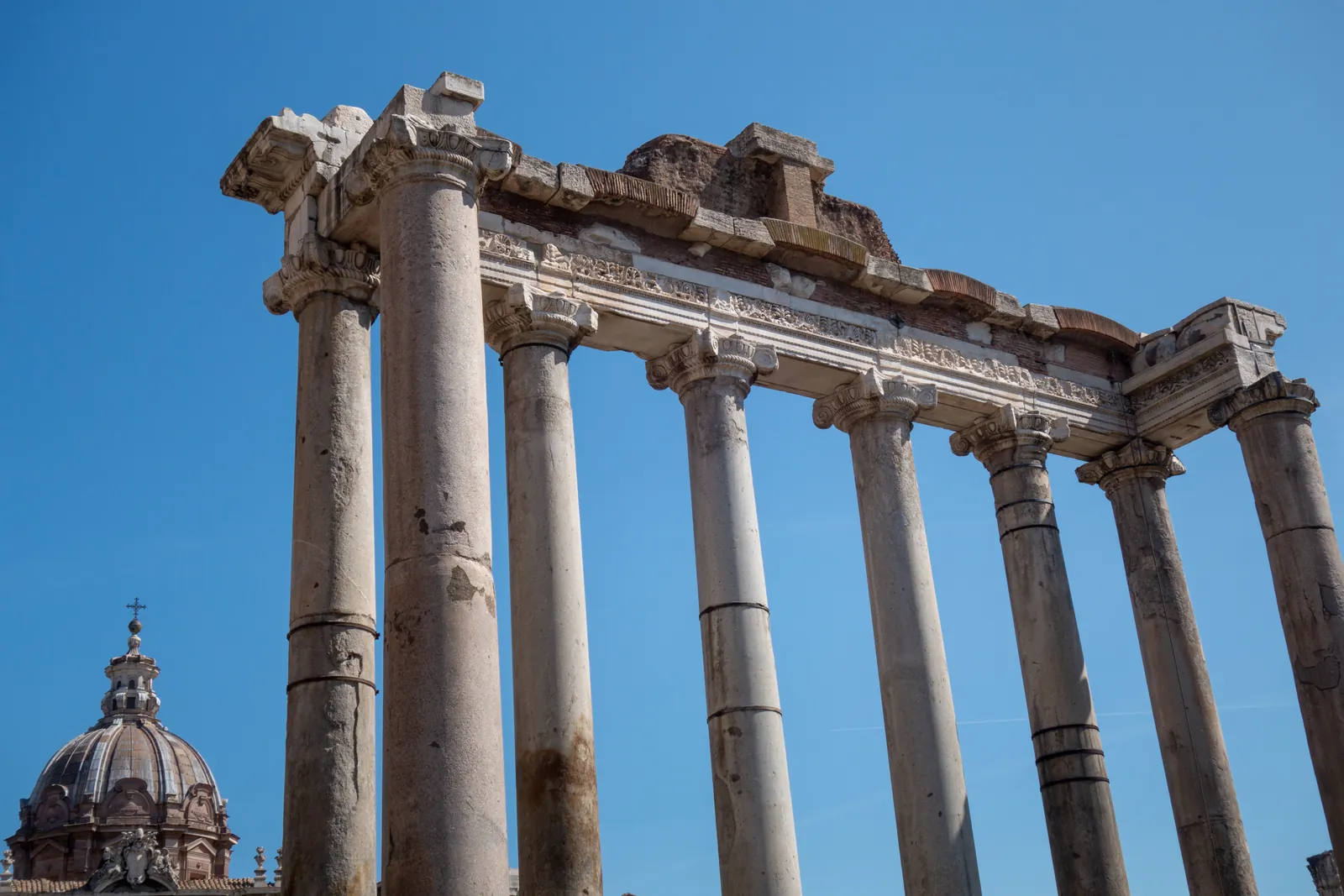
The Temple of Saturn — the aerarium in its podium, the Saturnalia, the late-antique rebuilding recorded in its own architrave, and the reused columns of the standing front.
Built Traditionally dedicated 497 BCE; the standing columns from a rebuilding after a late-4th-century CE fire. The principal date, traditionally 497 BCE, is traditional.
traditionally 497 BCE
The first temple
Livy gives the dedication of the temple and the institution of the Saturnalia to 497 BCE, and reports that even in his day there was disagreement about who dedicated it. The date is tradition, not record.
42 BCE
Plancus's rebuilding
Rebuilt by Lucius Munatius Plancus from the spoils of a campaign in the Alps. This is the phase most of the podium belongs to.
later 4th century CE
The late rebuilding
The standing architrave carries the inscription recording that the Senate and People restored the temple after it was consumed by fire. It names no emperor, which is itself unusual and undated.
Who ordered it built
Each attribution carries what supports it. Ancient buildings are routinely credited to people on the authority of writers centuries later, and that is not the same claim as an inscription on the building.
- Evidence level: Documented
Commissioned by
Lucius Munatius Plancus
Recorded by Suetonius (Augustus 29) among the buildings put up by leading men from spoils at Augustus's urging, and by the Fasti.
- Evidence level: Disputed
Dedicated by
Titus Larcius, or Postumus Cominius, or a dictator
Livy 2.21 reports competing traditions about who dedicated the first temple and declines to settle them. The disagreement is ancient.
What it was for
A temple of Saturn, and the home of the aerarium Saturni — the treasury of the Roman state, kept in vaulted chambers in the temple podium and administered by the quaestors. Public money, the state archives of certain classes of document, and the standards of the legions when not in the field were all held here.
That the treasury sat in a temple podium is not incidental. Deposits under divine protection were harder to touch, and the arrangement made an accounting office a sacred space with all the procedural consequences that followed.
The Saturnalia began at this temple on 17 December, with the untying of the woollen bonds that bound the cult statue's feet for the rest of the year — the release of the god matching the inversion of ordinary order in the festival.
How it was built
A high podium with a frontal stair, in the Italic manner rather than the Greek — the temple is meant to be approached from one end and to stand above the crowd, and its podium is a usable building in its own right.
The standing front is late-antique work assembled from older material. The shafts do not match, the capitals have been recut, and one shaft is inverted. Whether that was carelessness, urgency after a fire, or indifference to a distinction that mattered more to nineteenth-century observers than to fourth-century builders is not recoverable, but the fact is visible from the Forum floor.
Materials
- Evidence level: Documented
Grey and pink Egyptian granite
The eight standing column shafts, reused from other buildings and not matching each other
- Evidence level: Documented
Travertine and tufa
The podium, largely of the 42 BCE rebuilding
- Evidence level: Documented
Marble
The Ionic capitals and the architrave of the late rebuilding, themselves reused and recut
Measured
Every figure states what it rests on. A modern survey, an ancient text, a conversion from an ancient unit and a modern estimate are four different kinds of statement and are not interchangeable.
Podium
about 40 × 22.5 m, standing about 9 m above the Forum pavement
Modern survey of the surviving podium and its facing.
Standing columns
eight, six across the front and one on each flank
Direct observation and survey of the standing front. The shafts differ in stone, diameter and finish, and one on the right is set with its top downward.
What it meant
Where a state keeps its money is a statement about who controls it. The aerarium under senatorial management, in a temple on the Forum, is the Republican arrangement; Augustus's creation of a separate military treasury and the growth of the imperial fiscus alongside it is the constitutional change made visible in accounting.
The late inscription is a small political document. A restoration recorded in the name of the Senate and People of Rome, with no emperor named, at a date when emperors normally took credit for everything, is either an assertion or an accident of survival, and it cannot be dated closely enough to say which.
Saturn was associated with an age before the present order — a lost time of plenty without slavery or property, in the literary tradition — and his festival inverted the social order for several days. The temple is where a Roman abstraction about time and hierarchy was given an address.
The bound feet of the cult statue, loosed only at the Saturnalia, are reported by Roman antiquarian writers. What the statue looked like is not known.
After antiquity
Standing into the medieval period as a ruin and incorporated into fortified structures; the surrounding ground rose by metres, burying the podium, which was re-exposed by nineteenth-century excavation.
The temple was never converted to a church, which is why so little of it survives: the buildings that were converted are the ones that still have roofs.
Condition today
Standing ruin
The podium with its vaulted chambers, and eight columns carrying a fragment of architrave. Nothing of the cella walls stands.
Excavation of the podium established the vaulted chambers that held the treasury and the stair arrangement, and showed that the 42 BCE rebuilding reused the earlier foundation.
The temple's own building history is unusually legible because each phase reused the last, and the reused elements can be dated by their carving.
Written about in antiquity
Livy, From the Founding of the City 2.21
Livy on the dedication of the temple and the institution of the Saturnalia, with his own note that the tradition disagreed about who dedicated it.
Macrobius, Saturnalia 1.8
Macrobius collects the antiquarian traditions about the temple, the treasury, the bound statue and the origins of the festival, writing around the time of the late rebuilding.
Still argued
When was the standing front built?
The inscription records a restoration after a fire but names no consul or emperor. Datings range across the fourth century and rest on the letter forms, on the character of the reused material, and on which recorded fire is meant. There is no agreement, and the temple is often the last major building project on the Forum on one dating and not on another.
How to read the evidence labels
- Evidence level: Documented
- Supported by a named primary text or by excavated material evidence.
- Evidence level: Probable
- Supported by strong inference that most specialists accept.
- Evidence level: Disputed
- Substantial specialist disagreement exists; competing readings are stated.
- Evidence level: Literary
- Belongs to poetic or mythological construction rather than to history.
- Evidence level: Mythological
- Belongs to shared religious or mythic tradition rather than to any single text.
- Evidence level: Unknown
- The available evidence is insufficient to decide.
These labels describe the status of the evidence, not our confidence in a conclusion. A claim marked Literary is not a claim we doubt; it is a claim about what kind of thing a poem is.