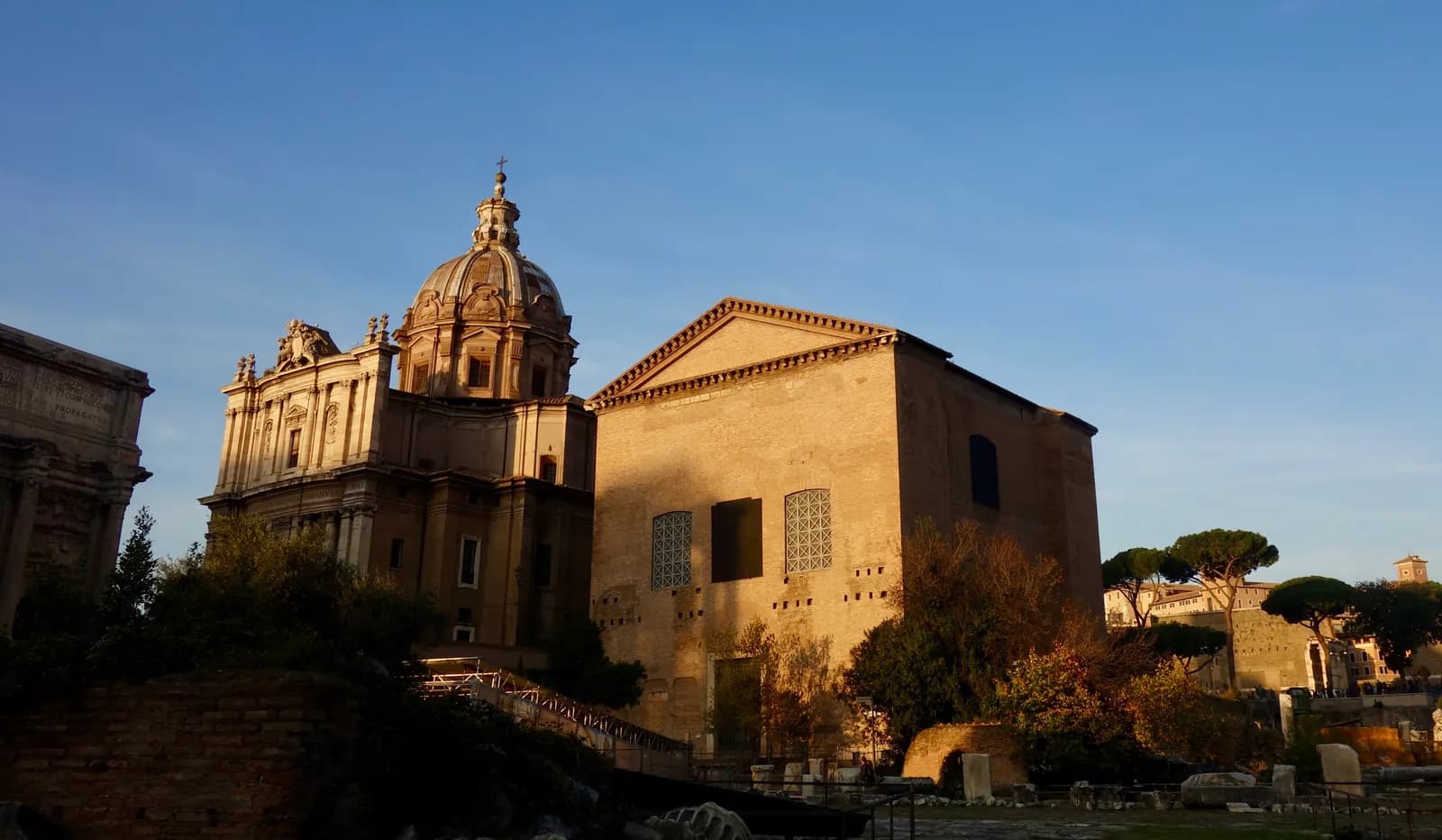
What it is
The Curia Julia — begun by Caesar, finished by Augustus, rebuilt by Diocletian, converted to Sant'Adriano in 630, and stripped back to its ancient form in the 1930s.
Built Begun 44 BCE, dedicated 29 BCE; the standing building rebuilt c. 283–303 CE. The principal date, dedicated 29 BCE, is fixed.
traditionally 7th century BCE
The Curia Hostilia
The predecessor hall on a different alignment, attributed by tradition to Tullus Hostilius. Burned in 52 BCE when the crowd cremated Clodius inside it.
44–29 BCE
Caesar's rebuilding
Caesar began a new senate house on a new alignment as part of his reordering of the Forum, and was killed before it was finished. Augustus completed and dedicated it, and named it for Caesar.
c. 283–303 CE
Diocletian's rebuilding
After the fire of 283. What stands today is this building, on Caesar's plan and footprint.
630–1935
The church of Sant'Adriano
Converted under Honorius I, remodelled repeatedly, and given a baroque interior. The conversion is the reason the walls and roof survive to full height.
Who ordered it built
Each attribution carries what supports it. Ancient buildings are routinely credited to people on the authority of writers centuries later, and that is not the same claim as an inscription on the building.
- Evidence level: Documented
Commissioned by
Julius Caesar
Cassius Dio 44.5 and 47.19 on the vote of a new senate house and its naming; the building carried his name from its dedication.
- Evidence level: Documented
Completed by
Augustus
The Res Gestae, in which Augustus lists the Curia among the works he built, and Cassius Dio 51.22 on its dedication in 29 BCE.
- Evidence level: Documented
Commissioned by
Diocletian
The rebuilding after the fire of 283 is attributed to the Diocletianic restoration of the Forum by the brickwork and by the Chronographer of 354.
What it was for
A roofed hall for meetings of the Senate. Three low steps ran down each long side to hold movable chairs, with a dais at the far end for the presiding magistrate, and the Senate voted by physically moving to one side of the room — a procedure the architecture is shaped around.
It was also a templum in the technical sense: an inaugurated space in which the auspices could be taken, which is why the Senate could only meet in certain buildings and why the room's status mattered as much as its size.
How it was built
A single-cell hall with a timber roof, thick brick-faced concrete walls, and three tall windows high in the façade above the door. The height relative to the plan is the striking feature and it is prescriptive rather than structural: the proportions come from a rule about what a senate house should be.
The Diocletianic building sits on Caesar's foundations and reproduces his plan. That continuity is itself the political statement — the Senate of the tetrarchy met in a room shaped by the man who ended the Republic.
Materials
- Evidence level: Documented
Brick-faced concrete
The walls, faced externally in stucco imitating marble blocks; the lower part was originally marble-revetted
- Evidence level: Documented
Coloured marble and porphyry
The opus sectile floor, largely original Diocletianic work
- Evidence level: Documented
Bronze
The doors, moved to San Giovanni in Laterano in 1660; the doors now in place are copies
Measured
Every figure states what it rests on. A modern survey, an ancient text, a conversion from an ancient unit and a modern estimate are four different kinds of statement and are not interchangeable.
Internal dimensions
about 25.2 × 17.6 m
Modern survey of the standing building.
Internal height
about 21 m
Modern survey. Vitruvius 5.2 prescribes that a rectangular curia's height be half the sum of its length and width; half of 25.2 plus 17.6 is 21.4, so the building follows the rule almost exactly. Whether it follows Vitruvius or they both follow a shared convention cannot be determined.
Seating
roughly 300 places on the stepped benches
A modern estimate from the length of the three steps on each side and an assumed chair spacing. The Senate had six hundred members from Sulla onward and considerably more under Caesar, so the hall was never built to hold the whole body.
What it meant
That the hall seated about half the Senate is the most useful thing the building tells us. Attendance was normally partial, quorums were an issue serious enough for legislation, and the picture of six hundred senators debating together is a modern one. The room was built for the body that actually turned up.
Caesar's decision to demolish the old Curia Hostilia and build a new one on a new alignment, named for himself, is of a piece with the rest of his reordering of the Forum. Augustus finishing it and putting Caesar's name on it is the same move the Pantheon inscription makes a century and a half later.
The Altar of Victory stood in the hall from 29 BCE. Its removal by Gratian in 382 and the resulting exchange between Symmachus and Ambrose is one of the best-documented arguments of late antiquity about what a state owes its traditional cults, and it happened over a piece of furniture in this room.
After antiquity
Converted into the church of Sant'Adriano al Foro in 630 and used as a church until the twentieth century, acquiring a raised floor, a baroque interior and a campanile.
The bronze doors were taken by Borromini in 1660 for San Giovanni in Laterano, where they remain and where they were enlarged to fit.
Between 1930 and 1937 Alfonso Bartoli stripped the church away and restored the building to what was taken to be its Diocletianic state, rebuilding the roof and the façade. The result is a genuine ancient building with a substantial modern component and a deliberate erasure of thirteen centuries of use.
Condition today
Standing
Standing to full height with its original floor, as a consequence of Christian reuse and then of a restoration that removed the evidence of that reuse.
Bartoli's 1930s campaign is the most consequential intervention. It recovered the ancient volume and the opus sectile floor, and it destroyed the medieval and baroque fabric that had preserved them. What a visitor sees is a Fascist-era decision about which past the building should display.
Excavation established the position of the earlier Curia Hostilia on a different alignment beneath and beside the standing building, and confirmed that Caesar's rebuilding shifted the senate house to align with his new forum rather than with the old comitium.
The Diocletianic date of the standing fabric rests on brickwork and on the record of the fire of 283, not on any building inscription.
Scattered fragments
What has left the building, and where it is now. Where a holding is contested, the museum page says so.
- Evidence level: Documented
The Plutei of Trajan — two marble relief screens showing the burning of tax records and an alimentary scheme, found nearby and now displayed inside the hall
In the Curia Julia
Their original position is not established and they were not made for this building.
- Evidence level: Documented
The bronze doors, enlarged and reused
San Giovanni in Laterano, Rome
Written about in antiquity
Cassius Dio, Roman History 44.5, 47.19, 51.22
Cassius Dio on the vote of a Curia Julia, on its naming, and on its dedication by Augustus in 29 BCE together with the placing of the Altar of Victory.
Augustus, Res Gestae Divi Augusti 19
Augustus lists the Curia among the buildings he made. A first-person account, and an inventory of self-presentation.
Vitruvius, On Architecture 5.2
Vitruvius on how a senate house should be proportioned: the height half the sum of the length and the width. The standing building conforms.
Still argued
How much of the standing building is Diocletianic?
The walls and floor are accepted as of the rebuilding after 283. The roof, the façade above the door and much of the external surface are Bartoli's, executed on the evidence of what survived and of the building's depiction on coins. The line between the two is not marked on the building, and published plans differ on it.
How to read the evidence labels
- Evidence level: Documented
- Supported by a named primary text or by excavated material evidence.
- Evidence level: Probable
- Supported by strong inference that most specialists accept.
- Evidence level: Disputed
- Substantial specialist disagreement exists; competing readings are stated.
- Evidence level: Literary
- Belongs to poetic or mythological construction rather than to history.
- Evidence level: Mythological
- Belongs to shared religious or mythic tradition rather than to any single text.
- Evidence level: Unknown
- The available evidence is insufficient to decide.
These labels describe the status of the evidence, not our confidence in a conclusion. A claim marked Literary is not a claim we doubt; it is a claim about what kind of thing a poem is.