Where the site is
On the east bank of the Tigris opposite modern Mosul, where the Khosr stream joins the river. The city wall enclosed some seven hundred and fifty hectares, with two great mounds inside it — Kuyunjik, holding the palaces, and Nebi Yunus, holding the arsenal and now a shrine and a cemetery.
- Ancient region
- Assyria
- Modern country
- Iraq
- Position
- 36.360° N, 43.153° E — The Kuyunjik mound
- Given to three decimal places, about a hundred metres. It locates the named feature, not the extent of the site.
What survives
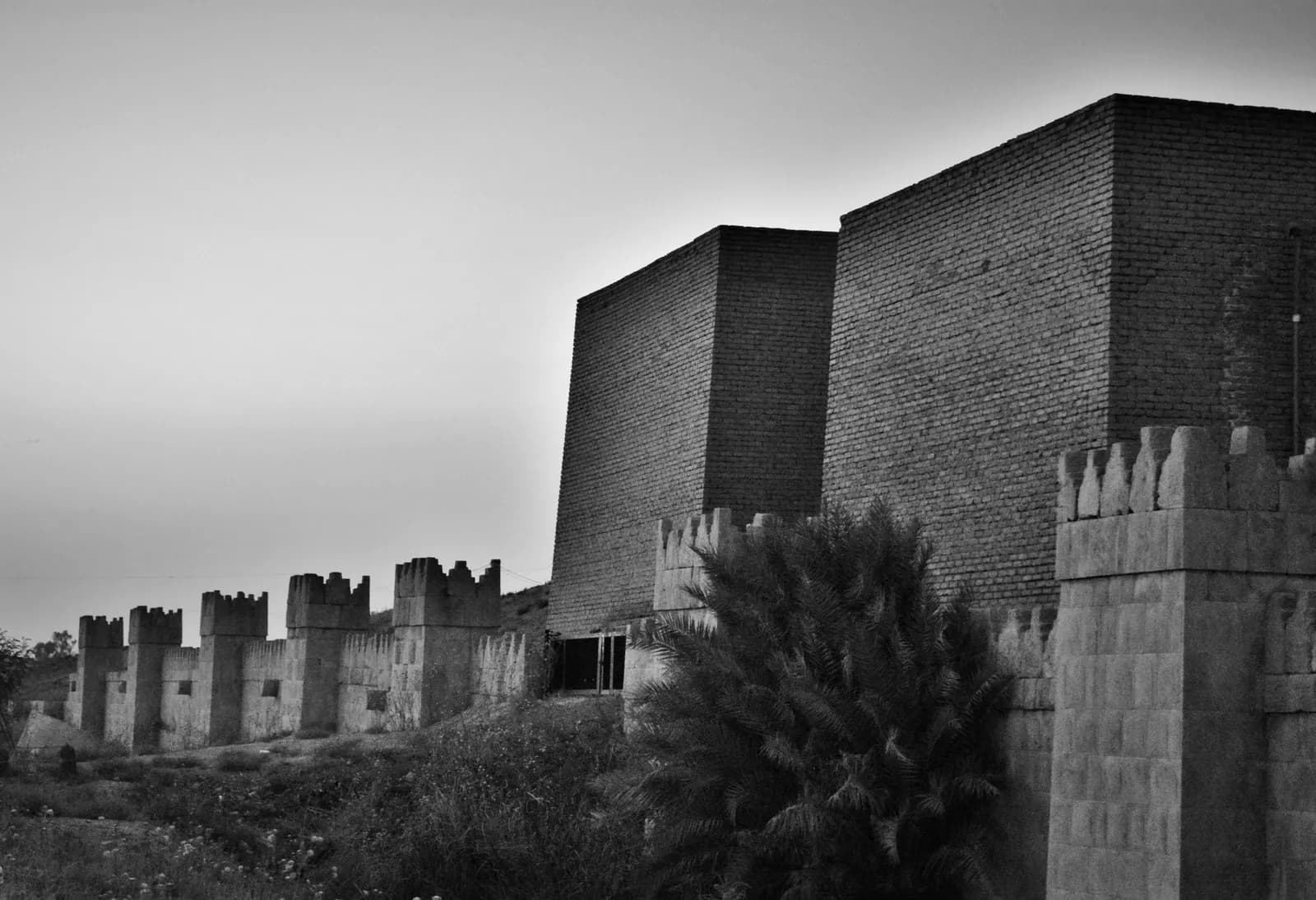
The city wall can be traced for twelve kilometres, with several gates reconstructed in the twentieth century. The two mounds stand above the plain, Kuyunjik largely open ground and Nebi Yunus built over.
The palaces survive as foundations and as the negative of what was removed: the great carved gypsum slabs that lined their walls were cut out in the nineteenth century and shipped to Europe, and the buildings are now known mainly from the reliefs in museums and from the excavators' plans.
Sennacherib's water system survives better than his palace. The aqueduct at Jerwan, some fifty kilometres away, is a stone-built channel carried over a valley on piers — the earliest large stone aqueduct known — and the canal head at Khinis carries reliefs and an inscription describing the works.
Occupation and chronology
Dates below are stored as signed years and rendered with the precision they actually carry. c. 6000 BCE is approximate; 612 BCE is fixed.
c. 6000–1000 BCE
Early city
Deep occupation under Kuyunjik, and a temple of Ishtar of Nineveh whose reputation reached Egypt — the Amarna letters record a statue of her sent to the pharaoh.
705–612 BCE
The imperial capital
Sennacherib moved the capital here and rebuilt on an enormous scale: a new wall, fifteen gates, an aqueduct and canal system, gardens, and the palace he called the Palace Without Rival.
612 BCE
The fall
Taken by a coalition of Medes and Babylonians after a siege. A Babylonian chronicle tablet records the campaign and the date, and burn layers and unburied bodies in the gates confirm it.
6th century BCE onwards
After
Reduced occupation, a Hellenistic and later settlement, and the growth of the shrine on Nebi Yunus. The mounds were never wholly deserted.
History of excavation
Who recovered the evidence, when, and by what method. Where an excavation destroyed as much as it found, the entry says so.
- Evidence level: Documented
1820
Claudius James Rich
Survey and a plan of the mounds, and the collection of inscribed fragments. Rich established that the site was Nineveh before anyone dug it.
- Evidence level: Documented
1842–1844
Paul-Émile Botta
The French consul dug Kuyunjik, found little near the surface, and moved to Khorsabad, where he found Sargon II's palace. The failure at Nineveh was a matter of where he put his trenches.
- Evidence level: Documented
1847–1851
Austen Henry Layard
The South-West Palace of Sennacherib, with something like three kilometres of carved wall reliefs, including the Lachish room. Layard's excavation was tunnelling along walls to extract sculpture, and it was conducted in competition with the French for the British Museum.
- Evidence level: Documented
1852–1854
Hormuzd Rassam
Assyrian-born, Layard's assistant and then his successor, Rassam found Ashurbanipal's North Palace with its lion-hunt reliefs and a large part of the library. He was systematically credited less than his European colleagues in the accounts of the period.
- Evidence level: Documented
1873
George Smith
Smith, a bank-note engraver who taught himself Akkadian while working at the British Museum, identified a flood narrative among the Nineveh tablets in 1872. A newspaper funded him to go and find the missing piece, and he did — an outcome so improbable it is usually told as anecdote and is in fact documented.
- Evidence level: Documented
1927–1932, 1987–1990
R. Campbell Thompson, then the University of California expedition
Stratigraphic work on the deep levels and on the Ishtar temple, and survey of the lower town, which had been almost ignored while the palaces were being emptied.
- Evidence level: Documented
2014–2016
Destruction
The shrine on Nebi Yunus was blown up, and the reconstructed Mashki and Adad gates were bulldozed. Tunnels driven under Nebi Yunus during the same period exposed previously unrecorded Assyrian reliefs, which were then documented by archaeologists after 2017.
Principal structures
The evidence level answers how we know what a structure looked like, not whether it existed.
- Evidence level: Documented
c. 700–690 BCE
The South-West Palace
Sennacherib's Palace Without Rival: some eighty rooms, wall reliefs throughout, colossal human-headed bulls at the doorways. Known from the excavators' plans and the removed sculpture.
- Evidence level: Documented
c. 645 BCE
The North Palace
Ashurbanipal's, and the source of the lion-hunt reliefs — the finest Assyrian narrative sculpture, and among the finest relief carving from anywhere in the ancient world.
- Evidence level: Documented
c. 700 BCE
The city wall and gates
Twelve kilometres of double wall with fifteen named gates. Several were excavated and reconstructed in the twentieth century; two of those reconstructions were destroyed in 2016.
- Evidence level: Documented
c. 690 BCE
The Jerwan aqueduct
A stone channel some three hundred metres long carried across a valley, built of around two million blocks, with an inscription of Sennacherib recording it. It brought water to Nineveh from the hills fifty kilometres away.
Finds and where they went
Almost nothing recovered from these sites is still on them. Where an object has a full provenance record on this platform, it is linked.
- Evidence level: Documented
The Library of Ashurbanipal
Around thirty thousand tablets and fragments from the two palaces: omen series, medical and astronomical texts, lexical lists, royal correspondence, and literature including the fullest text of the Epic of Gilgamesh. Assembled deliberately, partly by requisition from Babylonian temples, and baked hard by the fire that destroyed the city.
- Evidence level: Documented
The Lachish reliefs
A room-sized sequence showing the Assyrian siege of the Judaean city of Lachish in 701 BCE: the ramp, the siege engines, the assault, the deportation. Lachish itself has been excavated and its siege ramp found, which makes this one of the very few ancient battle images checkable against the ground.
- Evidence level: Documented
The lion hunt reliefs
Ashurbanipal hunting lions released from cages in an arena. The dying animals are observed with a precision the human figures are not given, and the scene is a statement about kingship rather than a record of sport.
- Evidence level: Documented
The Fall of Nineveh Chronicle
A Babylonian chronicle tablet recording the campaigns of 616–609 BCE, including the capture of the city in 612. It is the reason the fall of Nineveh is one of the securely dated events of the ancient Near East.
Ancient testimony
What ancient authors say about the place, and how far it can be trusted.
Sennacherib, The annals of Sennacherib The Taylor and Jerusalem prisms
The king's own campaign record, including the third campaign against Judah, the tribute exacted, and the phrase about Hezekiah shut up in Jerusalem like a bird in a cage.
The Epic of Gilgamesh Standard Babylonian version, Tablets I–XII
Recovered from this library. The flood narrative in Tablet XI was the passage George Smith identified in 1872.
Herodotus, Histories 1.102–106, 2.150
Herodotus on Nineveh's fall and on the Median campaigns, written nearly two centuries later and confused in detail. The Babylonian chronicle is much the better source, and the contrast is instructive.
How the site has been interpreted
Nineveh is where Assyria stopped being a name in the Hebrew Bible and became a documented state. Before Layard and Rassam, the Assyrian empire was known from scripture and from Greek writers who had it largely wrong; within twenty years it had palaces, kings' names, campaign records, an art, a literature and a library.
The library is the most important single find. Because Ashurbanipal collected systematically rather than accumulating incidentally, and because the collection was fired when the city burned, the result is a curated corpus of Mesopotamian knowledge surviving in one place. Almost everything known about Babylonian astronomy, divination and literature depends on it, including the standard text of Gilgamesh.
The excavation methods have a cost that is still being paid. Layard and Rassam were extracting sculpture for museums under competitive pressure, and they tunnelled along wall faces, removing the reliefs and leaving the buildings and their contents largely unrecorded. Much of what a modern excavation would want to know about these palaces was destroyed to get the slabs out.
The destruction of 2014 to 2016 belongs on the record as an event in the site's history, not as a postscript. It removed reconstructions, a shrine of long standing, and unknown quantities of buried evidence. The tunnels dug through Nebi Yunus in the same period exposed Assyrian reliefs nobody had recorded, which is a genuine gain retrieved from a deliberate loss and does not offset it.
Unresolved
Were the Hanging Gardens at Nineveh?
The gardens are attributed by Greek and Roman writers to Babylon, where no trace of them has been found and where Babylonian records do not mention them. Stephanie Dalley has argued that Sennacherib's inscriptions and reliefs describe an irrigated terraced garden at Nineveh with a screw-lifted water supply, and that the tradition attached the wonder to the wrong city. The Nineveh garden is documented; the identification with the wonder is a hypothesis, and a well-argued one.
What do the Lachish reliefs prove about the siege of Jerusalem?
The reliefs and Sennacherib's prisms record the capture of Lachish and the shutting up of Hezekiah in Jerusalem like a bird in a cage — and pointedly do not record Jerusalem's capture. The biblical account has the Assyrian army destroyed by divine action. The convergence on Jerusalem not falling is genuine; the explanations offered by the two sources are not comparable kinds of statement, and the reasons the siege was lifted are argued.
How to read the evidence labels
- Evidence level: Documented
- Supported by a named primary text or by excavated material evidence.
- Evidence level: Probable
- Supported by strong inference that most specialists accept.
- Evidence level: Disputed
- Substantial specialist disagreement exists; competing readings are stated.
- Evidence level: Literary
- Belongs to poetic or mythological construction rather than to history.
- Evidence level: Mythological
- Belongs to shared religious or mythic tradition rather than to any single text.
- Evidence level: Unknown
- The available evidence is insufficient to decide.
These labels describe the status of the evidence, not our confidence in a conclusion. A claim marked Literary is not a claim we doubt; it is a claim about what kind of thing a poem is.