What it is
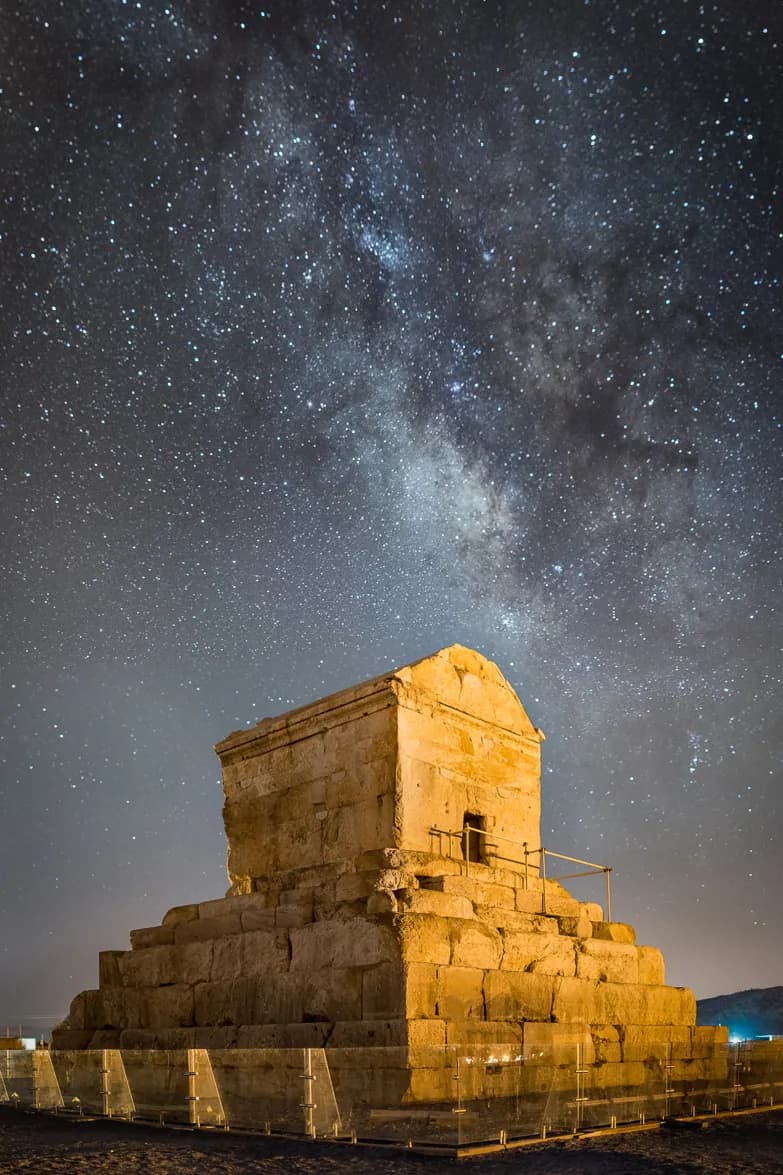
The Tomb of Cyrus at Pasargadae — its construction and its unplaced architectural pedigree, Alexander's visit and the restoration he ordered, the epitaph that no longer exists, and how it survived as the tomb of Solomon's mother.
Built Built around the death of Cyrus in 530 BCE. The principal date, c. 530 BCE, is approximate.
c. 530 BCE
Construction
Dated by association with Cyrus's death and by the masonry technique, which matches the rest of Pasargadae. No inscription on the tomb dates it.
6th–4th centuries BCE
The cult
Greek sources record magi attached to the tomb with a daily allowance of a sheep and a monthly horse sacrifice. It was an endowed institution.
330 and 324 BCE
Alexander's visits
Alexander found the tomb intact on the first visit and plundered on the second, and ordered Aristobulus to restore it and seal the door.
Islamic period
Mashhad-e Madar-e Soleyman
Taken for the tomb of the mother of Solomon and protected as such; a mihrab was cut inside and a mosque built around it from spoliated Achaemenid columns.
Who ordered it built
Each attribution carries what supports it. Ancient buildings are routinely credited to people on the authority of writers centuries later, and that is not the same claim as an inscription on the building.
- Evidence level: Probable
Commissioned by
Cyrus the Great
Greek sources from Alexander's officers identify it as Cyrus's tomb and describe its interior; the identification has never been seriously challenged. No inscription on the monument names him.
- Evidence level: Unknown
Architect
Unknown
No name survives. The masonry technique is Lydian and Ionian, which identifies where the workmen came from and not who designed it.
What it was for
A tomb, with a small gabled chamber on a stepped plinth reached by a doorway so low that entry requires stooping. Arrian, drawing on Aristobulus who saw inside, describes a golden sarcophagus, a couch, tapestries and clothing.
It was the focus of an endowed cult with a resident priesthood and regular sacrifices, funded by the royal treasury — an institution rather than a grave.
How it was built
Large dressed blocks laid without mortar and joined with metal cramps, with a gabled roof cut from separate blocks and a chamber whose walls are a single course thick. The finish is Ionian; the form is not.
The stepped plinth has been compared to Mesopotamian ziggurats, to Urartian and Anatolian tomb types, and to Lydian tumuli, and it matches none of them closely. It appears to be a one-off, and no later Achaemenid king was buried in anything like it — Darius and his successors cut their tombs into cliffs.
Materials
- Evidence level: Documented
White limestone
The whole monument, in large dressed blocks
- Evidence level: Documented
Iron and lead
Swallow-tail cramps set in lead joining the blocks, an Ionian and Lydian technique
Measured
Every figure states what it rests on. A modern survey, an ancient text, a conversion from an ancient unit and a modern estimate are four different kinds of statement and are not interchangeable.
Overall height
about 11.1 m
Modern survey.
Plinth
about 13.35 × 12.30 m at the base, in six receding steps
Modern survey.
Burial chamber
about 3.2 × 2.2 m internally
Modern survey of the interior.
What it meant
That the founder's tomb is a free-standing building and every subsequent royal tomb is a rock-cut façade is a break, and it happens at exactly the point where Darius takes the throne from a line whose relationship to his own is the empire's central political question. The tomb type changes when the dynasty's story does.
Alexander's treatment of the tomb is a deliberate political act. Finding it plundered, he had it restored, sealed and its guardians interrogated — presenting himself as the protector of the Achaemenid founder rather than his supplanter.
A body interred in a built chamber with a continuing sacrificial cult is difficult to reconcile with the exposure of the dead that later Zoroastrian texts require. That is one of several reasons for caution about describing the early Achaemenids as Zoroastrian in the sense the later texts define.
After antiquity
Plundered before 324 BCE, restored on Alexander's order, and thereafter left. The chamber was empty when Europeans first recorded it.
In the Islamic period the monument was identified as the tomb of the mother of Solomon, given a mihrab, and enclosed within a mosque built partly of columns taken from Achaemenid buildings nearby. That identification protected it for centuries; the mosque was removed in the twentieth century.
Excavated and studied by Herzfeld, Sami and Stronach; conserved since, with concern over stone decay and the effect of agricultural water use in the plain.
Condition today
Standing
Standing complete: plinth, chamber, gable and doorway. The interior is empty and has been since antiquity.
Stronach's excavation established the tomb's setting within a walled enclosure and its relationship to the wider garden layout of Pasargadae.
The remains of the later mosque and its spoliated columns were recorded and removed during twentieth-century conservation, which recovered the monument's isolation and destroyed the evidence of its medieval use.
Written about in antiquity
Arrian, Anabasis of Alexander 6.29
Arrian, using Aristobulus who entered the chamber: the golden coffin, the couch, the tapestries and clothing, the magi with their daily sheep, and the state in which Alexander found it on his return. The fullest ancient description of any Persian royal burial.
Strabo, Geography 15.3.7
Strabo, drawing on the same tradition, gives the tomb's description and a version of the epitaph asking the passer-by not to grudge the monument.
Xenophon, Cyropaedia 8.7
Xenophon's deathbed speech for Cyrus, in which the king asks not to be enclosed in gold or silver but returned to the earth. Philosophical fiction, and it contradicts what Alexander's officers say they saw.
Still argued
Was there an inscription?
Arrian and Strabo transmit an epitaph — that the passer-by should not grudge this monument to the man who won the Persians an empire. No trace of any inscription survives on the tomb, and the surfaces where one might have been are intact enough that its absence is meaningful. The epitaph may have been on a separate element, may be a Greek literary composition, or may have been reported at second hand.
Where does the form come from?
Comparisons have been made to Lydian tumuli, Urartian tombs, Anatolian gabled sarcophagi and Mesopotamian stepped platforms. None is close. The building may be a deliberate synthesis, or a local Fars type of which nothing else survives.
How to read the evidence labels
- Evidence level: Documented
- Supported by a named primary text or by excavated material evidence.
- Evidence level: Probable
- Supported by strong inference that most specialists accept.
- Evidence level: Disputed
- Substantial specialist disagreement exists; competing readings are stated.
- Evidence level: Literary
- Belongs to poetic or mythological construction rather than to history.
- Evidence level: Mythological
- Belongs to shared religious or mythic tradition rather than to any single text.
- Evidence level: Unknown
- The available evidence is insufficient to decide.
These labels describe the status of the evidence, not our confidence in a conclusion. A claim marked Literary is not a claim we doubt; it is a claim about what kind of thing a poem is.