What it is
The Apadana — Darius's foundation deposits, the tribute procession reliefs and the peoples they name, the columns still standing, and the fire of 330 BCE.
Built Begun under Darius I c. 515 BCE, completed under Xerxes I. The principal date, begun c. 515, completed c. 470 BCE, is approximate.
c. 515 BCE
Darius's foundation
Gold and silver foundation plaques with trilingual inscriptions of Darius were found in stone boxes under two corners of the hall in 1933, in place and undisturbed. They date the building and name its builder.
c. 490–470 BCE
Completion under Xerxes
Xerxes' inscriptions on the terrace record work he completed. The Apadana's finishing belongs to his reign.
330 BCE
The fire
Burned when Alexander's army took Persepolis. The cedar roof timbers came down and the fire is legible in the ash layer and the calcined stone.
Who ordered it built
Each attribution carries what supports it. Ancient buildings are routinely credited to people on the authority of writers centuries later, and that is not the same claim as an inscription on the building.
- Evidence level: Documented
Commissioned by
Darius I
The trilingual foundation plaques found in situ beneath the corners of the hall, naming Darius and the extent of his empire.
- Evidence level: Documented
Completed by
Xerxes I
His own inscriptions on the terrace recording the completion of works begun by his father.
What it was for
A columned audience hall on the terrace at Persepolis, entered by two monumental stairways, with porticoes on three sides and guard towers at the corners. It is the largest building on the terrace and the ceremonial centre of the complex.
What happened in it is not directly attested. The reliefs on the stairs show a procession of delegations bringing goods, and the terrace as a whole is generally understood as a setting for royal ceremonial, possibly seasonal. No Achaemenid text describes the occasion, and the reconstruction of a New Year festival at Persepolis is a modern proposal built on later evidence.
How it was built
The columns are the point. Achaemenid builders used slender stone shafts at heights Greek and Egyptian practice did not attempt, with intercolumniations wide enough that the roof had to be timber. The capitals are double animal protomes — bulls, lions, human-headed creatures — with the beams resting in the saddle between the two backs.
That system produces an interior that is mostly air: a hall sixty metres square with thirty-six widely spaced columns, lit from clerestory level. It is the opposite of an Egyptian hypostyle hall, where the columns crowd out the space, and the difference is a difference of intention rather than of capability.
The masonry technique — anathyrosis at the joints, swallow-tail cramps, and the finishing of blocks in place — is Ionian and Lydian, brought by craftsmen the Susa inscription lists by origin.
Materials
- Evidence level: Documented
Grey limestone
The columns, doorframes, stairs and reliefs, quarried locally
- Evidence level: Documented
Mudbrick
The walls, now almost entirely gone, which is why the building reads as a forest of columns rather than a room
- Evidence level: Documented
Cedar of Lebanon
The roof beams, named in Darius's building inscription from Susa as brought from Lebanon
- Evidence level: Documented
Gold and silver
The foundation plaques, and applied decoration on the reliefs, now lost
Measured
Every figure states what it rests on. A modern survey, an ancient text, a conversion from an ancient unit and a modern estimate are four different kinds of statement and are not interchangeable.
Central hall
about 60 × 60 m
Modern survey of the column bases and the terrace walls.
Columns
72 in all, about 20 m tall; 13 still standing
Modern survey and count.
Delegations on the stair reliefs
23
Count of the panels. The delegations are not labelled on the Apadana itself; their identification rests on comparison with the labelled throne-bearer figures at Naqsh-e Rustam and on their dress and gifts.
What it meant
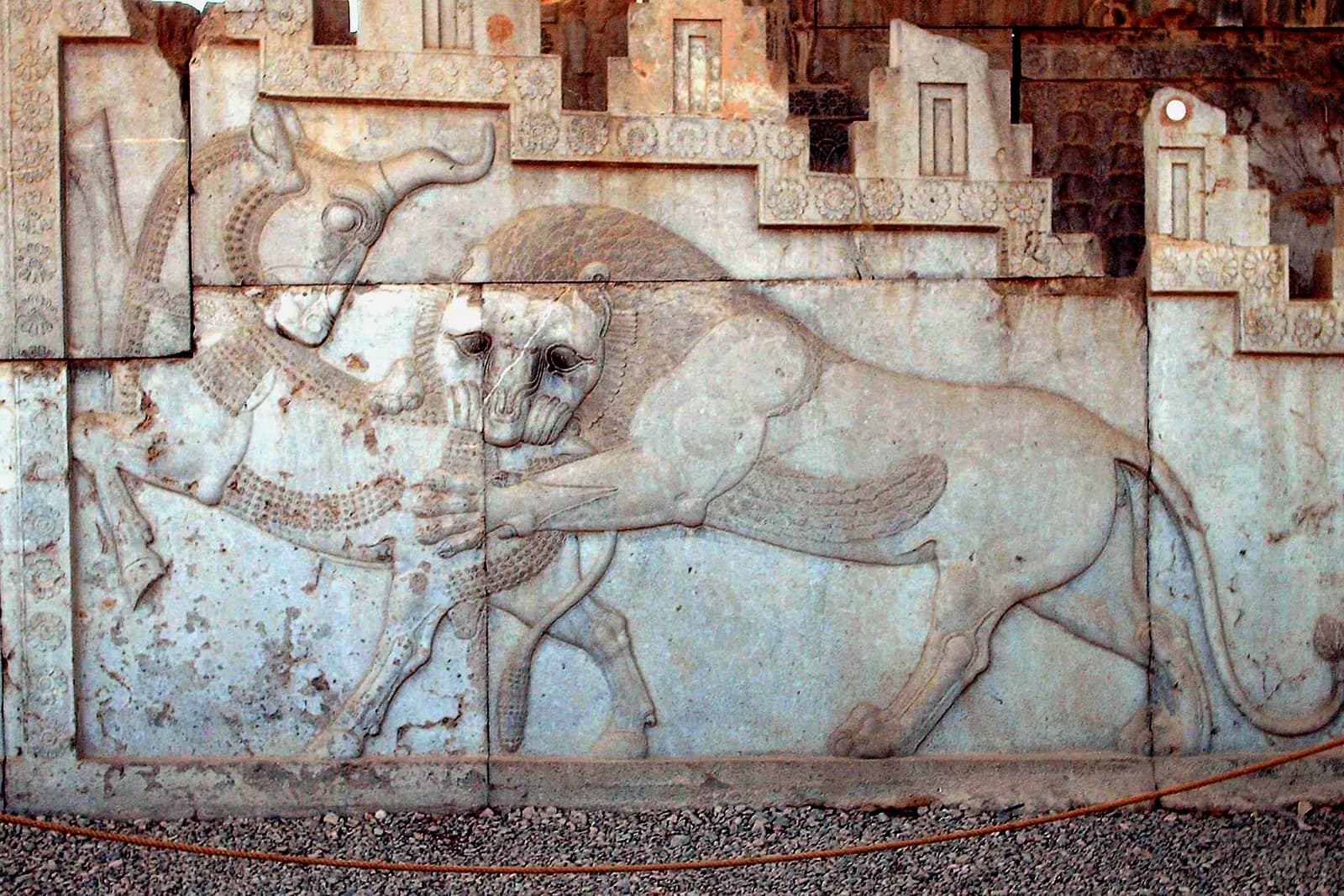
The stair reliefs are the empire's self-portrait and they are worth reading closely against the Greek description of the same empire. Delegations approach in orderly files, led by an usher who takes each by the hand; they carry vessels, textiles, animals and metals; nobody is bound, nobody kneels, and the Persian and Median guards on the adjoining panels stand at ease.
That is a picture of an empire held together by exchange and obligation rather than by terror, and it is a picture — a commissioned image, not a report. The Persepolis Fortification tablets, from the same terrace, show the administrative reality of rations, travel authorisations and labour allocations that the reliefs do not depict.
Herodotus's tribute list in Book 3 covers the same subject from outside and in a different register, assigning cash sums to satrapies. The two documents are the best paired evidence there is for how an ancient empire described its own revenues.
After antiquity
Burned in 330 BCE and never rebuilt. Whether the fire was a deliberate act of policy, a drunken impulse at a banquet, or a calculated signal that the Persian wars were avenged is reported differently by the ancient sources and remains argued.
The terrace stood as a visible ruin thereafter; Sasanian and later visitors left inscriptions, and European travellers drew it from the seventeenth century.
Condition today
Standing ruin
Thirteen columns standing, the stairways with their reliefs in position, and the platform and column bases of the hall. The mudbrick walls are gone.
The foundation deposits were found by Herzfeld's expedition in 1933 in stone boxes under the north-east and south-east corners: gold and silver plaques with the same trilingual text, undisturbed since they were laid.
The central panel of the north stair, showing the king enthroned receiving an official, was found not on the stair but reused in the Treasury, having been removed and replaced in antiquity. It is now in Tehran, and the change of subject on the stair is itself evidence of a change of programme.
Excavation by Herzfeld and then Erich Schmidt for the Oriental Institute in the 1930s established the terrace's sequence and recovered the fortification and treasury archives.
Scattered fragments
What has left the building, and where it is now. Where a holding is contested, the museum page says so.
- Evidence level: Documented
The Apadana foundation plaques
- Evidence level: Documented
The audience relief from the stair, later reused in the Treasury
- Evidence level: Documented
Relief panels removed in the nineteenth and early twentieth centuries
Written about in antiquity
Herodotus, Histories 3.89–97
Herodotus's account of Darius's satrapies and their tribute, in silver. A Greek reckoning of Persian revenue, to be read against the reliefs' picture of the same relationship.
Darius I, The Apadana foundation inscriptions DPh
Darius's trilingual text on the gold and silver plaques, naming the extent of his kingdom from the Sakas beyond Sogdia to Kush. Found in place beneath the building.
Arrian, Anabasis of Alexander 3.18
Arrian on the taking of Persepolis and the burning of the palace, and on Parmenion's objection that Alexander was destroying what was now his own property.
Still argued
What ceremony did the reliefs depict?
The New Year festival is the most cited proposal, on the analogy of later Iranian practice and on the seasonal reading of the terrace's use. Others hold that the procession is a generalised statement of empire rather than a record of an event, and that the terrace was used at various times. No Achaemenid text names an occasion.
Was the burning of Persepolis deliberate?
Arrian and Diodorus give different accounts, one of a considered decision and one of a drunken impulse at a banquet on the suggestion of the courtesan Thais. Curtius follows the banquet story. The archaeology shows an intense fire and no attempt at salvage, which is consistent with either.
How to read the evidence labels
- Evidence level: Documented
- Supported by a named primary text or by excavated material evidence.
- Evidence level: Probable
- Supported by strong inference that most specialists accept.
- Evidence level: Disputed
- Substantial specialist disagreement exists; competing readings are stated.
- Evidence level: Literary
- Belongs to poetic or mythological construction rather than to history.
- Evidence level: Mythological
- Belongs to shared religious or mythic tradition rather than to any single text.
- Evidence level: Unknown
- The available evidence is insufficient to decide.
These labels describe the status of the evidence, not our confidence in a conclusion. A claim marked Literary is not a claim we doubt; it is a claim about what kind of thing a poem is.